Uncategorized
-
Blog
·
-
BiO
·

Arcangelo Constantini
is an artistic inventor, technological hacker, and cultural producer whose practice develops through a constant existential speculation on the nature of reality. His work is characterized by the development of experimental hypotheses that connect art, science, technology, and mystical thought through transdisciplinary processes.
A passionate reader of science fiction and an avid dreamer, he began exploring the possibilities of digital media in the late 1980s as tools for correlating the structure of reality with technological systems. In 1997, he began an intensive practice on the internet, founding unosunosyunosceros.com, a semantic repository of aesthetic-conceptual experiments exploring the perceptual relationship between dreamlike, concrete, and digital spaces. He later created bakteria.org, a neuroaesthetic investigation into automatic generative drawing and writing that alludes to the hologenome and the microbiota of the human ecosystem.
For more than three decades, his artistic and curatorial practice has developed in dialogue with philosophical currents such as object-oriented ontology and panpsychism, while simultaneously questioning the paradigms of scientific and mystical methodologies. His work oscillates between the re-signification of abandoned functional objects—hacked to engage in philosophical dialogues—and the construction of experimental artifacts intended to explore gravitational, electromagnetic, and energetic phenomena.
Sound occupies a central place in his work because of its symbolic and meaning-generating capacity, manifesting itself through sound artifacts, mantra machines, interactive installations, and performative activations. A significant part of his recent research focuses on anomalies in the water molecule, approached through physical computing, electromagnetic experimentation, and processes that connect science, art, and cosmological speculation.
His explorations have led him to develop interactive devices, installations, and experimental systems to investigate physical and perceptual processes. He has conducted experiments on gravity at the microgravity laboratory of the Russian space agency Roscosmos as part of the project The Gravity of Matters, and was an artist-in-residence at the Fluid Mechanics Laboratory of the Institute for Materials Research at UNAM.
His work has been presented at museums and institutions including Laboratorio Arte Alameda, Museo Tamayo, Museo de Arte Carrillo Gil, Museo de Arte Moderno, Ex Teresa Arte Actual, Museo Universitario del Chopo, and MUAC, among other venues in Mexico and abroad, including the Lyon Biennale and the Havana Biennial.
Curatorial Practice and Cultural Management
Constantini has developed significant curatorial and cultural management activities at the intersection of art and technology. He was curator of the Cyberlounge at Museo Tamayo, where he programmed more than twenty net-art exhibitions as well as the Inmerso / Foro Sonoro sound intervention program (2004–2006).
Between 2000 and 2010, he organized numerous visual and sound events at inte[r]perie, the terrace of his home-studio, which later evolved into the independent space ¼ un-cuarto, dedicated to artistic experimentation with technology.
He was part of the curatorial team of the Transitio MX Electronic Art Biennial (2005 and 2009) and served on the board of Dorkbot Mexico City, where he organized more than twenty gatherings devoted to the intersection of art, science, and technology. He also participated as a curator in the inaugural event of the Fonoteca Nacional (2008) and was co-curator, with Iván Abreu, of the inaugural event of the Centro de Diseño, Cine y Televisión.
He currently directs the FACTO Festival and co-organizes, with Marcela Armas, the Meditatio Sonus series, sessions combining meditation and sound art. He also develops educational initiatives such as Entorchados.net and Entorno.org, focused on technological and artistic experimentation.
Awards and Grants
Throughout his career, he has received various awards, grants, and forms of support, including:
S+T+Arts4Water
FONCA Young Creators Grant (2000)
Rockefeller–MacArthur Fellowship (2002)
First Prize, Vidarte Festival (1999)
First Prize, Interférences Festival, France (2000)
Third Prize, Art in the Net, Machida City Museum, Tokyo (1998)
VIDA 11 Grant, Fundación Telefónica (2009)
Fundación Bancomer Grant
Production Grant, Centro Nacional de las Artes (2009)
Mente QUO Award (2013)
PAC 2020
Member of the National System of Art Creators (SNCA–FONCA)
-
Marcela Armas / Arcangelo Constantini
Commissioned by Arte – Ciencia UNAM 2013The project was originally presented as part of the exhibition SIN ORIGEN, held at the Museo Universitario de Arte Contemporáneo and MUCA Roma in 2012, in Mexico City. SIN ORIGEN was an exhibition curated by María Antonia González Valerio as part of the ARTE + CIENCIA program.
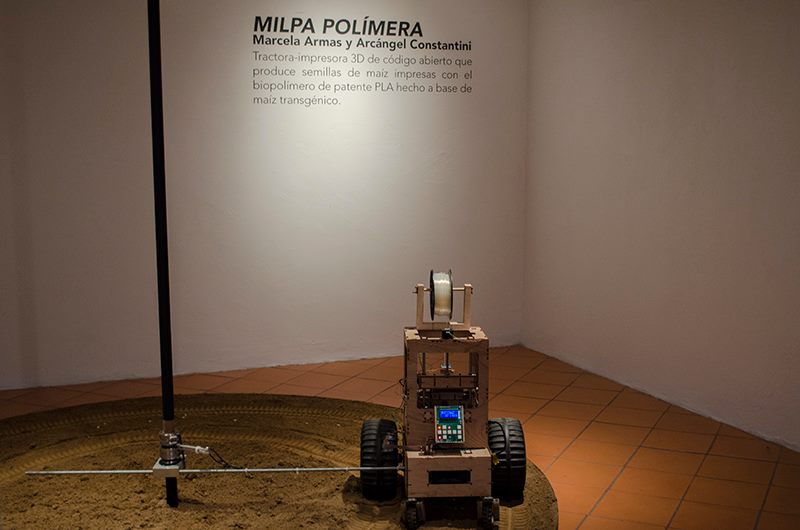
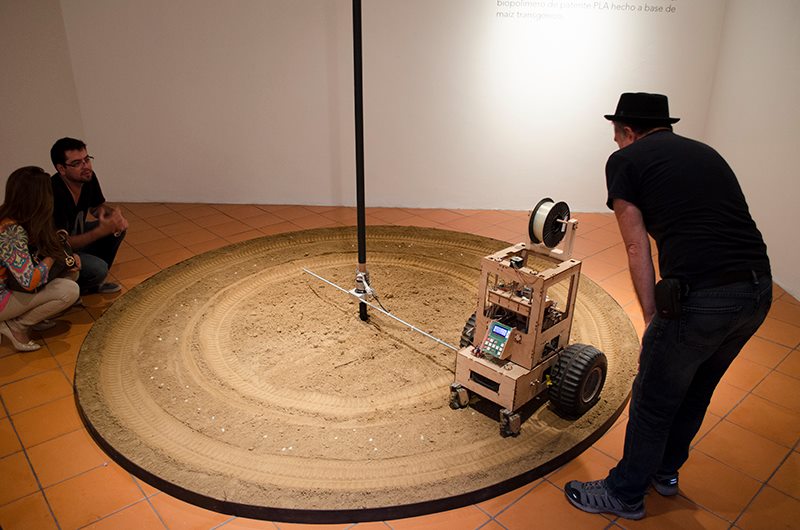
Milpa polímera (tractora polímera)
BIOS Ex MachinA con colaboración del Depto. de Ingeniería Mecatrónica de la Facultad de Ingeniería de la UNAM.
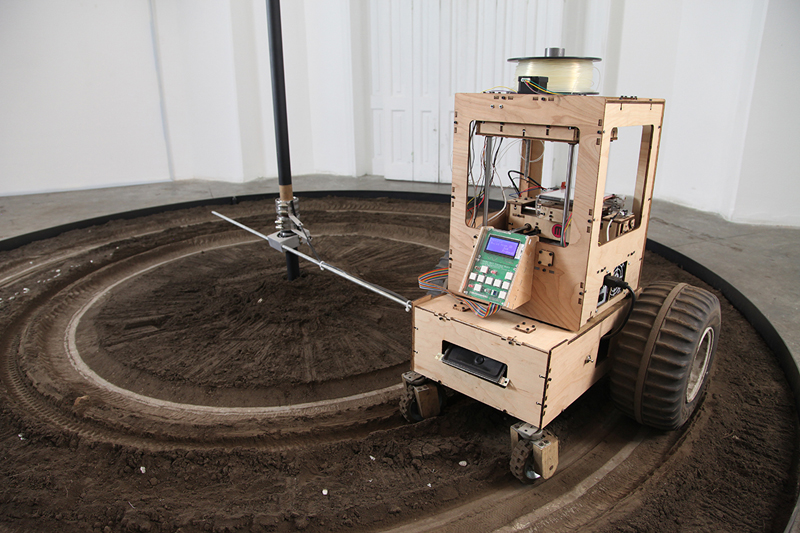
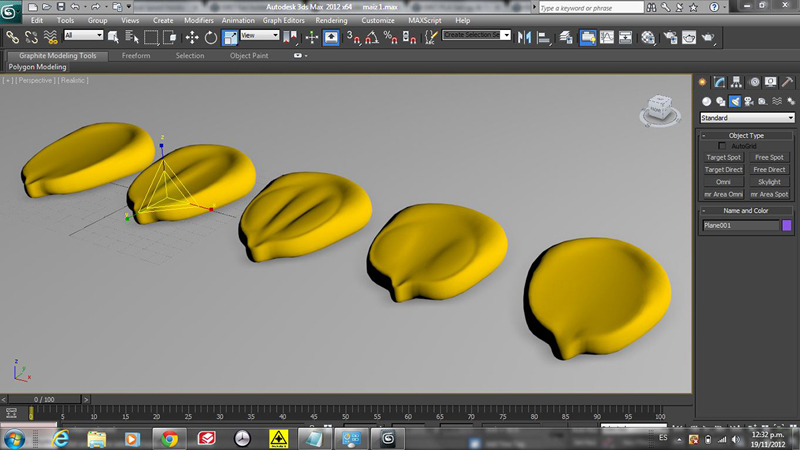
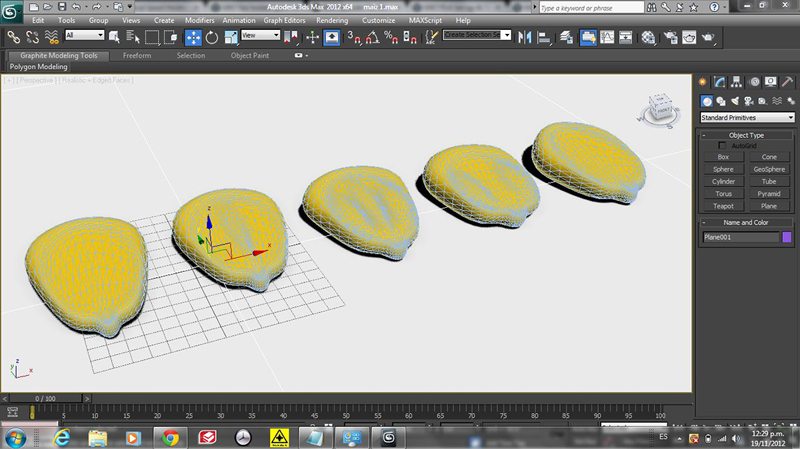
Therefore, the seed’s artificial nature –corn plastic corn- poses a paradox of no easy solution for the conception of the artificial as a copy of the natural. In the seed, both the natural and the artificial are represented, the original and the derivative. The seed evidences the tensions inherent to these distinctions. The seed sown by our piece is not “really” a corn seed, although it has its (material) origin in it.
Corn becomes the mythical origin of several peoples precisely when it ceases to be completely natural, to become also a cultural entity, a device defining eminently human activities such as agriculture. Somewhere between the natural and the artificial, farming maize domesticates both the farmer and the cornfield. But the agriculture represented in Milpa Polímera is also artificial in a second sense: it is mechanized agriculture. The piece itself is a biotechnological mechanism.
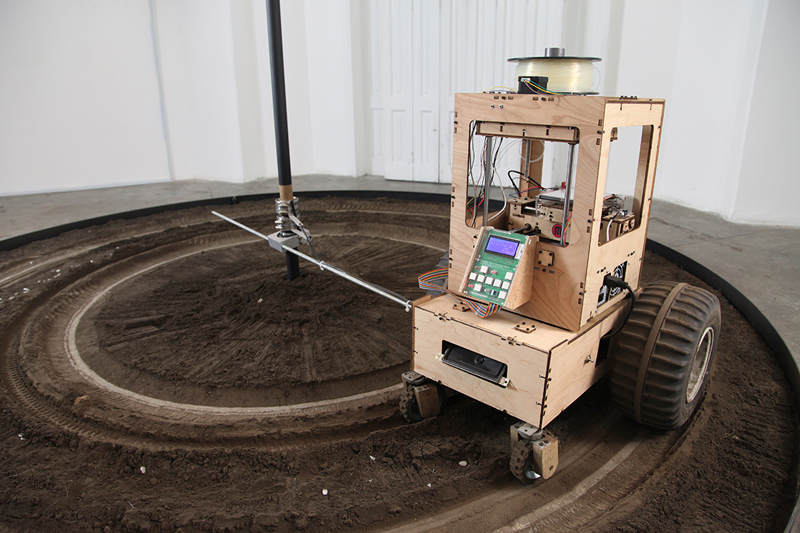
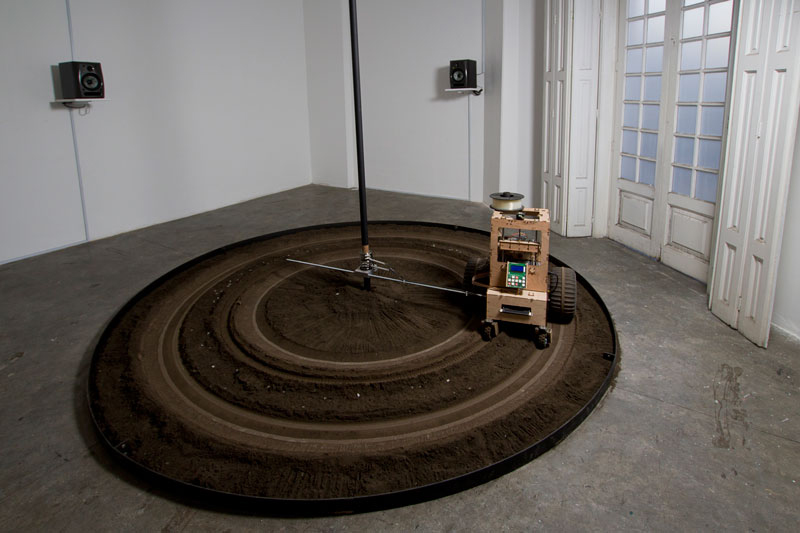
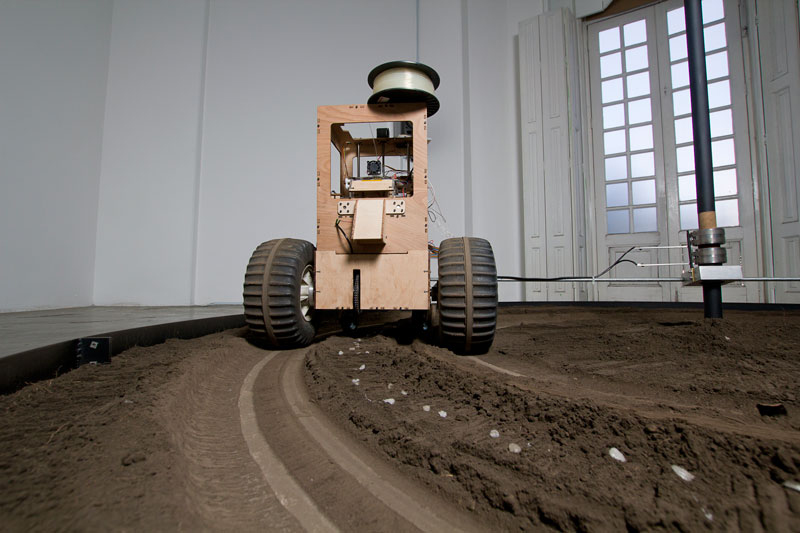
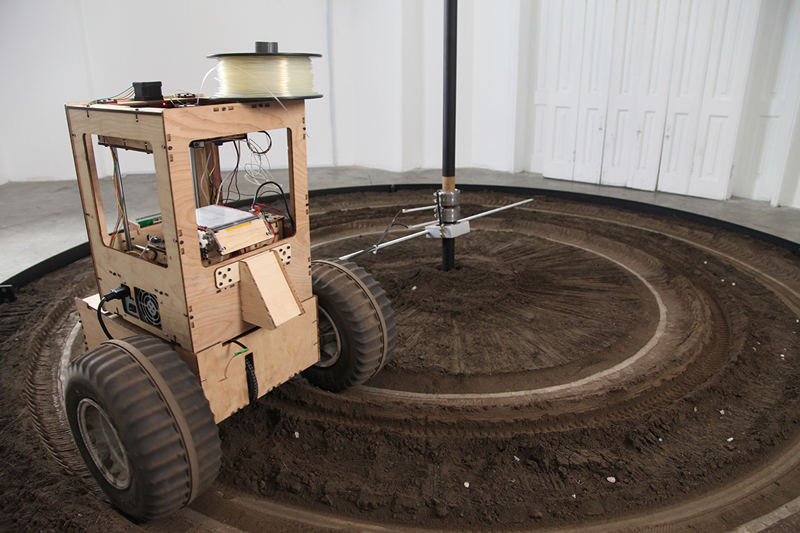
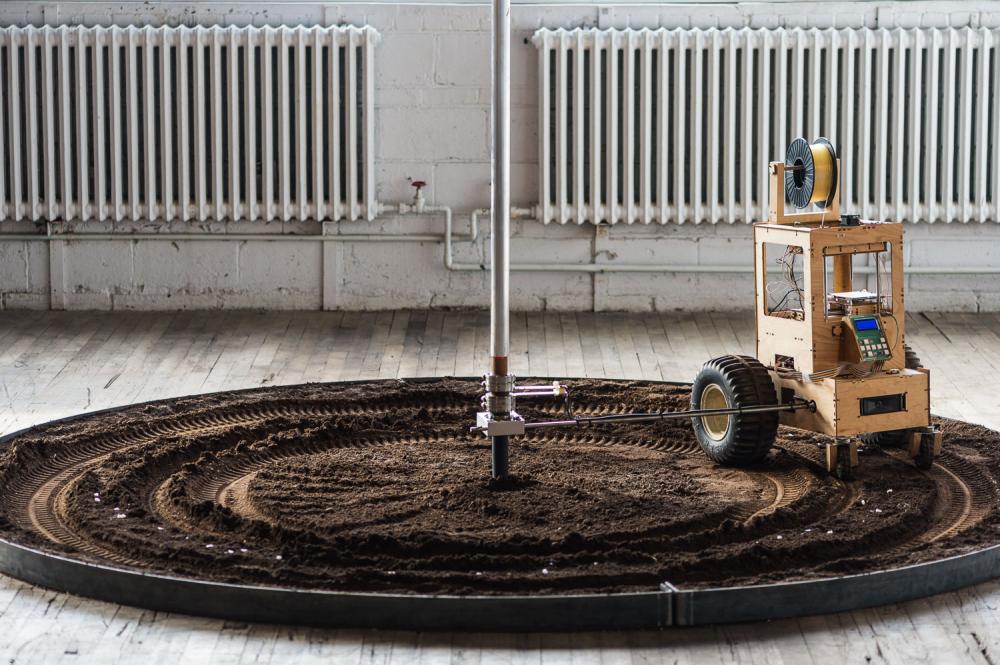
At its center, a tractor robot swivels in a closed cycle, sowing the artificial seed. The sterile seeds are printed and fall to the ground on the radial space, turning the soil into a sown field, into a cultural and economic artifact, but a sterile one from which no plant will ever grow, such as its industrial counterpart, a system trapped in a cycle aiming to establish itself as the only possibility. Thus it presents the complex relationship between the natural and the artificial, the origin and the originated, while the soil becomes a representation of what does not remain, furrowed by the biotechnological mechanism and its own sounds.
The seeds printed are made from polylactic acid (PLA), a thermoplastic biopolymer made from corn. While proponents argue that it is biodegradable, actually it is compostable, being degraded under strict methods with precise humidity and temperature control. The truth is there is no evidence that it would disintegrate faster or more efficiently than PET or other plastics in a traditional landfill. It is worth noting that much of the corn used to produce PLA is genetically modified.
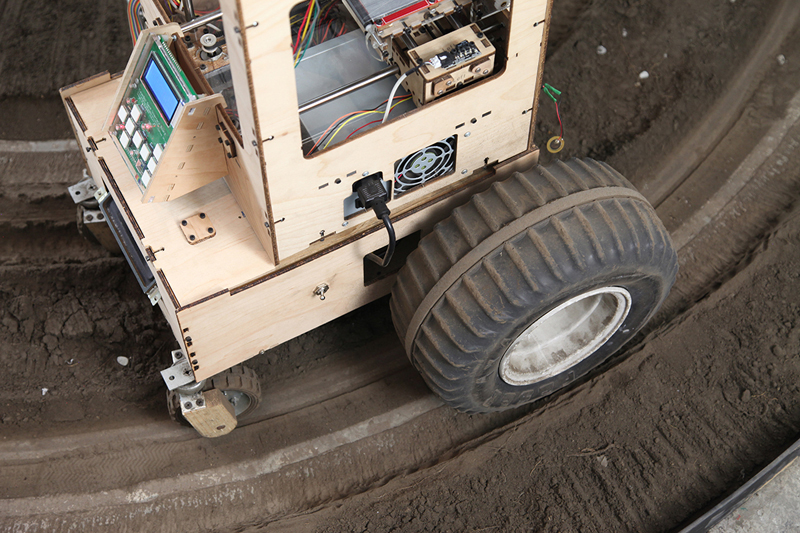
The 3D printer included in the tractor uses open-source technology promoted by the collaborative work of a community that seeks to optimize its functions and sharing codes and knowledge. PLA, in contrast, is a patent material with plenty of industrial applications. By coupling both kinds of technology, the tractor blends the contradiction between open and closed, free and limited, and presents it in a transformative act that mimics the production of life through dead and inert materials.
Traditionally in art, nature used to play the role of original model, from which the art piece –epitome of the artificial entity– was the copy. Giorgio Vasari expressed this view of art as follows: “Art owes its origin to Nature herself… this beautiful creation, the world, gave us the model, while the divine intelligence was the original master, which created us as beings superior to other animals, more like God himself –if I dare say”. In Milpa polímera, by contrast, the nature that serves as a model for the work is not the natura naturans, but the domesticated nature and its problematic relationship with technology. The corn of Milpa polímera, such as the corn from all the country’s fields, is not the “original” corn: it is not corn in a state of “pure nature”. On the contrary, it is the current corn from technologized fields: less a domesticated corn than a sterilized one due to biotechnology of genetic modification.
Text: BIOS Ex MachinA
BPLTC III: Food Control
January 14 – February 3, 2016
Eastern Bloc MontrealThe conception of the artificial as a copy of the natural is no longer really possible today.
Maize in particular, while being a link to nature, defines human cultural activity. The production of domestic corn is done in the fields, in an increasingly mechanized way, by the agricultural industry. Milpa Polimera (Arcangelo Constantini & Marcela Armas) thus presents a tractor robot that turns in a closed circle to sow artificial seeds, including a reflection on biotechnology and the transformation of living things in their very heart. The sterile seeds thus sown constitute a cultural and economic object from which no plant will ever grow back. The cycle of life and reproduction is interrupted, and there is no alternative, except to resort, again and again, to the industrial production system. It is a closed system that self-legitimizes in a closed circle … The 3D printer (which prints the seeds) included in the tractor, meanwhile, uses open-source technology promoted by the collaborative work of a community that seeks to optimize its functionalities and share its codes and knowledge.https://easternbloc.ca/fr/expos-events/expositions/bpltc-iii-controle-alimentaire
BIOARTEFACTOS: DESGRANAR LENTAMENTE UN MAÍZ. MACO OAXACA, 2014.
Bioartefacts. Slowly Shelling a Corn was presented at the Museum of Contemporary Art of Oaxaca, where the debate centered around the issue of transgenic corn, non-industrialized agricultural production, and Oaxacan traditions.
The event featured participation from the collectives BiosExmachinA, MAMAZ, and Desmodium-máquina, as well as artists Minerva Hernández, Héctor Cruz, Lena Ortega, and Alfadir Luna. The exhibition was curated by María Antonia González Valerio.
“Corn is not what it seems. To pretend that these seeds are in only one way, that they represent a single thing, that they can be bioartificially produced in a factory and that this changes nothing is… pretending.”
-
PulseJet
·
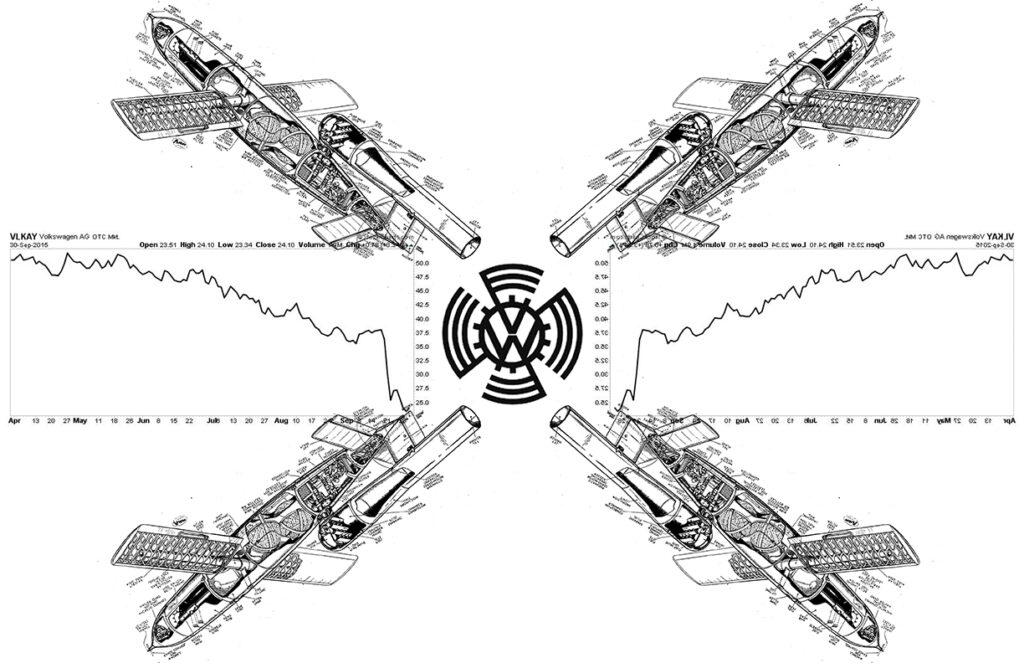
During World War II, artifacts with chilling sounds traversed the skies of England; they were not combat aircraft but flying bombs.
The V1 emitted a pulsating sound like the deafening flutter of giant insects, powered by the PulseJet—a type of engine invented by the Russians in which internal combustion occurs in constant pulses—that does not require moving parts and can burn any type of fuel.
During the Nazi army’s attacks on London, the greatest terror was not the incessant noise but its cessation. Silence meant that the V1 Bomb had run out of fuel and was diving to detonate.
The V1s were designed and built by the German army in 1944. Hundreds of V1s were manufactured at the Fallersleben plant of Volkswagen near Hamburg, to be subsequently launched against the civilian population…
Nahum Mantra invited me to participate in the “Kosmika 2015 – War and Peace in Outer Space” event. I had known about these engines for many years with the intention of using them in some action, and it was the ideal moment to do so. I invited artist 220 to collaborate, and we developed a discourse in three stages about illusion and control. For the final stage, we used a Pulse Jet as a dissipator of illusion.
Wars are generators of “important” technologies for humanity, such as those in the space race, but at the same time that they are ‘bloody’, these technologies also cause enormous damage to the environment.
Grabación de PulseJet el 5 de enero de 2016 en LABORATORIO ARTE ALAMEDA
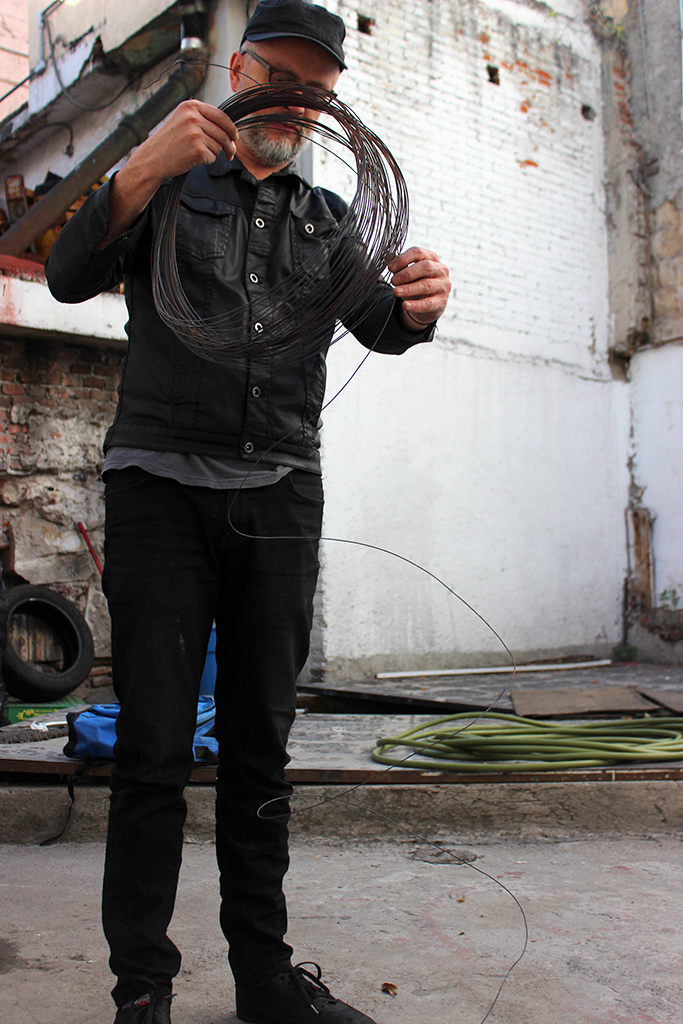
I built a Pulse Jet engine using exhaust waste from cars, and it was activated inside the Laboratorio Arte Alameda under the dome of the room, to explore the sound and resonance of the place in the presence of the public.
It was then that I realized that the catalyst we used for the Pulse Jet’s combustion chamber was from the VolksWagen-Audi brand, and just in those days, the news came out that the German company had manipulated the software of millions of cars to deceive emissions verification systems, a synchronous event that had to be explored.
Thanks to Julian Bonequi’s invitation and his interest in the project, I decided to focus the exploration and experimentation on a third discourse.
The registration for Audition Records began with this knowledge, using the stock market quotation of the VW company and the historical events of its origin as a ‘diagrammatic score or conceptography of the action’, and we invited Felix Blume to carry out this on-site sound recording.
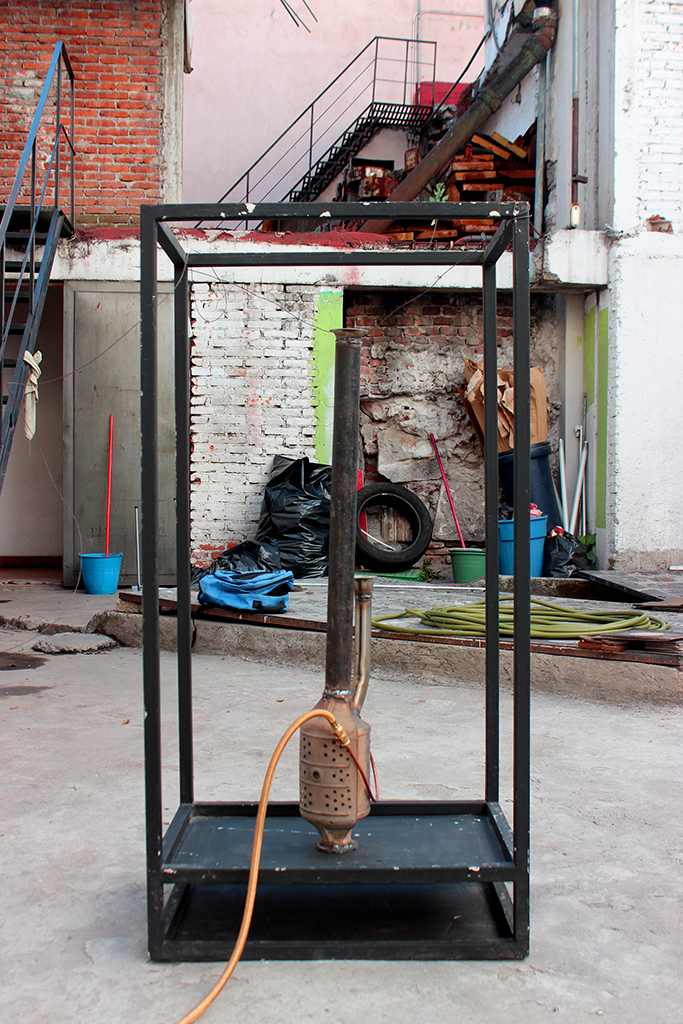
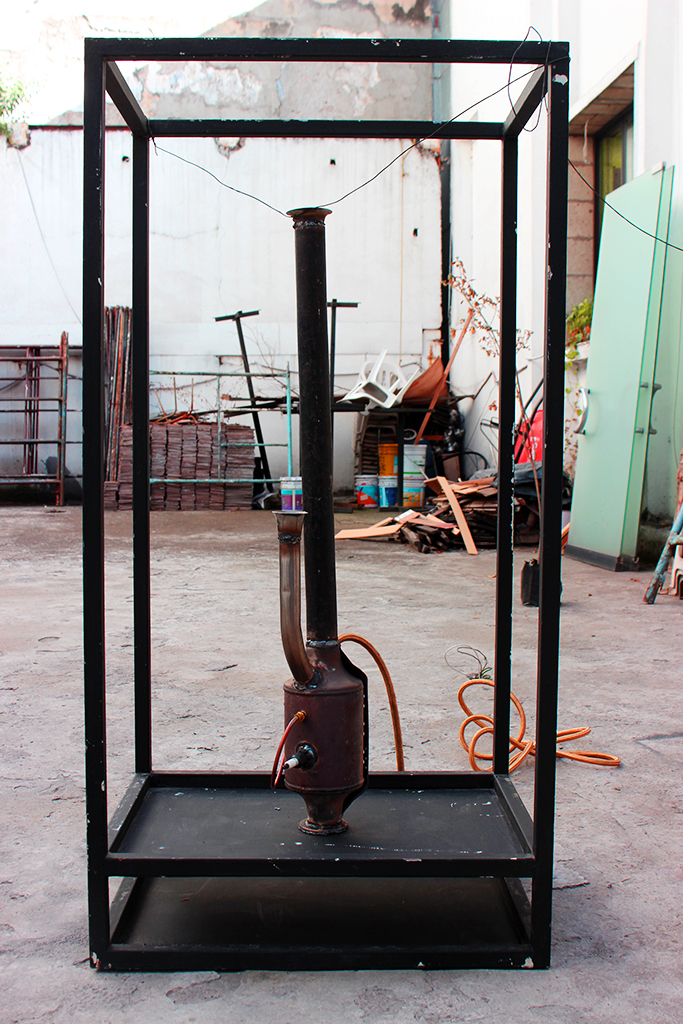
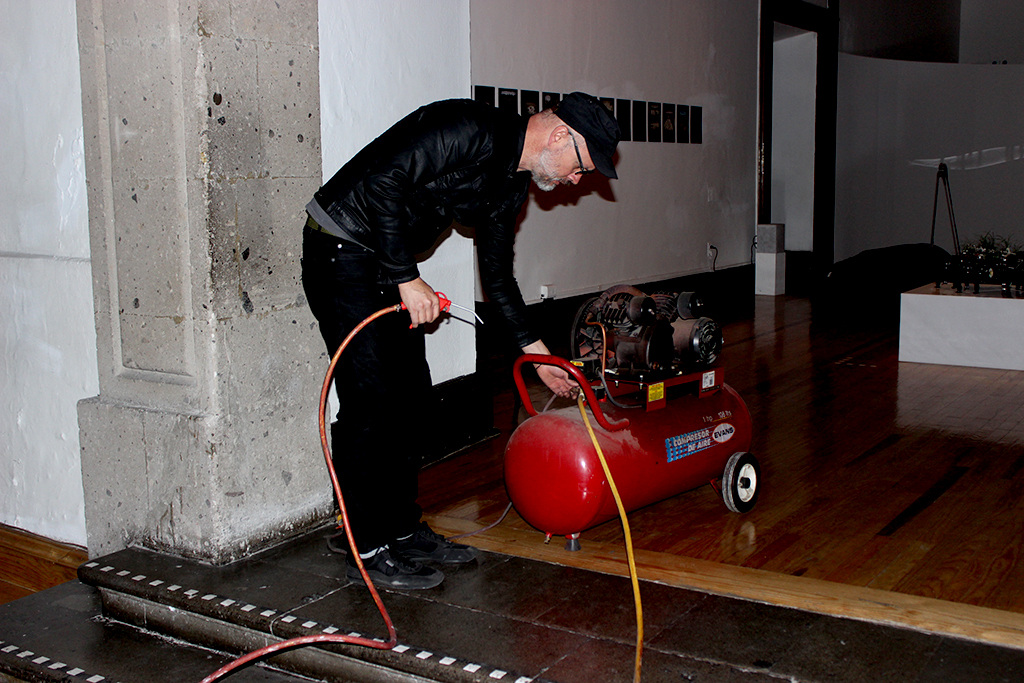
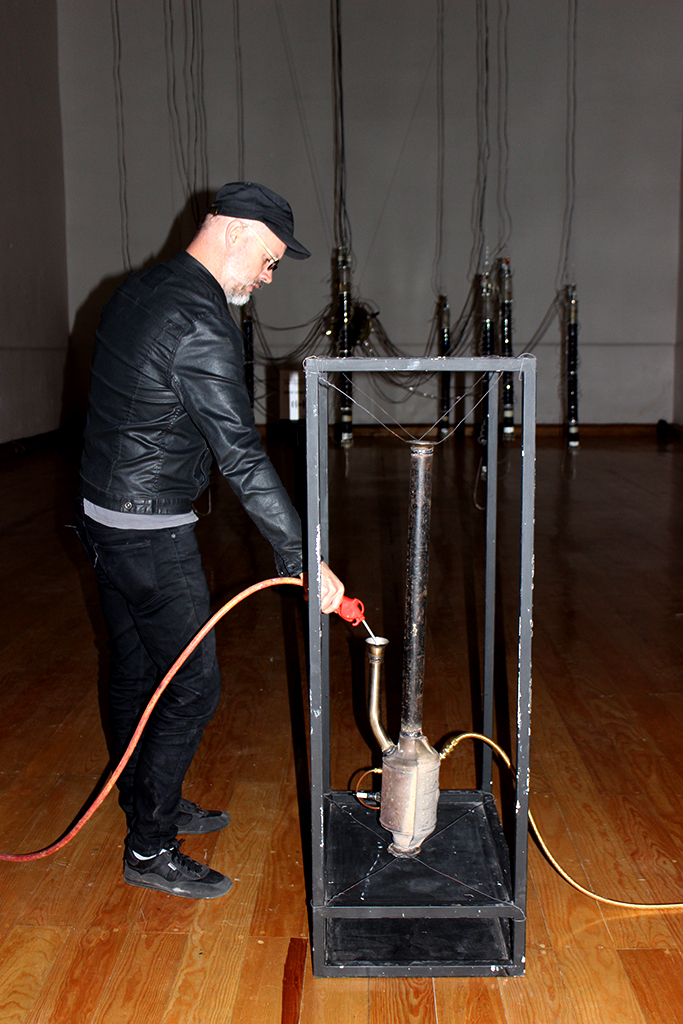
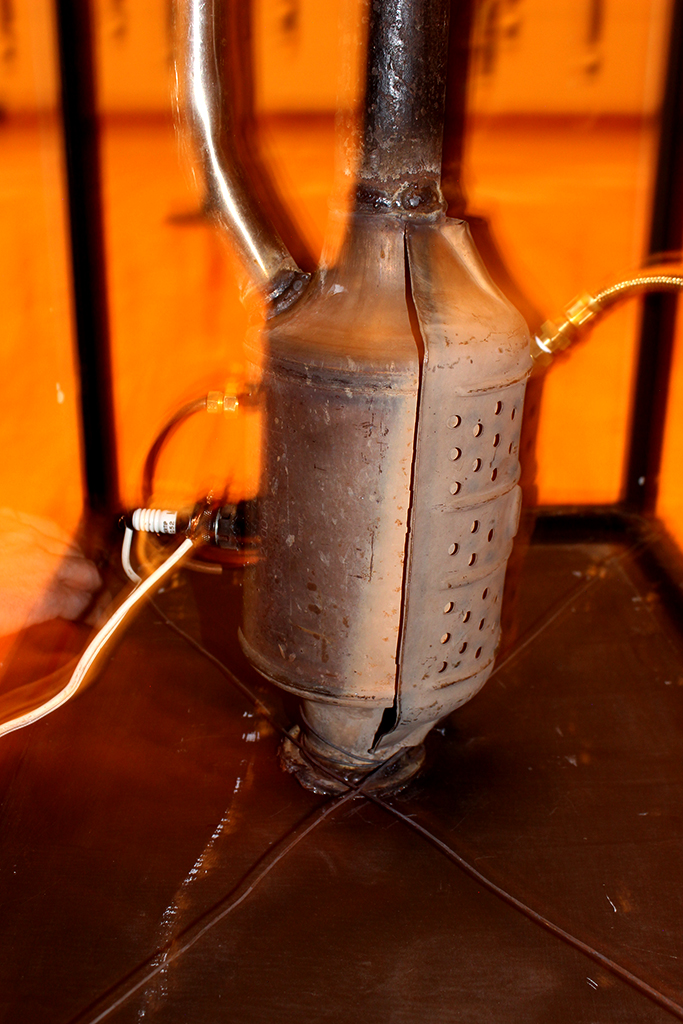
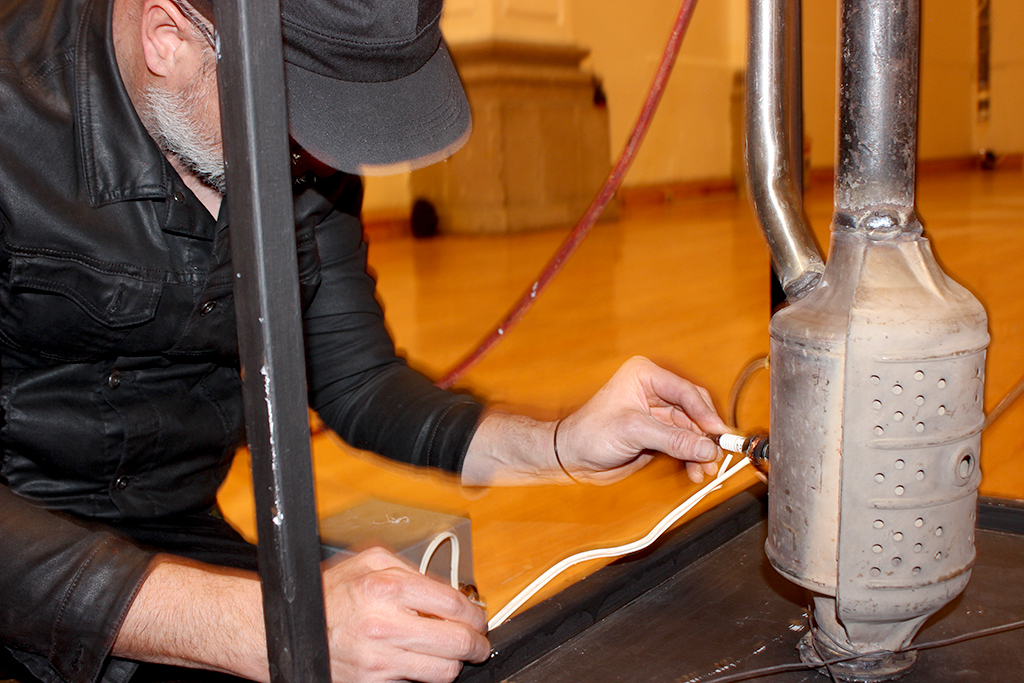
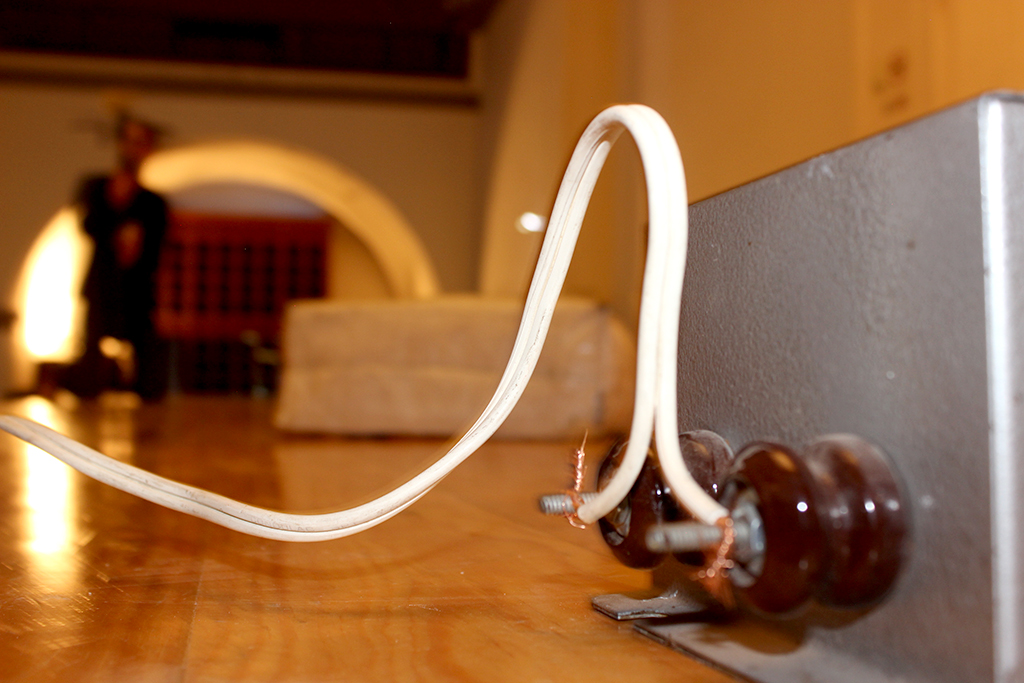
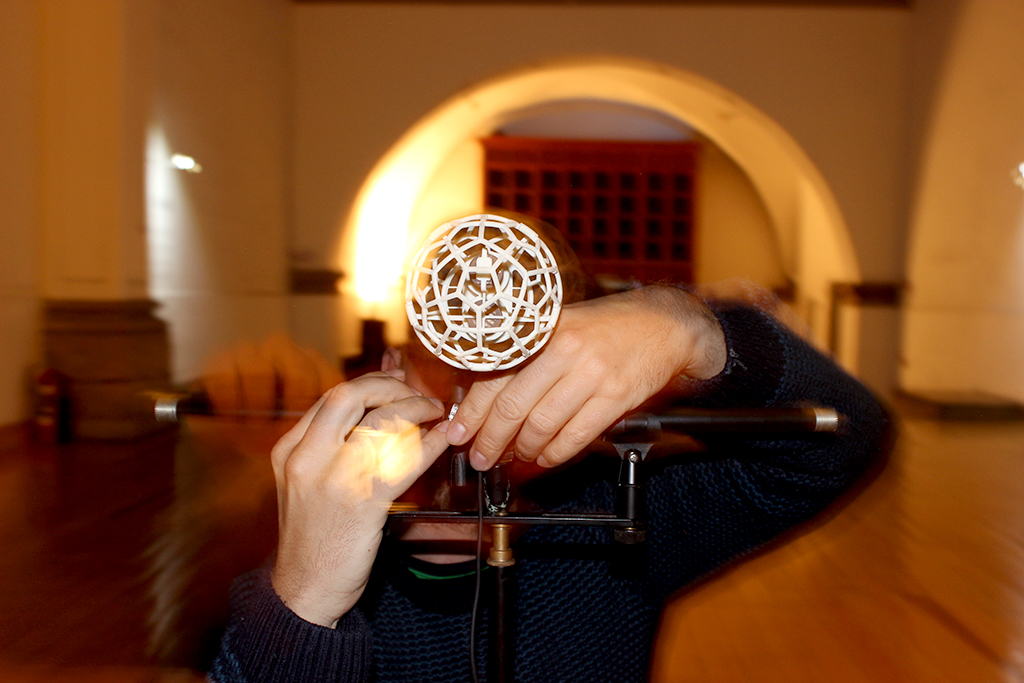
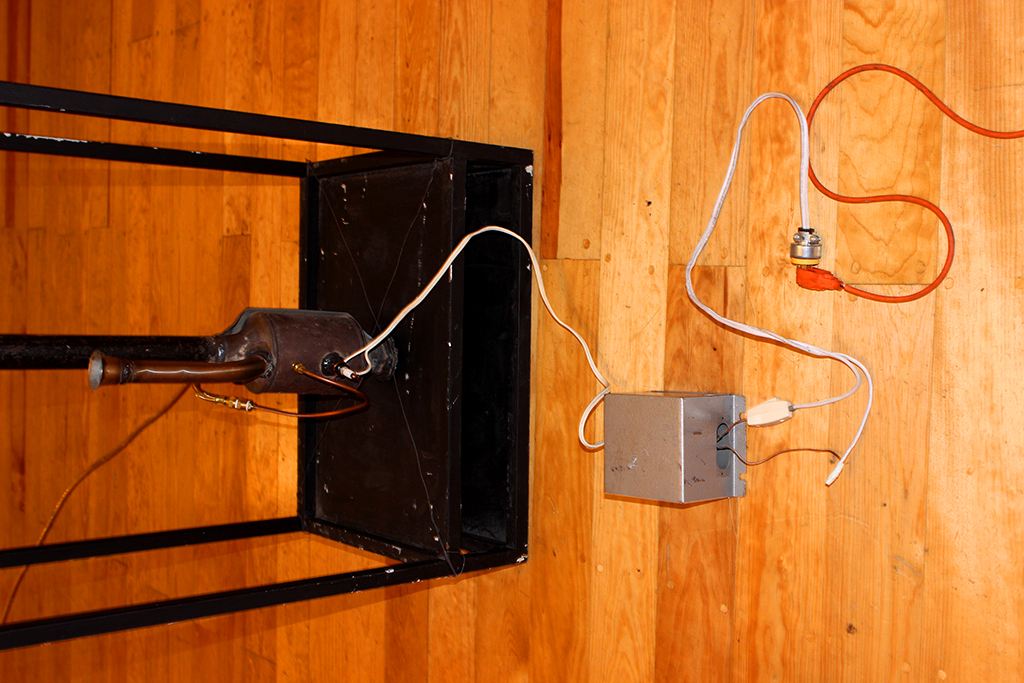
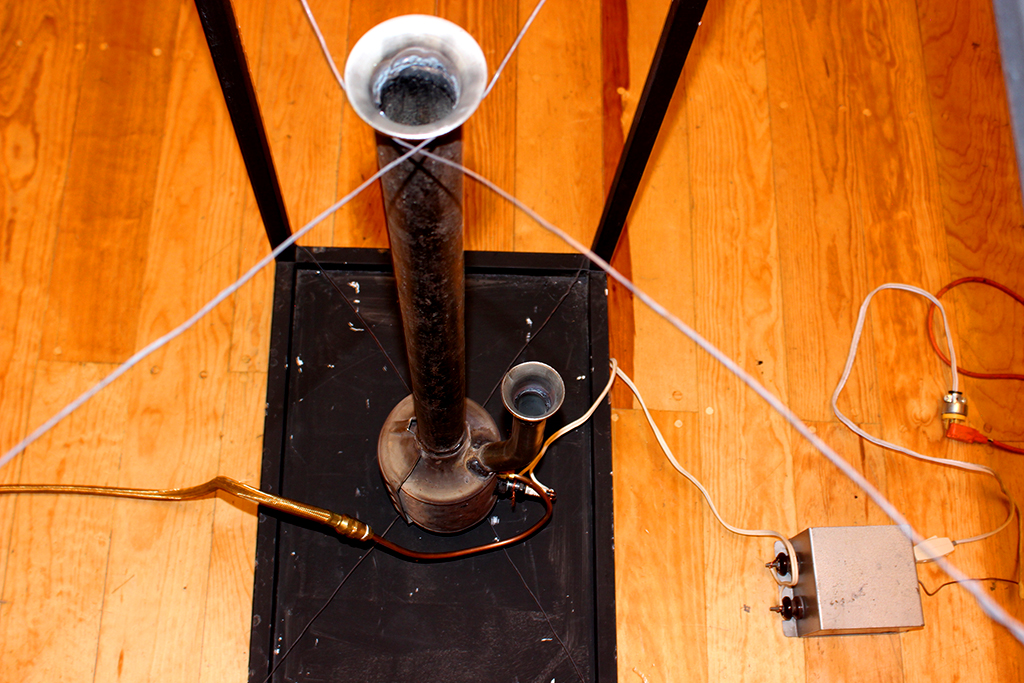
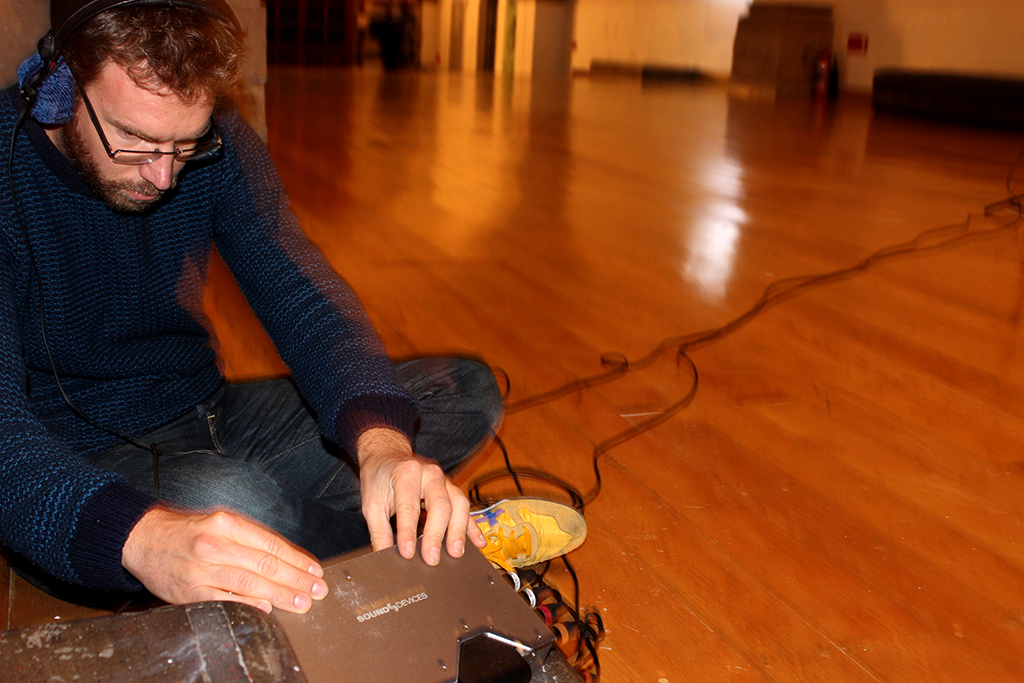

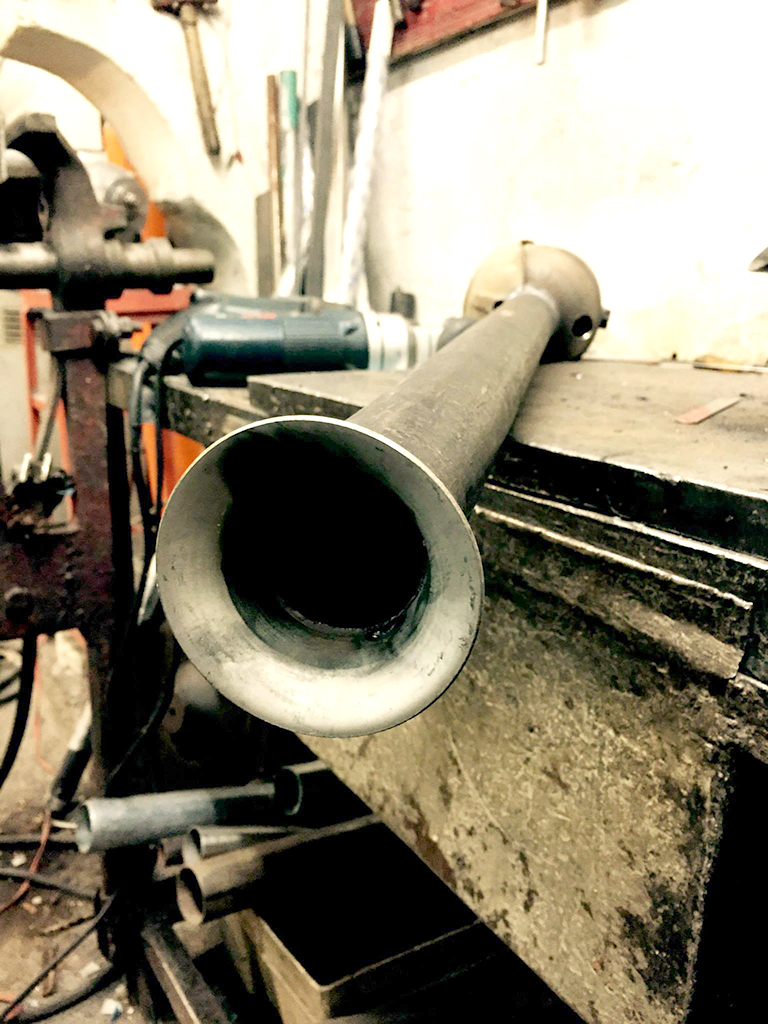


Pulse Jet > HyperSonorous Action of Dimensional Magnitude in the Idolatry of Combustion
VW emerged with the Nazi regime and was on the verge of disappearing after the fall of the Reich. From those years, after international negotiations, it stabilized and began a constant economic growth. It positioned itself as the most important company in Germany until the crisis of 2015, caused by the deceit and greed of its directors.
The machine that was built has a reduced air intake. To start the Pulse Jet, butane gas is introduced into the combustion chamber, a spark plug generates electric arcs, and air is injected into the chamber with a compressor that oxygenates, causing one explosion after another, starting the combustion process.
The frequency of Pulse Jets ranges between 35 and 45 Hertz. When the air intake is reduced, it is not self-sufficient, and to continue combustion, it requires a constant injection of air. When it is stopped, gas accumulates, and if air is injected again, it changes the power of the explosion.
Air is the control with which I can sequence and modulate the machine to build specific events of sonic power. The score is really the action itself and is an explosive timeline: the attacks on London, the Allied defense, the bombing of Berlin, the destruction of the VW plant, its economic growth, concluding with the crisis caused by its environmental unconsciousness
We are immersed in an idolatry of combustion due to an addiction to fossil fuels and decadent systems of extreme energy that we must stop. These systems must either renew or perish.
In reality, we are immersed in many more errors.
Arcangelo Constantini, 04.03.16
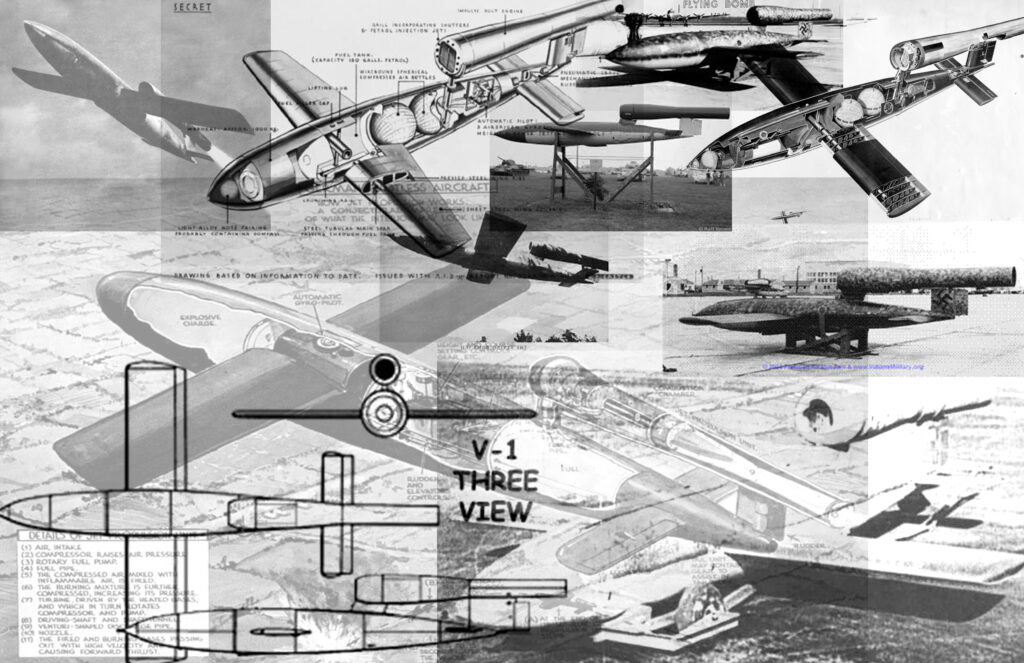
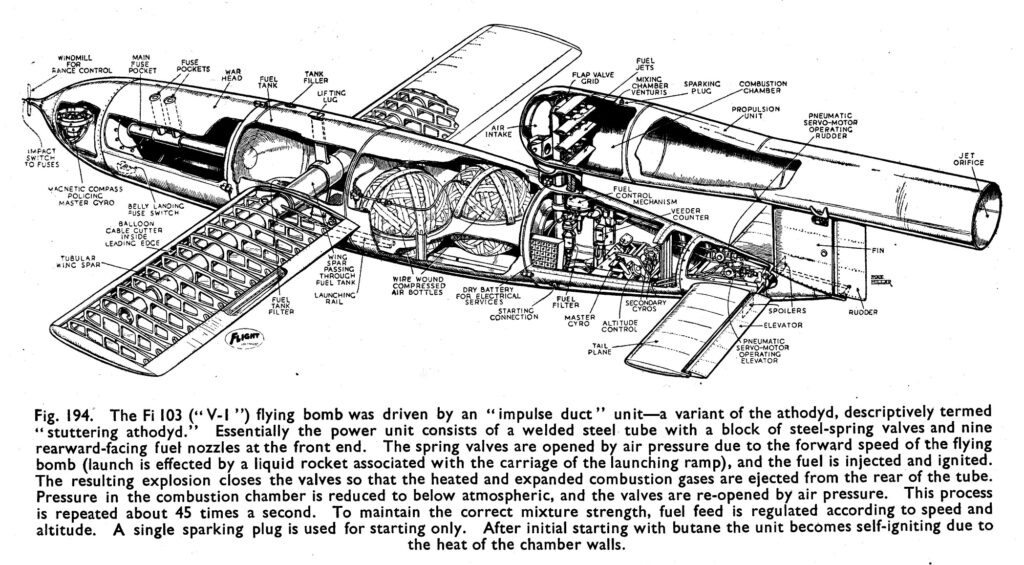
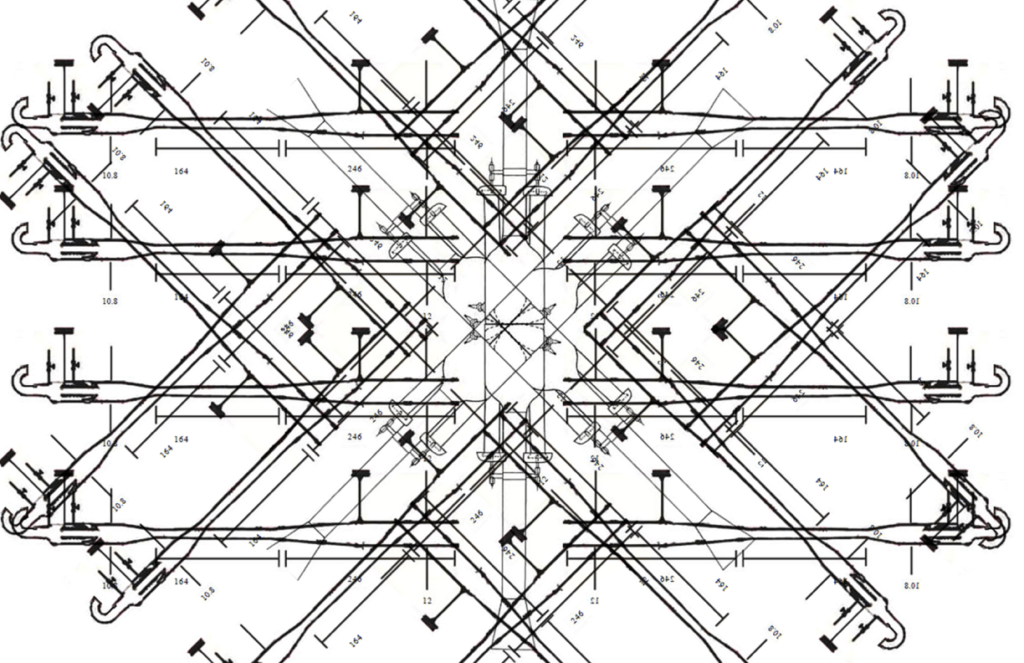
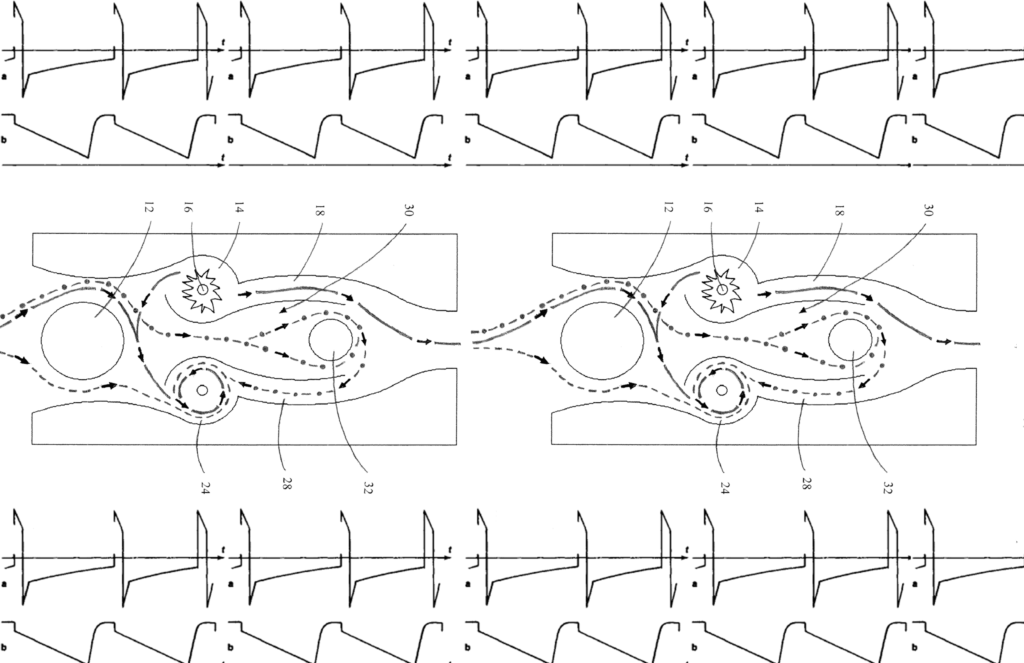
partitura diagramática o conceptografía de la acción
Agradecimientos especiales a Tania Aedo, Mariana García y al equipo del Laboratorio Arte Alameda. Julian Bonequi
To be released @ ART IN RELEASES
https://www.auditionrecords.com/critic13.php Publicado el Sábado 5 de Marzo de 2016
-

Hailku-a-Gaia
The poetics of Haiku generally rely on the astonishment and rapture that the contemplation of nature produces in the poet; it is not an excuse for human feelings but a poetic object in itself.Haikus are short, vivid poems originating from Japan, predating Buddhism and Zen philosophy. They have a semantic structure of 5-7-5 and unfold touching the macro and microcosms.
Contemporary Haiku is more free within its brevity, consolidated as an autonomous poetic form with its own conventions and rules.
Gaia is the Earth mother, recognized in various cultures and mythologies as Tonanztin, Pachamama, Kundalini, Diana, Isis, Rea, Cibeles, Adonia, among others. These are feminine deities associated with constructing reality, present mystical forces in nature, and are known by different names that embody the essence of nurturing existence. Nature is seen as an immediate and everyday deity, directly interacting with and engaged in continuous dialogue. In Greek mythology, Gaia represents this concept and has been reinterpreted by James Lovelock as a contemporary scientific hypothesis, recognizing Earth as a self-regulating organism.
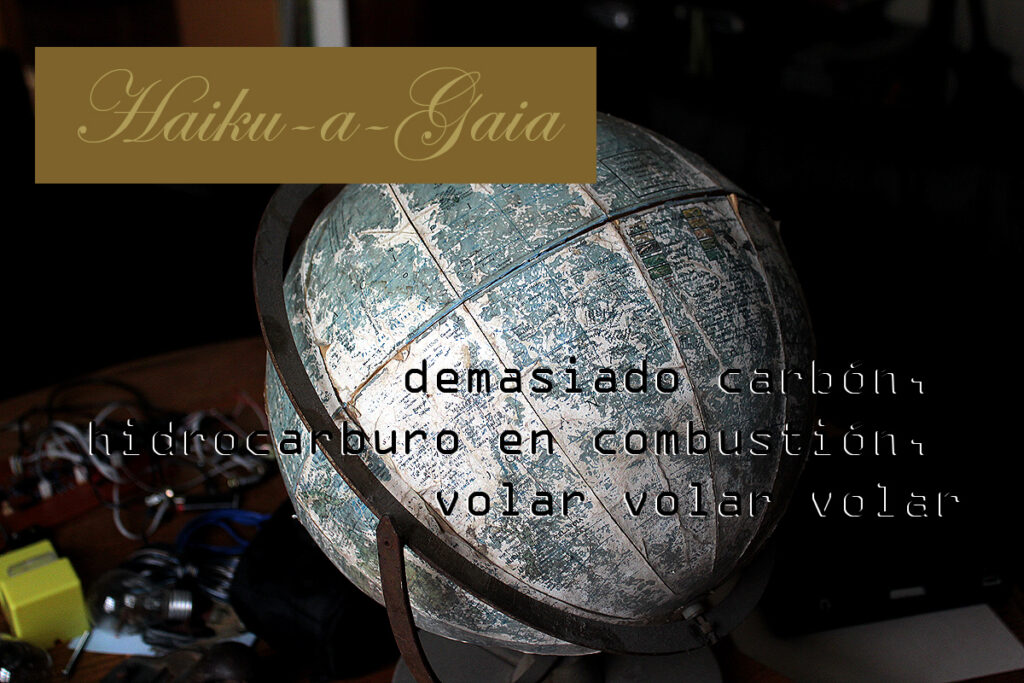
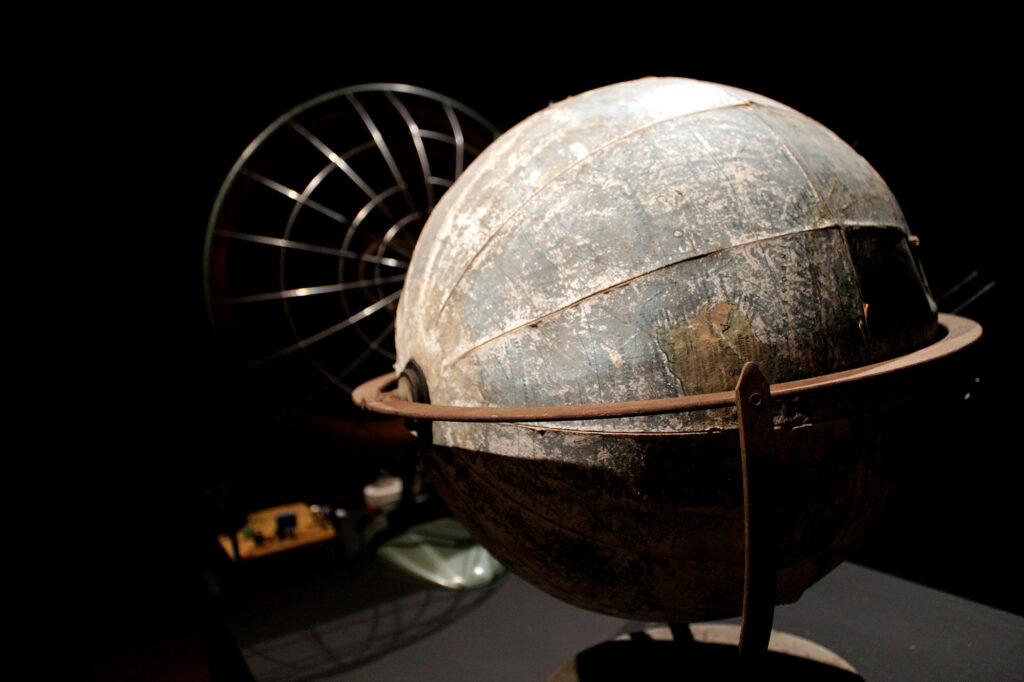
Haiku-a-Gaia is the model of a spherical Earth in the process of degradation.
“To a globe recovered from obsolescence, electromagnetic fields will be induced through electrostatic discharges, using an electric heater transformed into a parabolic dish antenna. An electronic circuit will amplify frequencies and increase its power in high voltage, fluctuating voltaic arcs like a plasma speaker.”
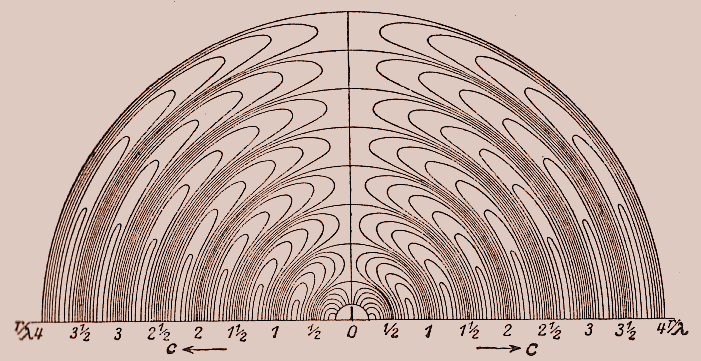
Heinrich Hertz performed the first radio transmission in 1888 using electrostatic discharges as pulses of high voltage, generating electromagnetic fields that propagate in space. These laboratory micro-lightning bolts replicated natural phenomena. “Spark-gap transmitters” were the primary method of wireless radio signal transmission for many years until the invention of high-vacuum tubes.Through a text-to-voice application, Haikus-a-Gaia sent by people using Twitter will be recited. These electromagnetic signals will be transmitted to the rotating globe. An oscillating voltaic arc will emit photons. A thin film of water will be present between the parabolic system and the spherical earth, acting as a light filter; the micro prism-like droplets will diffract and amplify photons as luminous electromagnetic fields, creating a flow distributed as communicative quanta.
Gaia is at a crossroads: nature has been subjected to factual powers and obsolete technologies. We have the technological capacity to stop the degradation that ecosystems are suffering due to decadent technologies or energy abuse and extraction. The constant burning of fossil fuels is causing irreversible climate changes.
Haiku-a-Gaia is a poetic detachment with sustainable intentions towards an Eco-tropism from a mystical animistic recognition. It’s a Holo-movement without prejudices that advocates for open and free technology, with the ability to reverse issues and awaken the inquisitive mind about the mysteries of nature. It acknowledges the integration of territorial mappings from science and mysticism consecrated in experimentation with intuition, maintaining a positive intentionality towards relevant changes in consciousness.
The planetary representation as a holographic model, substantial metaphors about fractals, where each particle represents the entirety of the system, so that what affects one affects us all.

¿Es un imperio
esa luz que se apaga
o una luciérnaga?Bajo el alero
el espejo no copia
más que la luna.Jorge Luis Borges

La mariposa revolotea
como si desesperara
en este mundo
Kabayashi Issa (1763-1828)
Mi cuenco de mendigar
Acepta hojas caídas
Taneda SantokaLas noches son breves
¿Cuántos días más
aún por vivir?
Shiki (1867-1902)
Bajo la lluvia de verano
El sendero
Desapareció
Yosa Buson (1715-1783)

Un mundo
que sufre
bajo un manto de flores
Watanabe Hakusen (1913-1969)
Este camino
ya nadie lo recorre
salvo el crepúsculo.
Matsuo BashoPasó el ayer,
pasó también el hoy,
se va la primavera
breve siesta
y al despertar
se fue la primavera
Yosa Buson (1716-1784)
La..KAz/PA . .KOZ.Mi:ka
Ez.. Noc.Tur-Na
Dez.Ti-No Bri/Llan/Te . Le(ja)No
bakteria.org

-

comisionada por Priamo lozada y Plataforma PUEBLA 2031
Plataforma Puebla 2006
Laboratorio Arte Alameda 2007
Mide Museo interactivo de economia 2010
Galeria Metropolitana ” la Sombra del agua ” 2011
Spark-un-Plug: Arcángel Constantini**
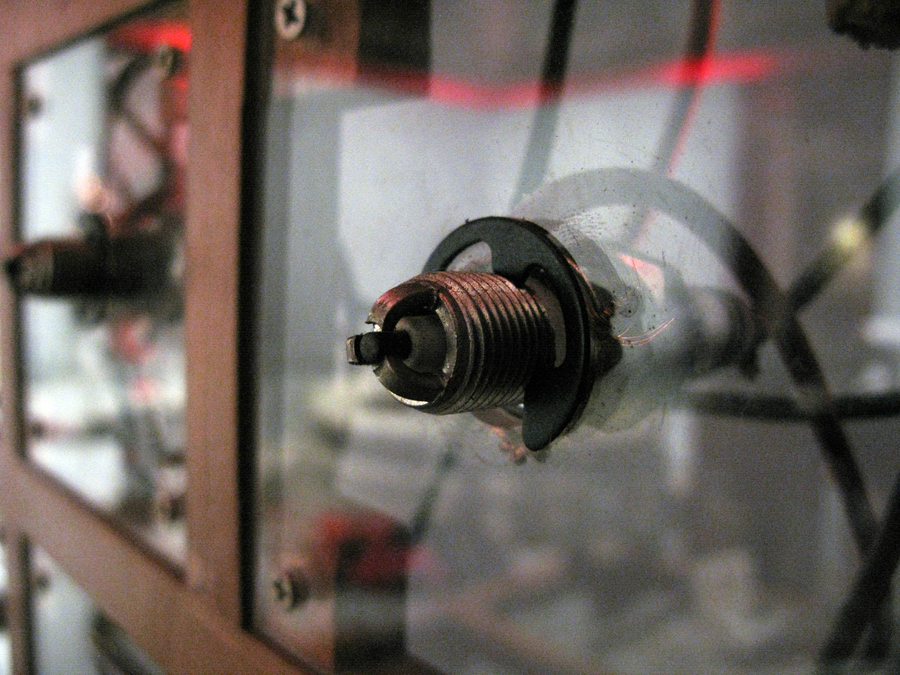
spark plugs are the essential electrical system of internal combustion engines. Its main function is to ignite combustion, thus providing thrust to the engines.
Spark plugs transmit electrical energy from the coil in high-voltage sparks. These voltaic arcs, produced inside the engine chambers, ignite the mixture of fossil fuels with high-pressure oxygen, generating the necessary force to move the pistons and expel combustion gases.
The first internal combustion engine using voltaic arcs was designed by Isaac de Rivas in 1807. The fuel it used was hydrogen obtained through water electrolysis. Two hundred years ago, there was consideration of using the most abundant element in the universe as an energy system, but political and economic powers chose the burning of oil.
Spark plugs are the simplest yet most complex electrical element in an engine. They not only serve to generate ignition but also to dissipate heat from the engine chambers.
It is contradictory that an element whose one of its functions is heat dissipation contributes to the main cause of global warming on Earth and, consequently, to the melting of the poles, which naturally shares the same function of dissipating Earth’s heat.
In the majority of the automotive and aerospace industries, this internal combustion mechanism is used as the sole source to produce mechanical energy, which has led, due to its excessive and exclusive use, to irreversible consequences for the environment. Billions of spark plugs flickering at every moment: electrical energy misused, a function that releases CO2 (carbon monoxide) into the atmosphere. It’s a use of electricity for archaic and environmentally depleting mechanical purposes.
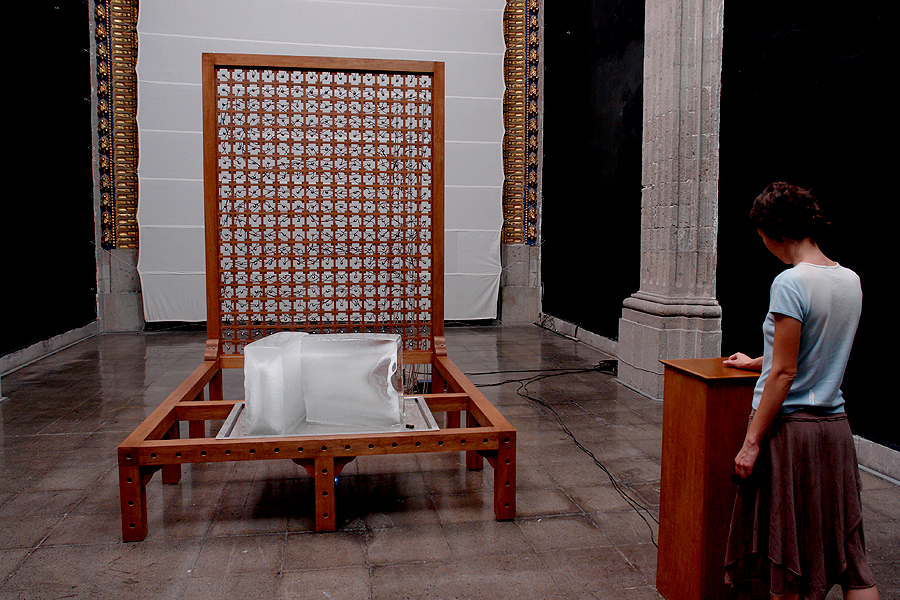
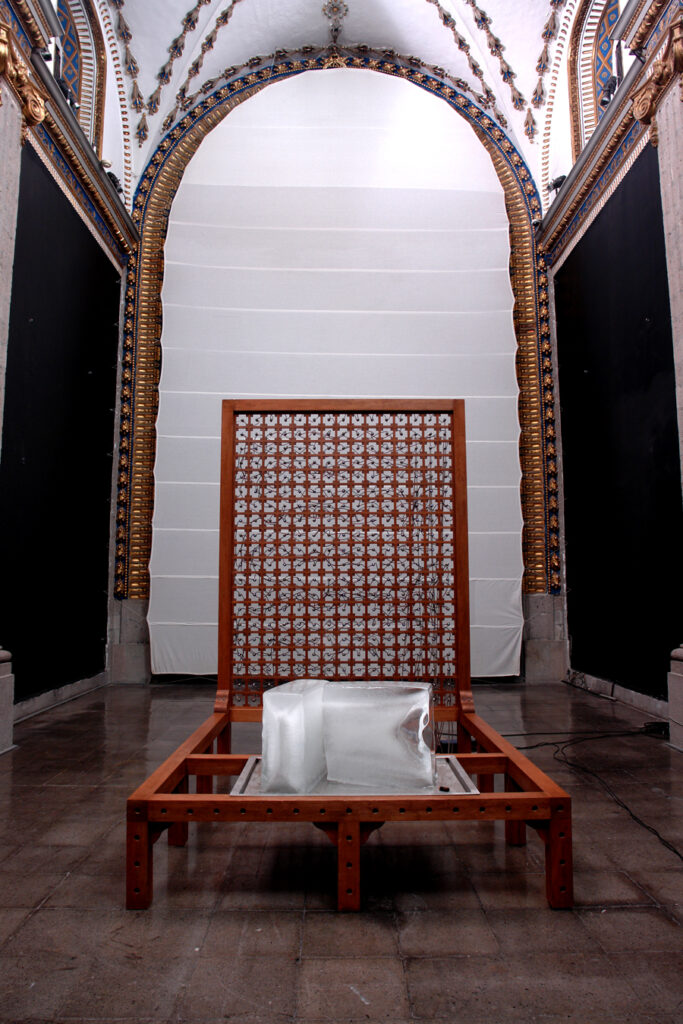
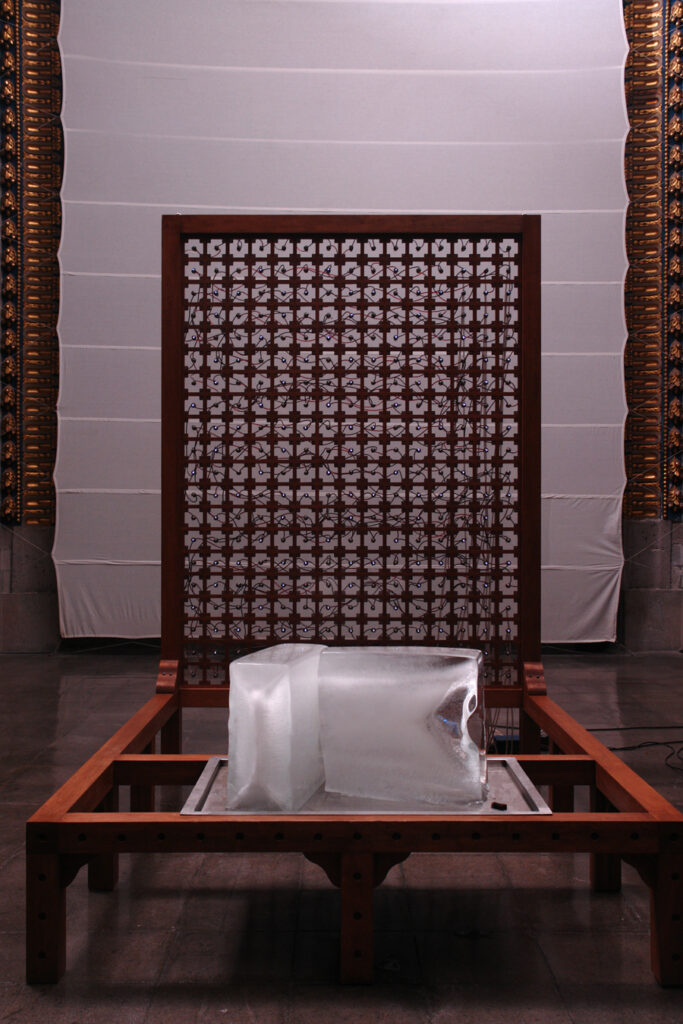
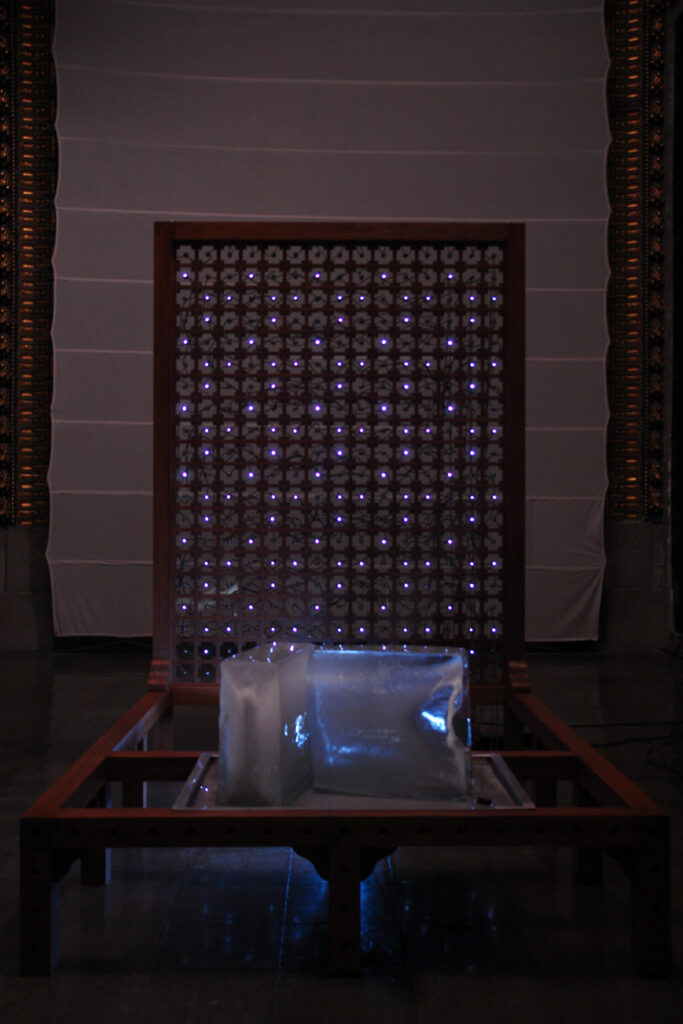
**Spark-un-Plug** is a system of physical and conceptual feedback based on the number 3.
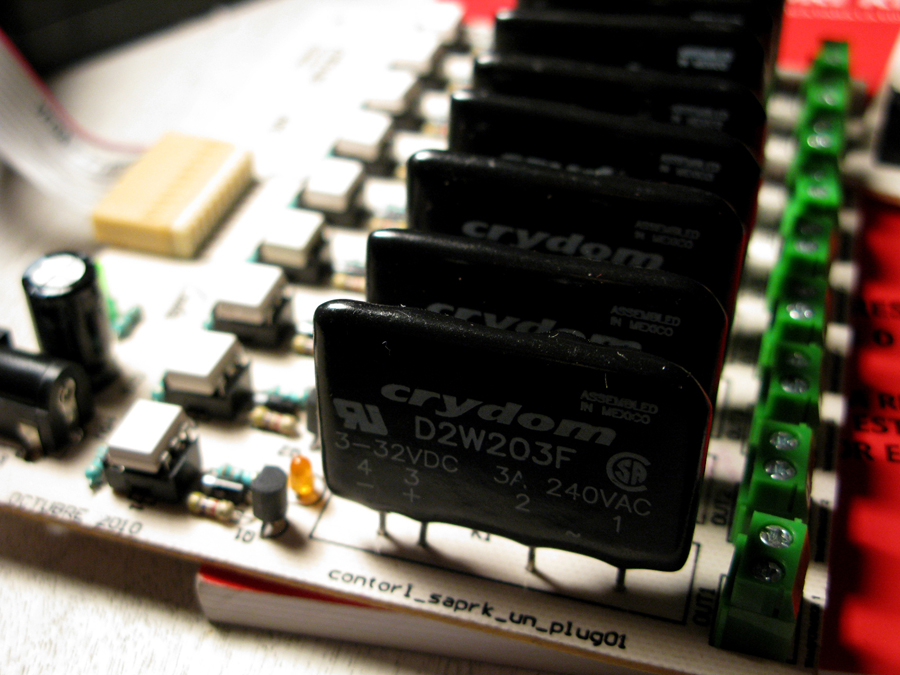
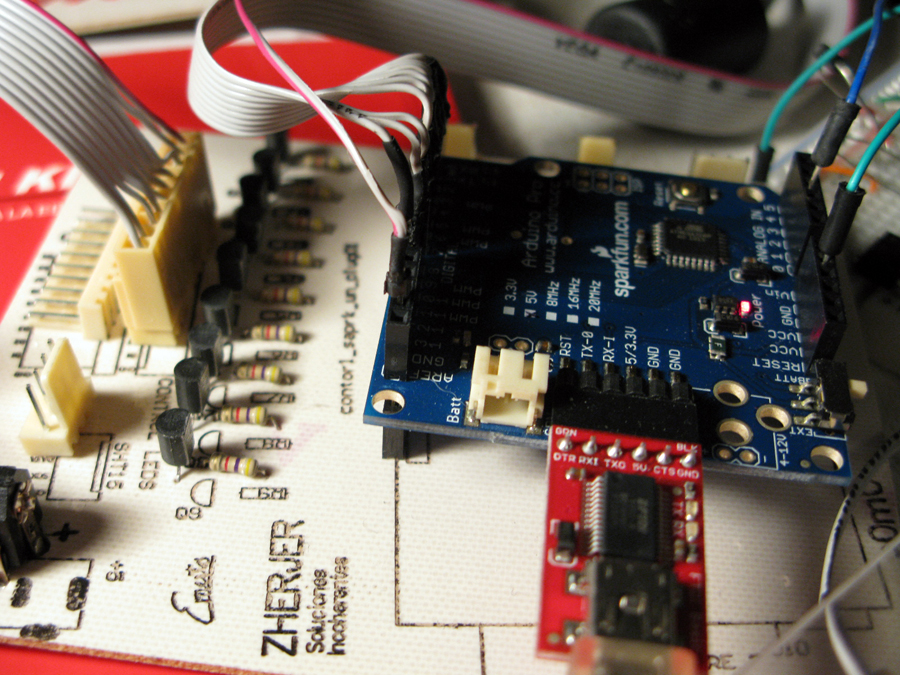
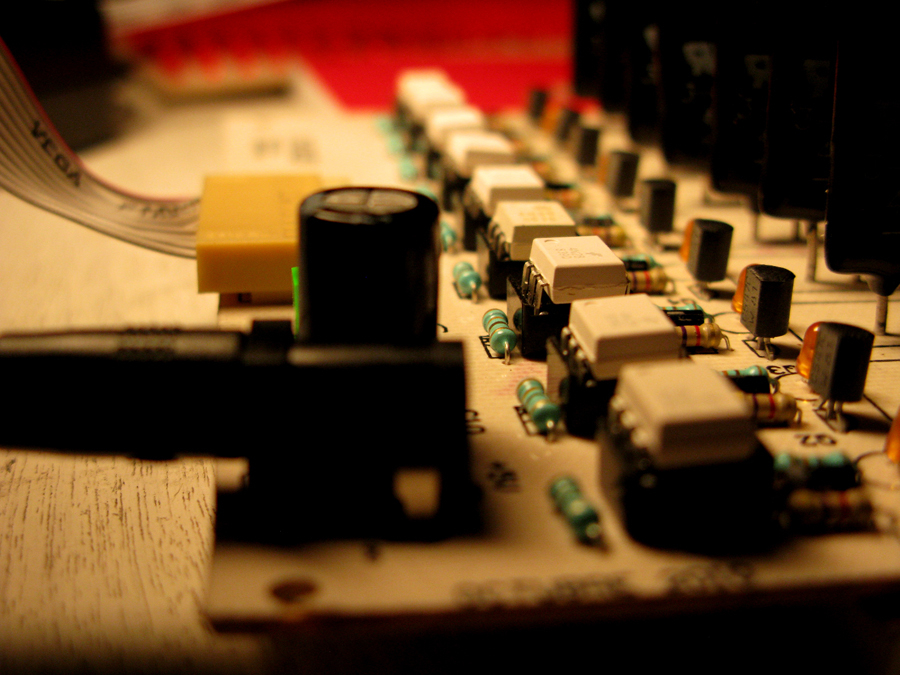
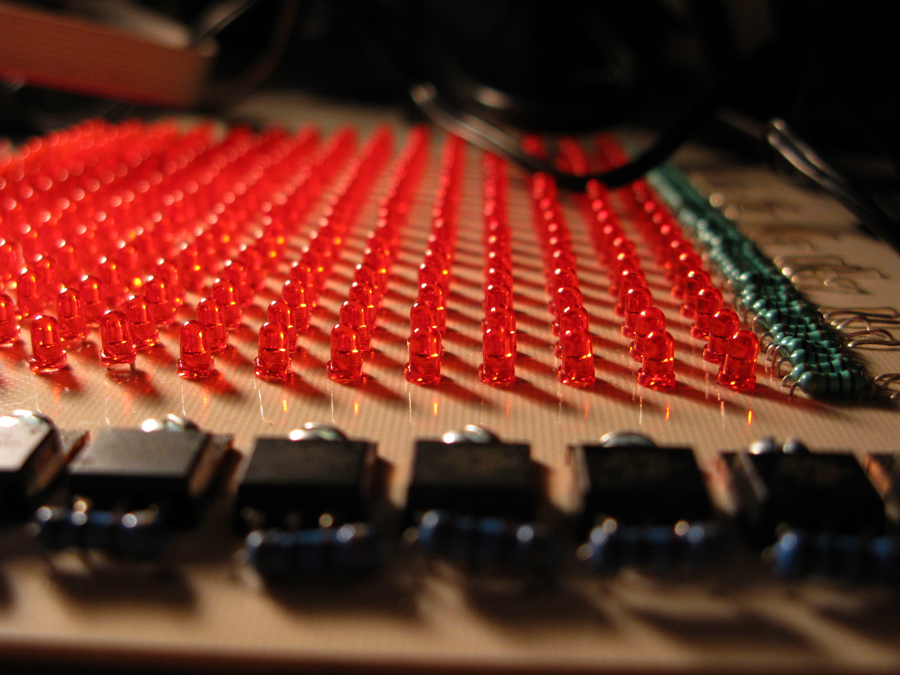
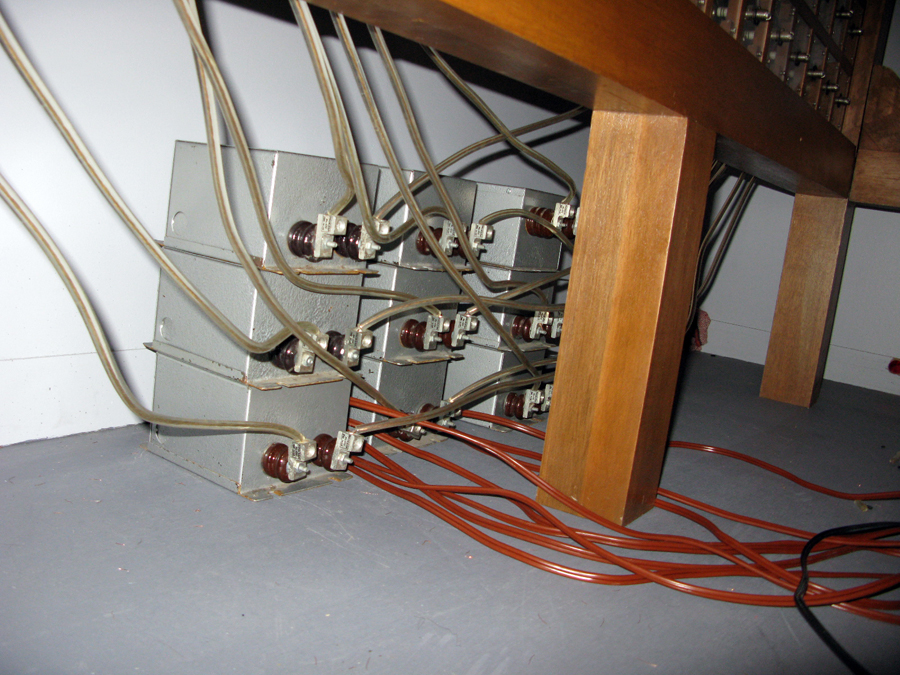
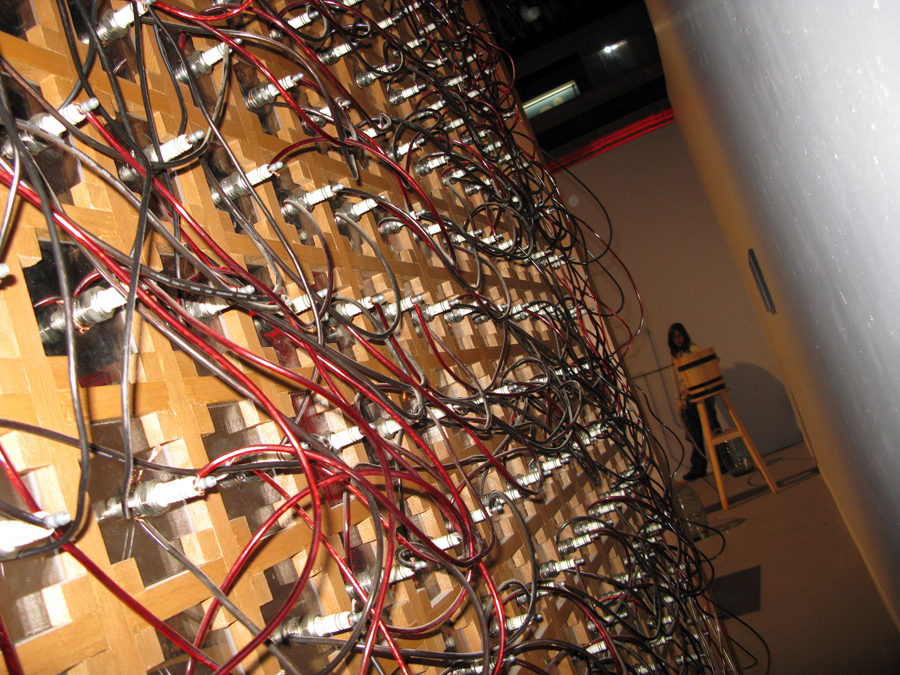
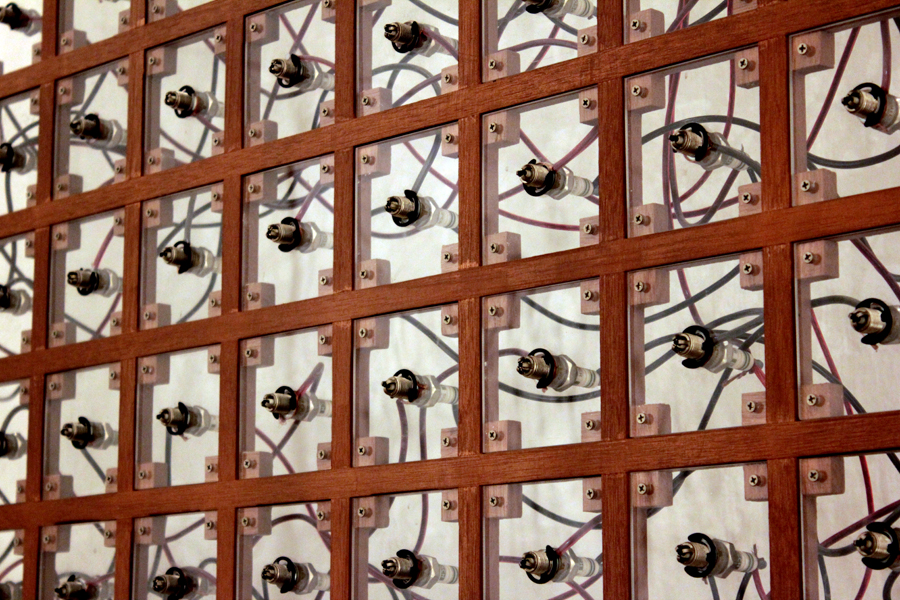
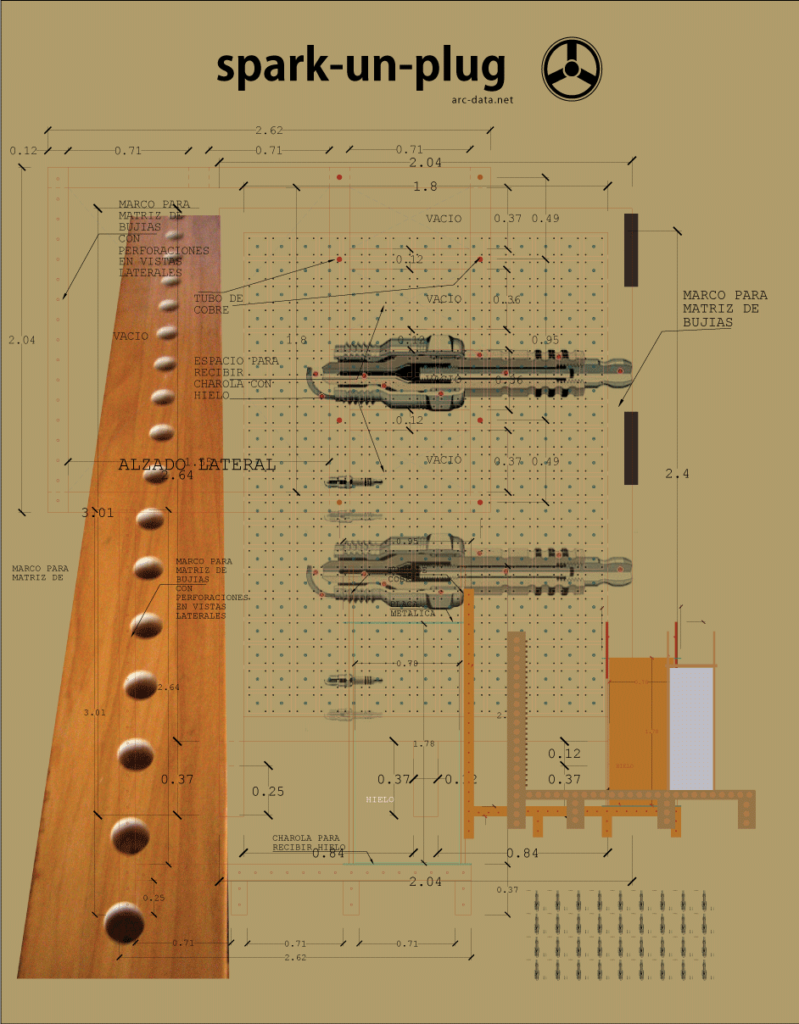
The piece consists of a matrix of 300 spark plugs, divided into small 3×3 matrices that repeat in tessellation. These spark plugs with three anodes are controlled independently and emit high-voltage electrical energy to a block of ice placed in front of them. When the audience places a coin in a collection box, it activates the piece, and at that moment, values from three types of sensors are obtained: one for temperature, another for CO2, and another for humidity. These physical and chemical processes are monitored in real-time. The data obtained is used as an intervention in the artwork.
The high voltage generated by the spark plugs, a phenomenon in which an electric charge travels between the cathode and anode of the system, is the visual and auditory event, a result of the dialogue between the two systems: the generator of the patterns of electrical discharge in the matrix and that of the environmental balance and life support, water.
The voltaic arcs of the spark plugs in the matrix represent simulations of the states of water:
– Liquid: simulation of rain.
– Solid: simulation of geometric patterns of ice crystals.
– Gaseous: simulation of gaseous fluids.
Water stands out as the most recognized element in nature; however, its complexity is equally unparalleled. The atomic bond formed by two hydrogen atoms and one oxygen atom is among the most stable in the natural world. The energetic potential of water is vast, and its intrinsic connection with electrical energy is of fundamental significance. The amalgamation of hydrogen and oxygen atoms results in the creation of water, accompanied by the release of electrons.
Water in nature follows a hydrological flow cycle: it rises as vapor, flows as a liquid, and solidifies.
Spark-un-Plug is based on the number 3, the simplest scientific formula, and the theological representation of the deity. Its electronic logic is binary, 1 and 0.
Water is the spiritual element of existence; it represents purity, rebirth, the energetic flow of the spirit to another existence, communication with divinity. It is present in all theologies and is constantly debated through scientific, empirical, and metaphysical methods, seeking to balance its mystery.
Electricity is a phenomenon of nature that is changing human consciousness.
In Spark-un-Plug, the spark plug, like the retro-generating mechanical heat dissipator, will confront and pay symbolic tribute to the natural heat dissipator of the planet: ice. Through this arrangement, it will communicate to us the danger of its extinction, rising as vapor to dream of the future continuation of its vital natural cycle.
Spark-un-Plug, a project driven by the conscious use of energy.

-
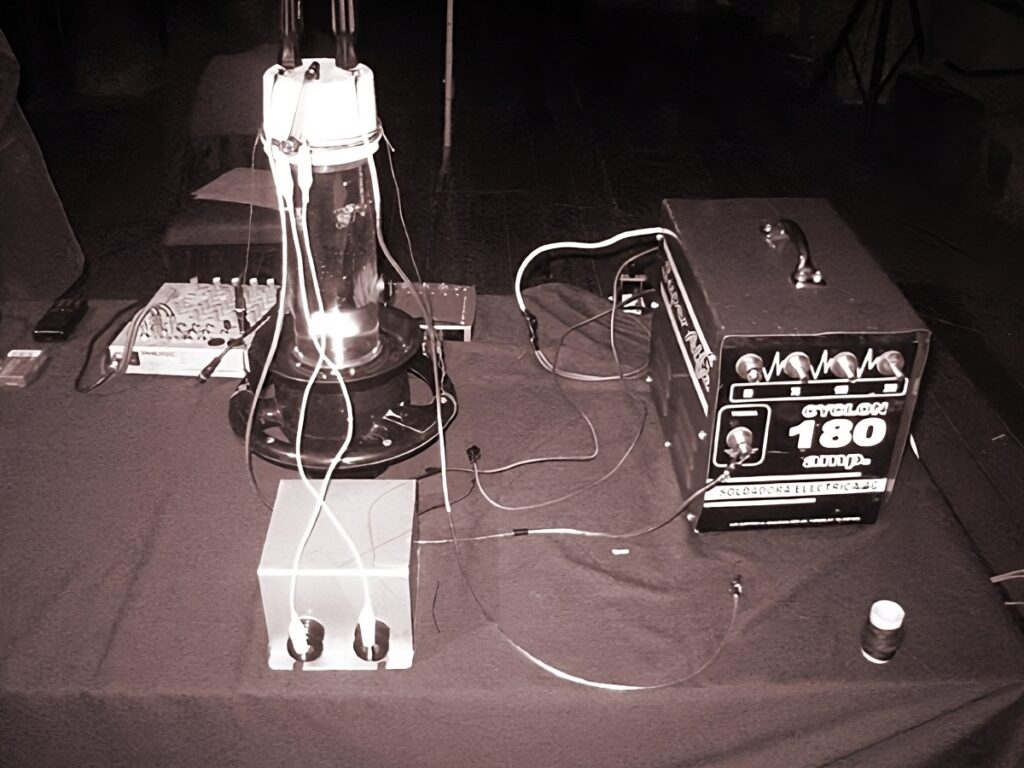
AquaElectricArcPlasma is a visual and sound artwork that arises from a scientific experiment from the early 20th century. By using carbon electrodes submerged in water and high amperage electric energy, a subaquatic plasma is generated that causes an electrochemical electrolysis. This release of oxygen, hydrogen, and carbon ions leads to the creation of the COH2 gas.
The photoluminescence that occurs during the gas generation process is a crucial element of the artwork, as are the sounds generated during water electrification. This transdisciplinary experiment combines scientific, artistic, and mystical methodologies.
The experimental action took place in a memorial for the death of Príamo Lozada, an exceptional being who illuminated us with his love for art and life. The result of the transdisciplinary experiment was an energetic metaphor about the transcendence of existence.
As a society, we must find the best ways to transform energy to live in balance with nature, avoiding extreme extractive energies and the combustion of hydrocarbons. Chemical electrolysis by subaquatic plasma is an emerging way to transform energy in a more balanced and environmentally friendly way. Energy is neither created nor destroyed; it simply transforms, and it is our responsibility to find more sustainable ways to do so.
2007 Laboratorio Arte Alameda 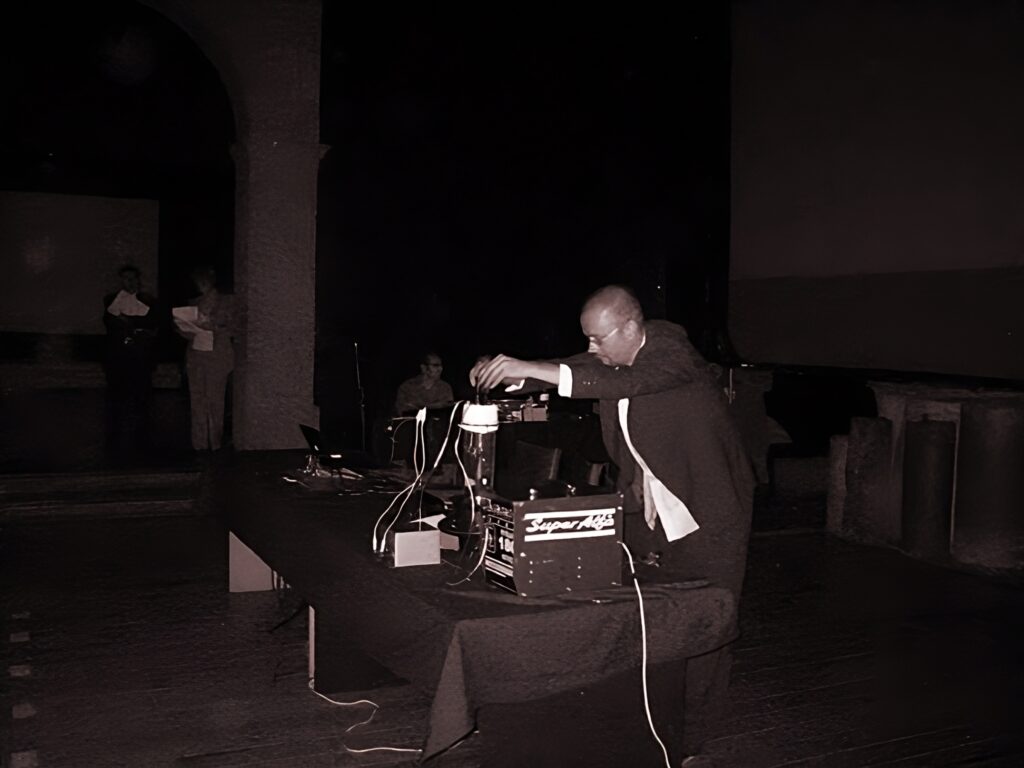
2007 Laboratorio Arte Alameda Laboratorio Are Alameda ,
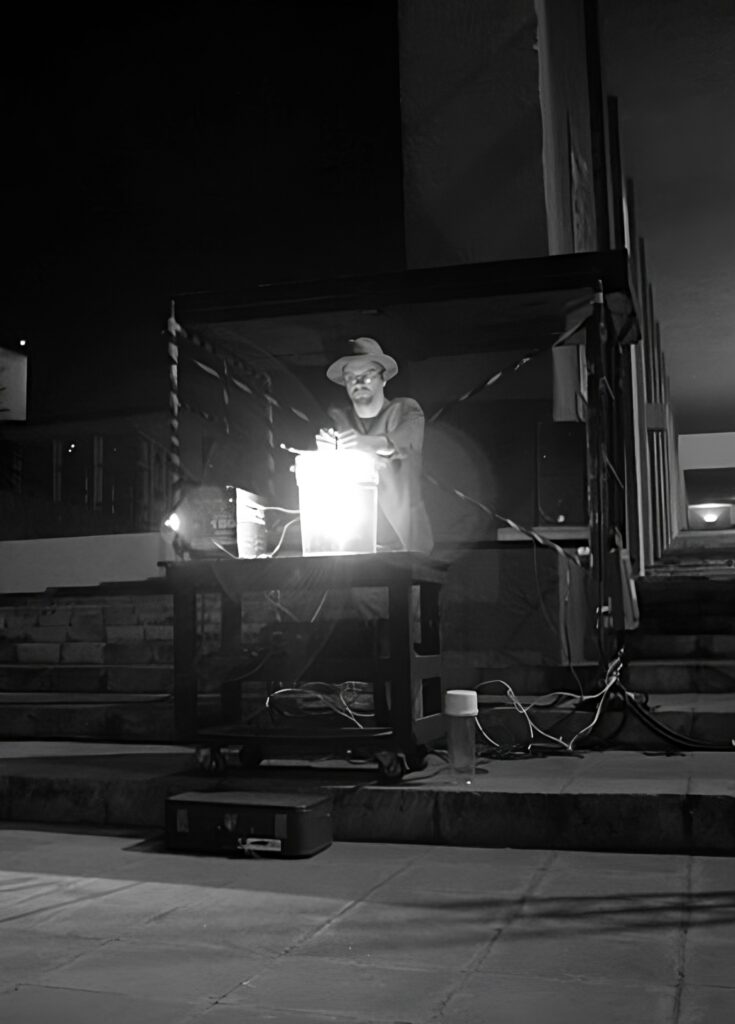
Centro Nacional de lasArtes 2009
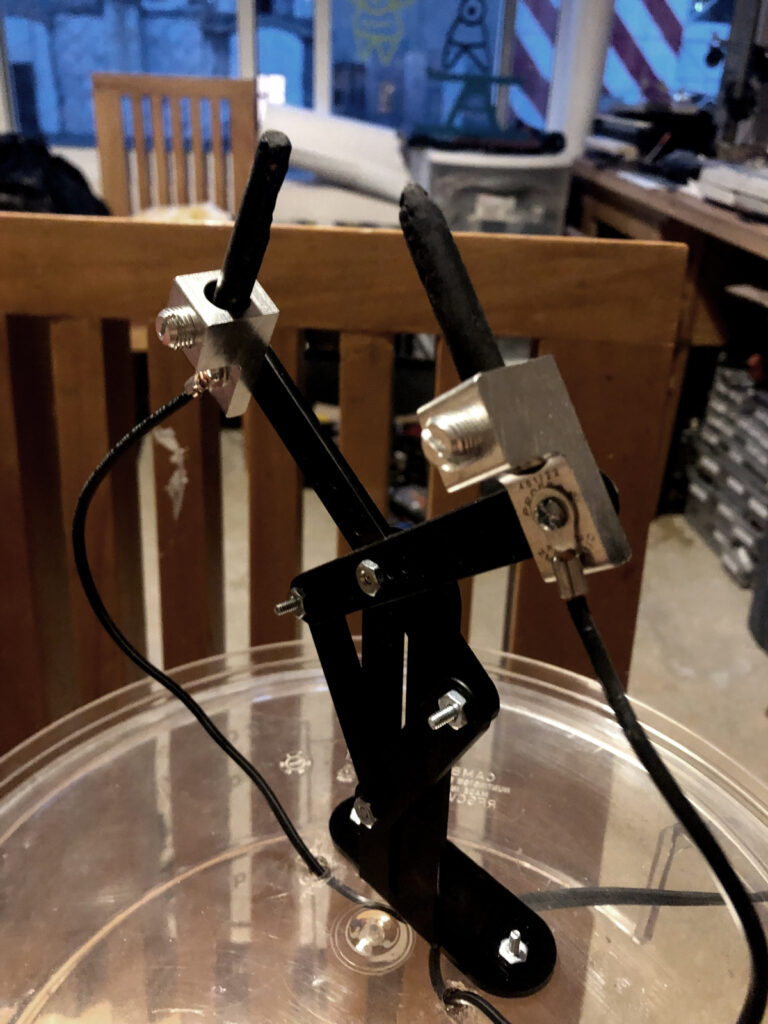
electrode system 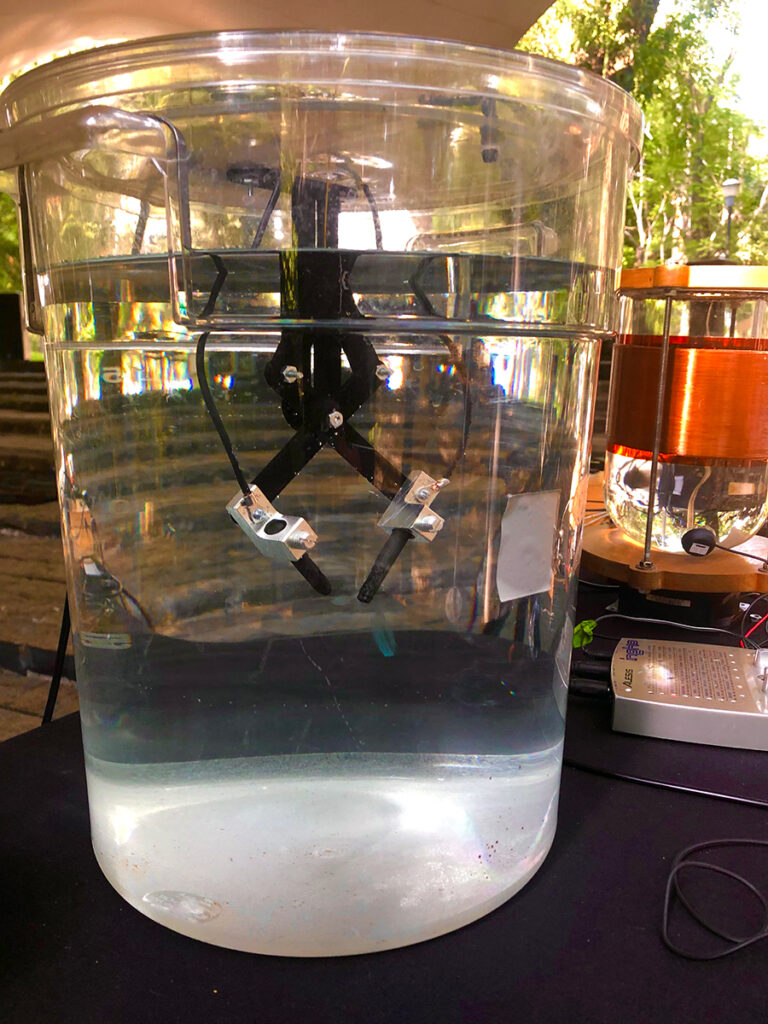
Volta Abismal Live Act Casa del Lago , Unam 2023 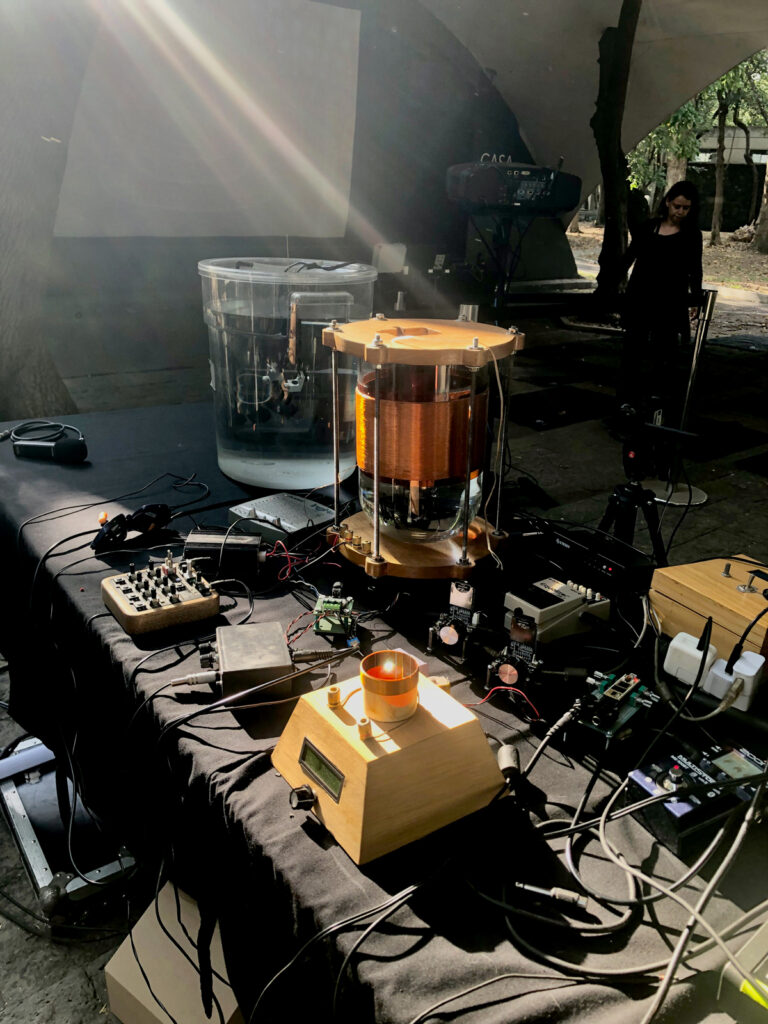
Volta Abismal Live Act Casa del Lago , Unam 2023 
Volta Abismal Live Act Casa del Lago , Unam 2023 
Volta Abismal Live Act Casa del Lago , Unam 2023 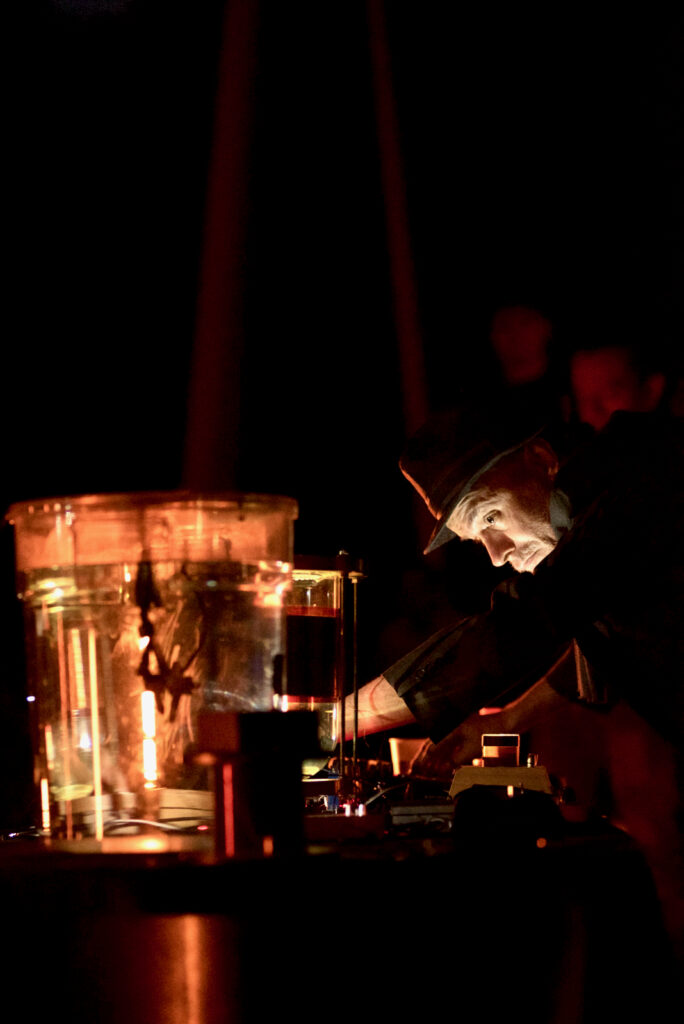
Volta Abismal Live Act Casa del Lago , Unam 2023 
Volta Abismal Live Act Casa del Lago , Unam 2023 
Volta Abismal Live Act Casa del Lago , Unam 2023 
Volta Abismal Live Act Casa del Lago , Unam 2023 
-

- << SpeStri >> , Speaker Strings , Instrumentos de cuerda acusticos acoplados con parlante amplificado y electronicos
- << SpeStri >> , Speaker Strings , Acoustic string instruments embedded with amplified Speaker & electronics

Following the tradition of prepared instruments in experimental music, such as John Cage’s prepared pianos, Laurie Anderson’s magnetic violin, or Christian Marclay’s turntables, prepared electric guitars are instruments that have been modified with a variety of devices to explore their sonic capabilities and experiment with processes beyond chords, riffs, or scales. They offer a wide range of sonic and expressive possibilities in their execution. Artists like Fred Frith and Hans Tammen specialize in improvisation and performance using prepared electric guitars, both electric and acoustic.
In many of my pieces, I explore the hypotheses of electromagnetic induction. Ultimately, every process, whether electric or acoustic, is electromagnetic. The Spanish guitar, being a classical instrument, started to rely on electromagnetism for amplifying the strings when it became electric. The guitar lost its acoustic chamber as it became unnecessary, and its form evolved along with the aesthetic possibilities and sonic experimentation with the instrument.
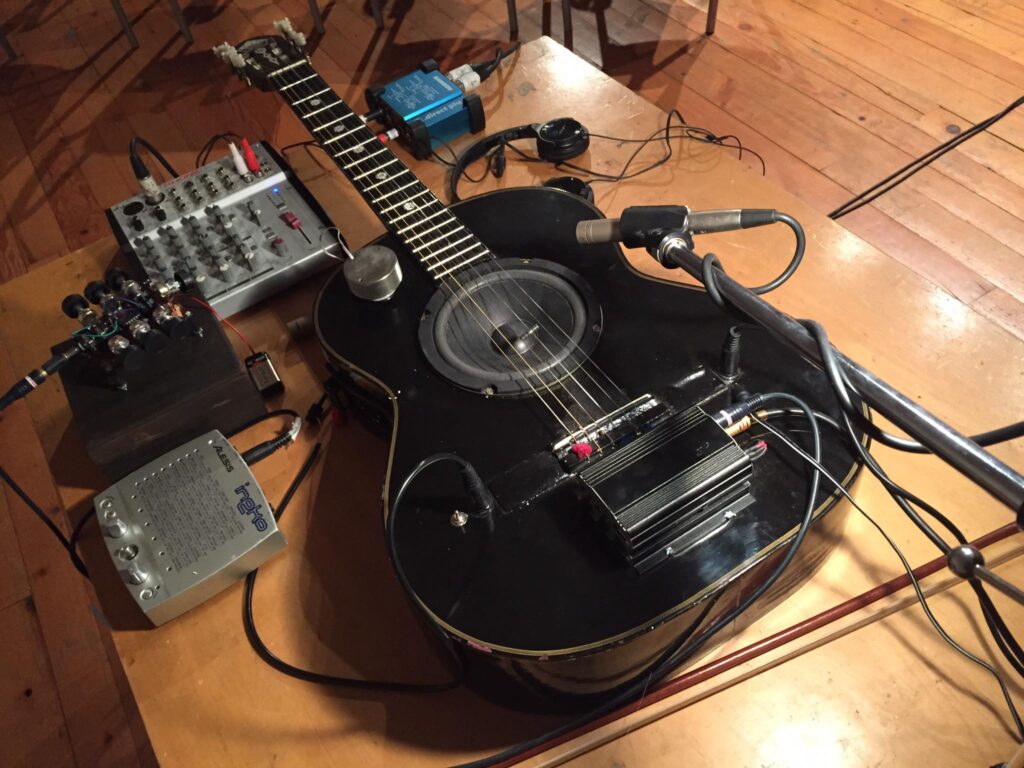
Spestri Guitar: It is a prepared electroacoustic guitar. A classical guitar was fitted with a 100-watt speaker directly on the soundboard, an equalizer preamplifier with a piezoelectric strip, a 30-watt amplifier with two channels, transducers, and various analog and DSP electronic processes.
The classical acoustic process of the guitar is disrupted as a self-amplifying system generating autonomous chaotic oscillations. This occurs due to sympathy in resonance, a phenomenon in which two vibrating systems have similar natural frequencies and mutually influence each other. When a string is played, it is amplified by the speaker, resulting in a transfer of vibrational energy between the systems and generating a resonant response from the vibrating string. This creates a loop, a feedback, producing unstable harmonics like processed drones through feedback loops.
The audio signal passes through a Matrix Mixer and is processed by a series of pedals and filters. As an expressive and intrusive act, the strings are tuned during performance, electromagnets and motors are used, and a series of LowFi oscillators amplified by a transducer system are employed to strike the strings, transmitting the generated frequencies to the preamplification system. Equalization is important during improvisation, which is a continuous dialogue with the artifact, determined by the pseudo-autonomy of the system and the expressive orientation of chaos.
SpeStri was performed at Soundscapes 2015 (MX-UK) curated by Laura Plana, at the Fonoteca Nacional alongside J Milo Taylor, Juanjose Rivas, and Gudinni Cortina. At the Museum of Contemporary Art in Santiago, Chile with Anilla Cultural, at Hospedería del Errante in Ciudad Abierta, Chile for an improvisation set with Oscar Santis, and as a duo with Fernando Vigueras at the Infinito Festival and Habitación del Ruido. They were part of the Articulaciones del Silencio series as a duo with Liliana Rodriguez at the Centro Cultural España and performed at the Museum of Modern Art in Medellin. it also participated in the Sensory Laboratory at No Estamos Solos, ElektronischeArtandMusic in London with J Milo and Dr. Nexus at Chalton Gallery in London, at Perfume, Galería Labor. At H34r in Taller 30 San miguel de allende Guanajuato






Primer concierto de Spestri Guitarr , 2015 Fonoteca Nacional 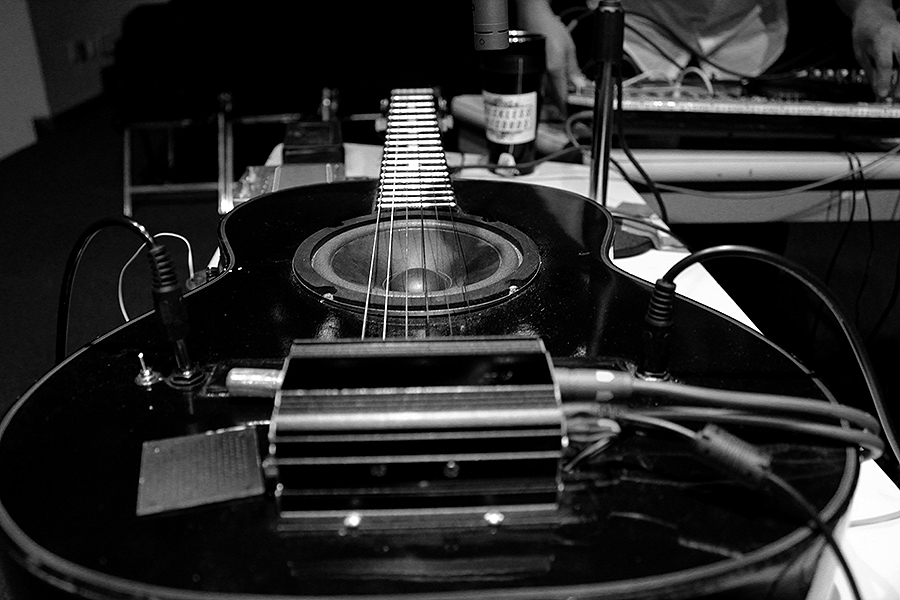
Spestri Guitar , 2015 Fonoteca Nacional 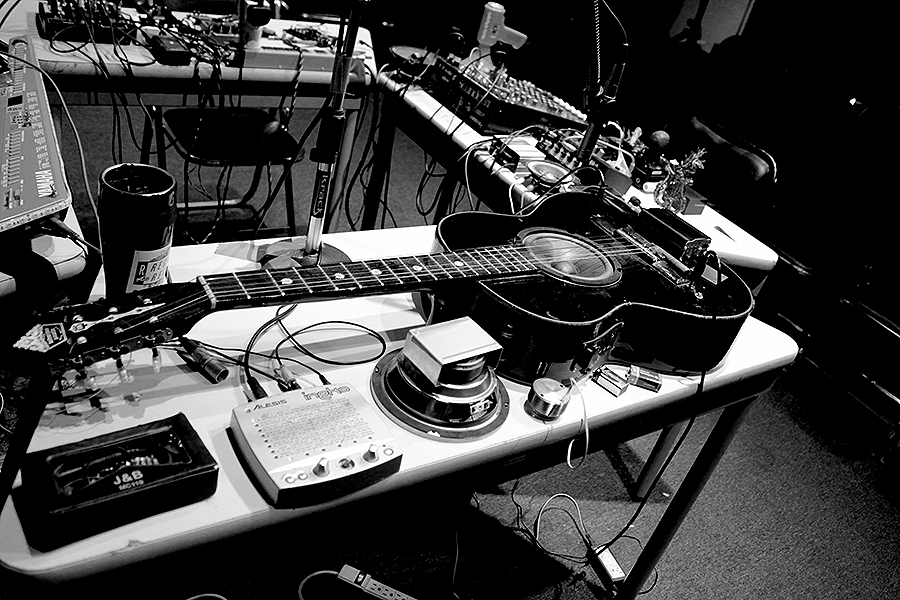
Spestri Guitarr , 2015 Fonoteca Nacional 
Spestri Guitarr , 2015 Fonoteca Nacional 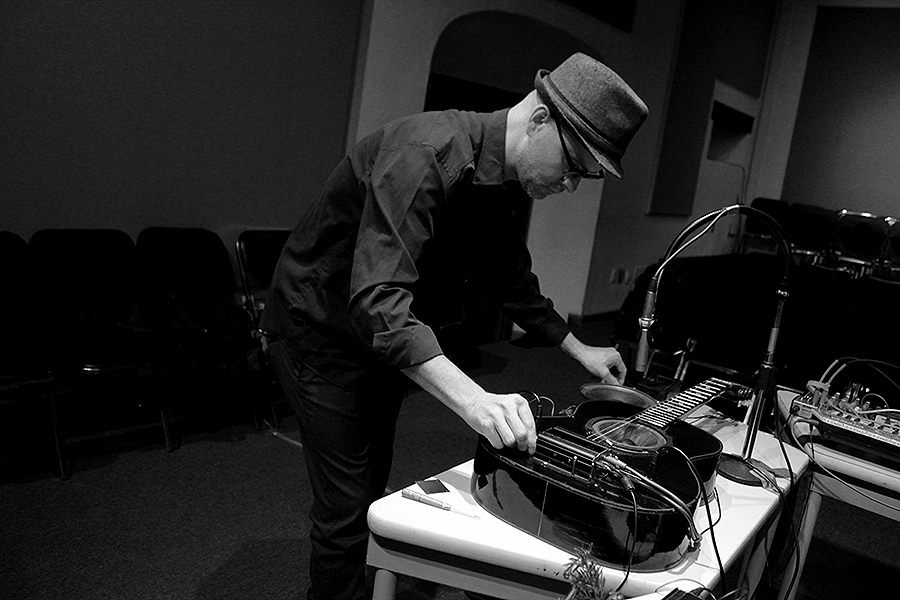
Spestri Guitarr , 2015 Fonoteca Nacional 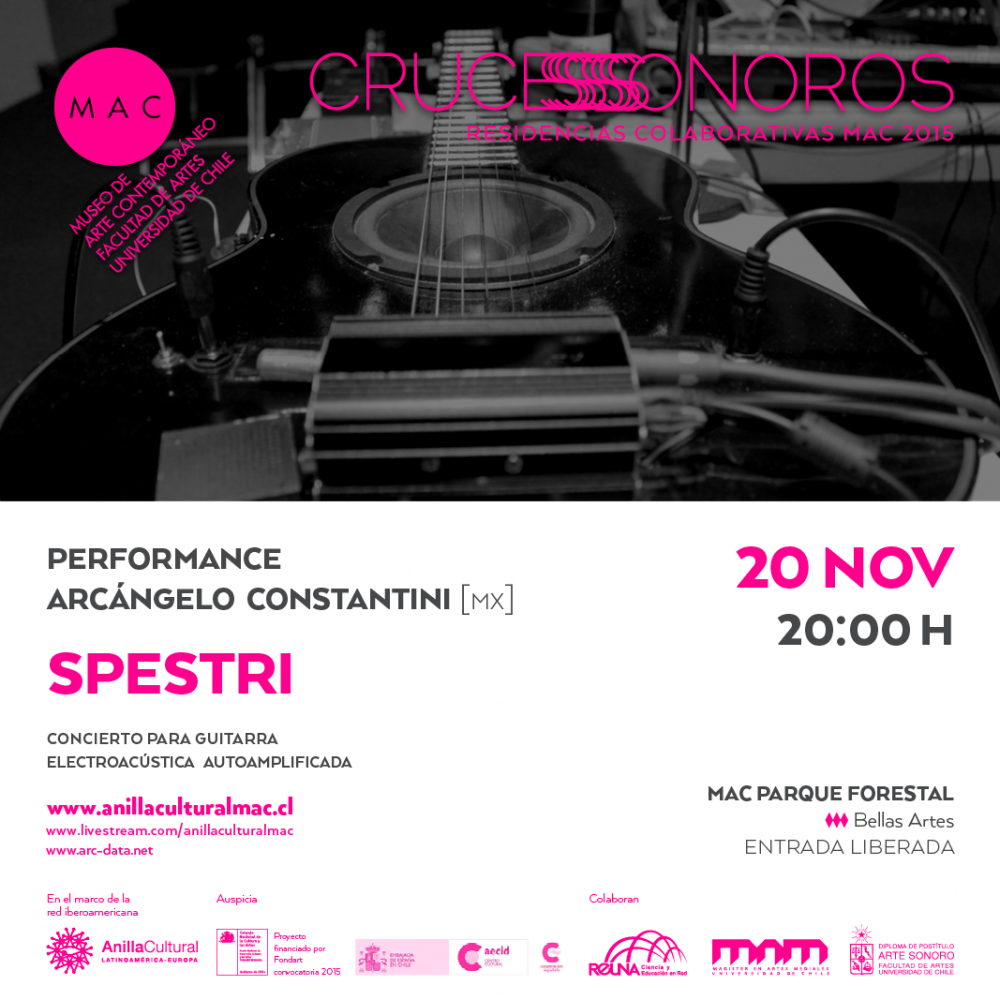
Hospedería del Errante in Ciudad Abierta, Chile for an improvisation set with Oscar Santis 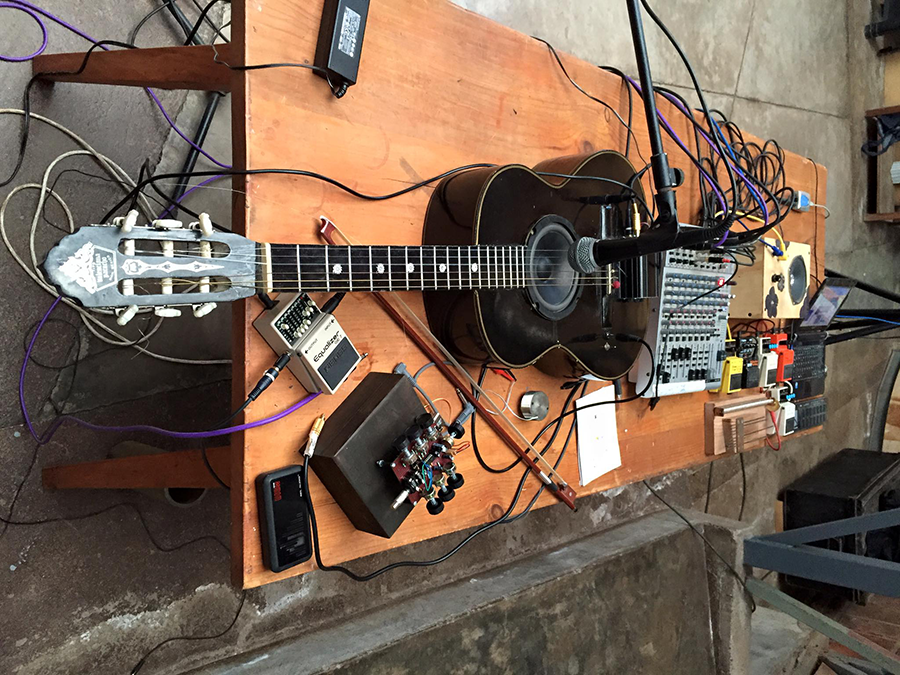
Hospedería del Errante in Ciudad Abierta, Chile for an improvisation set with Oscar Santis 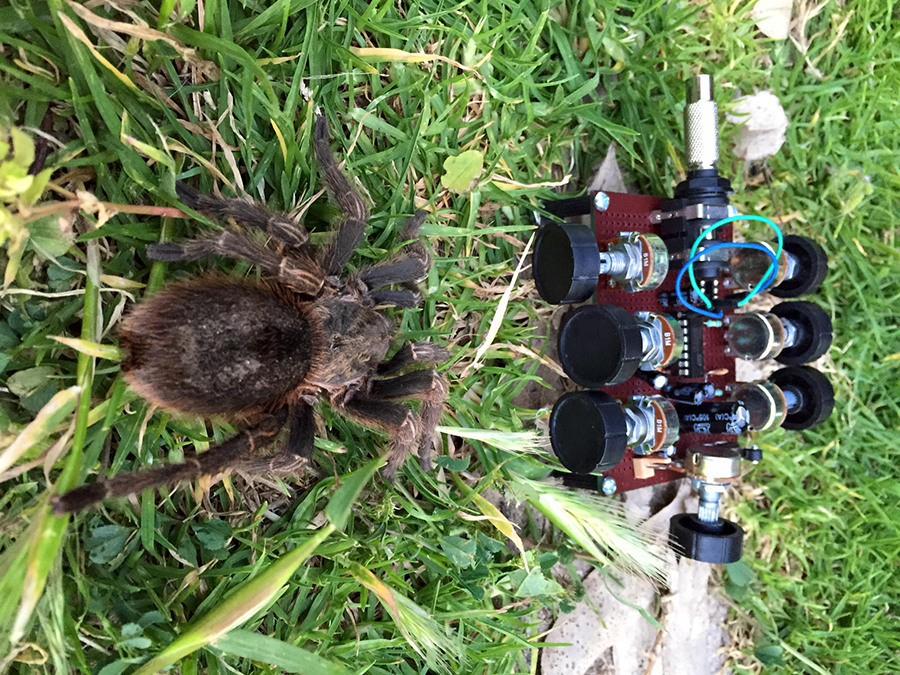
CmossTroso meet Tarantula . Hospedería del Errante in Ciudad Abierta, Chile for an improvisation set with Oscar Santis 

Habitación del Ruido, Claustro de Sor Juana 
Habitación del Ruido, Claustro de Sor Juana 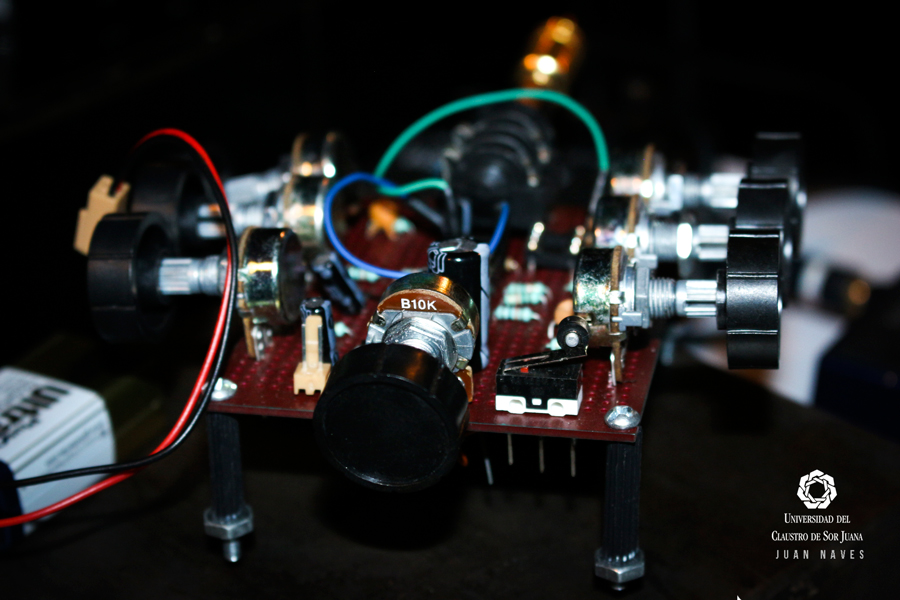
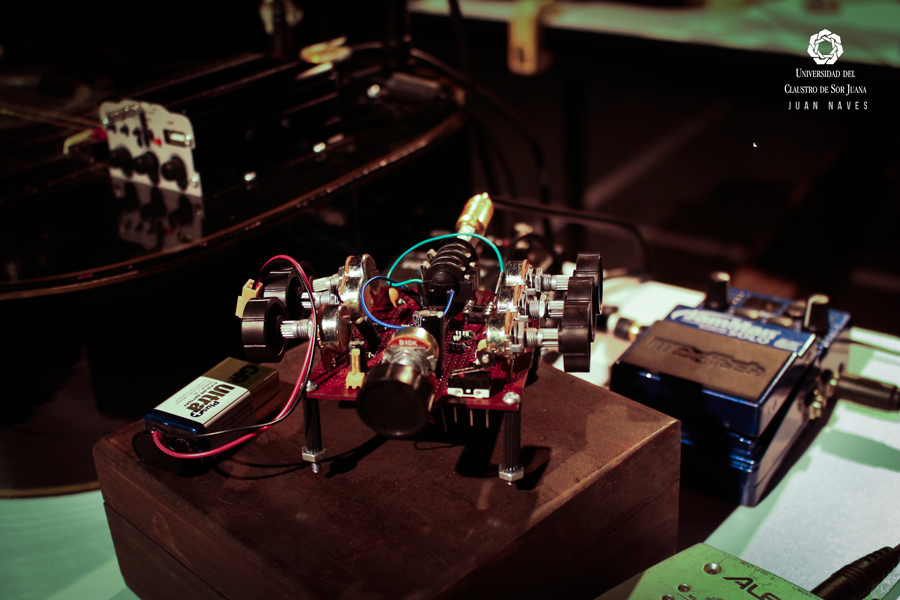
Habitación del Ruido, Claustro de Sor Juana 
Habitación del Ruido, Claustro de Sor Juana 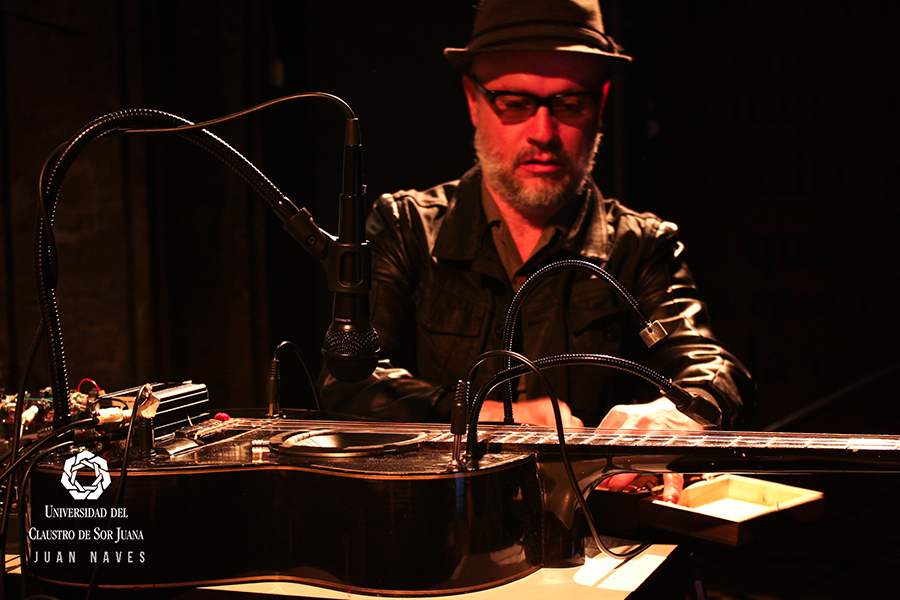
Habitación del Ruido, Claustro de Sor Juana 
Dueto de Guitarras Fernado Vigueras & Arcangelo Constantini , Festival infinito
Fotografias Viviana Martinez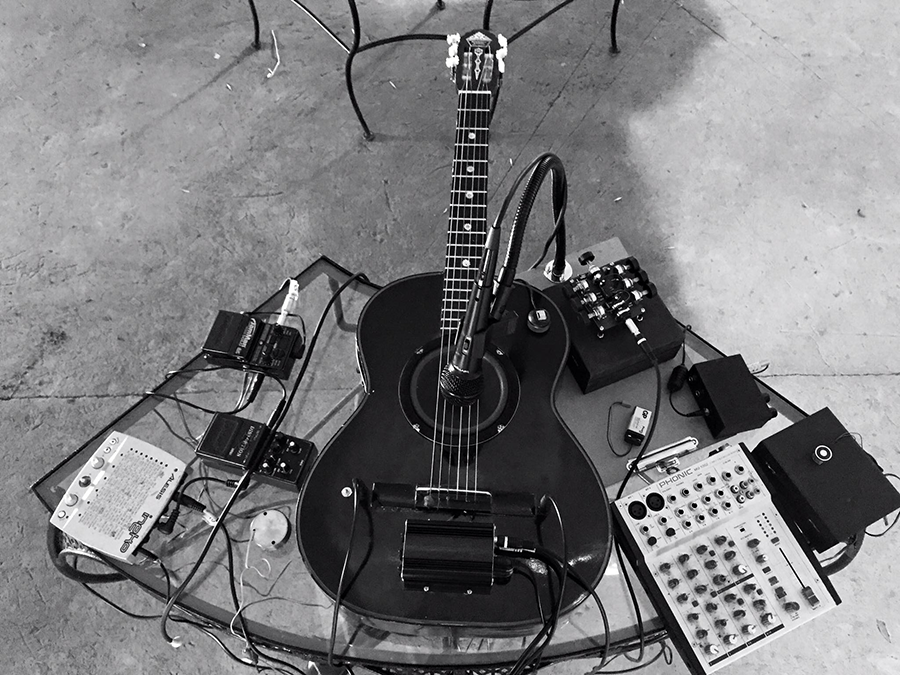
Dueto de Guitarras Fernado Vigueras & Arcangelo Constantini , Festival infinite Huerto Roma 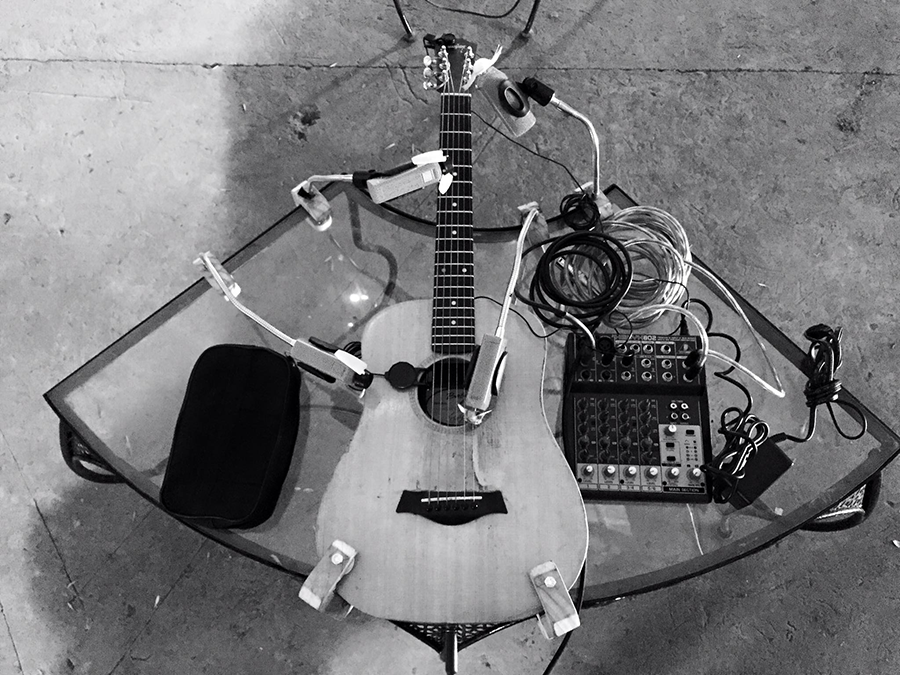
Dueto de Guitarras Fernado Vigueras & Arcangelo Constantini , Festival infinite Huerto Roma 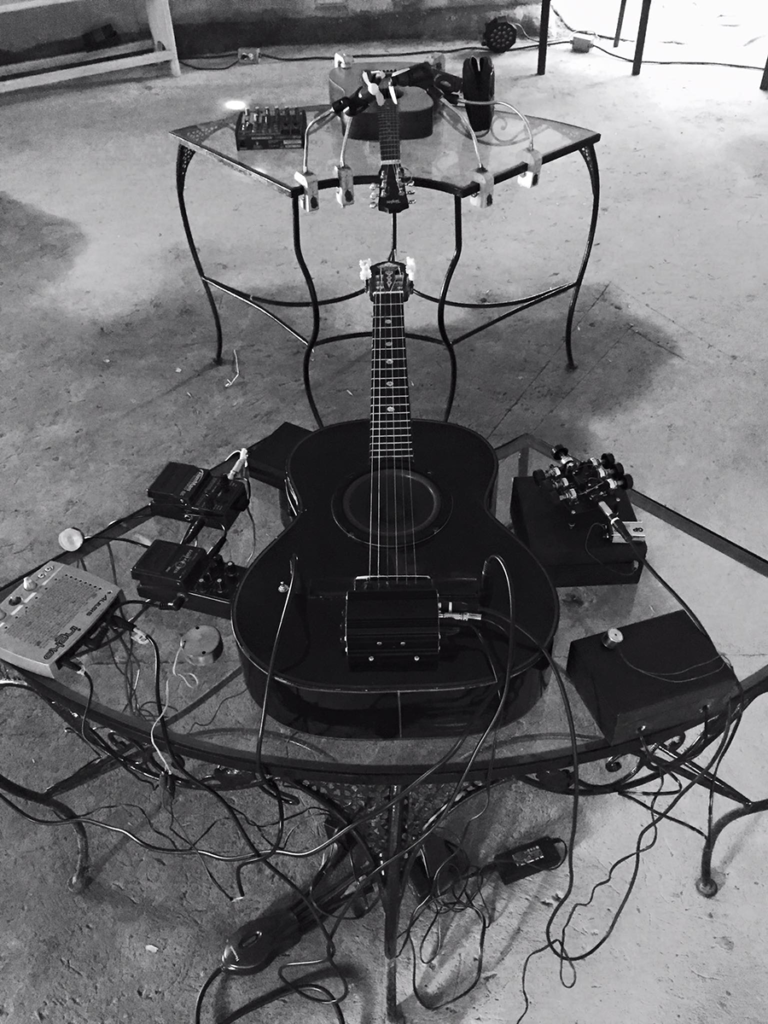
Dueto de Guitarras Fernado Vigueras & Arcangelo Constantini , Festival infinite Huerto Roma 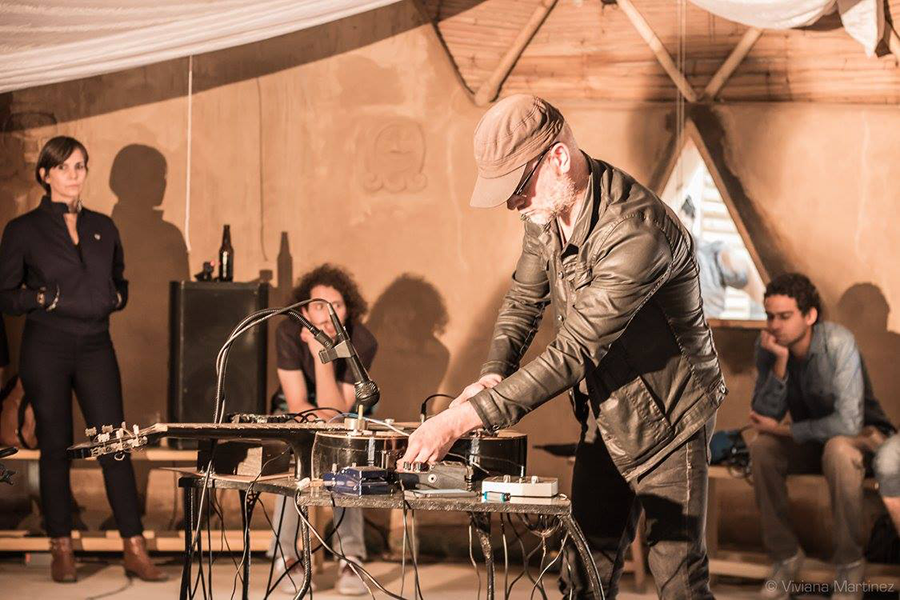
Dueto de Guitarras Fernado Vigueras & Arcangelo Constantini , Festival infinite Huerto Roma 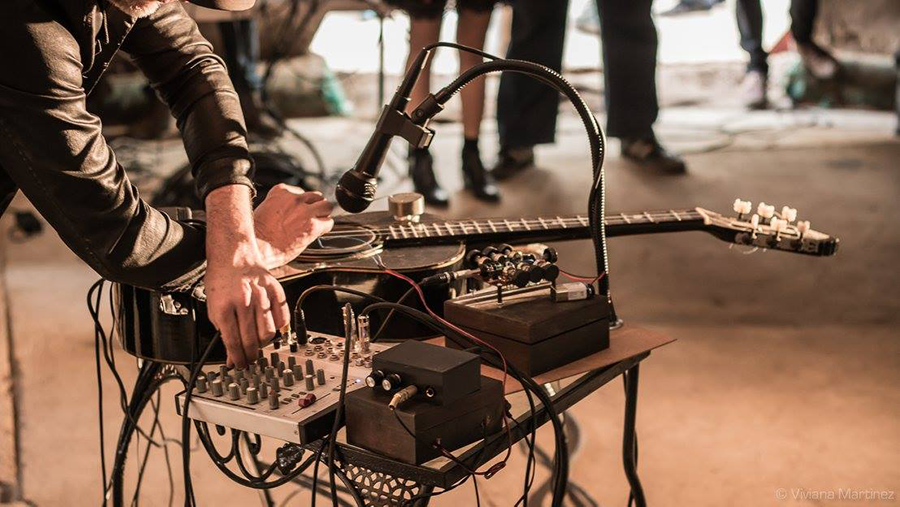
Dueto de Guitarras Fernado Vigueras & Arcangelo Constantini , Festival infinite Huerto Roma 

Articulaciones del Silencio series as a duo with Liliana Rodriguez at the Centro Cultural España 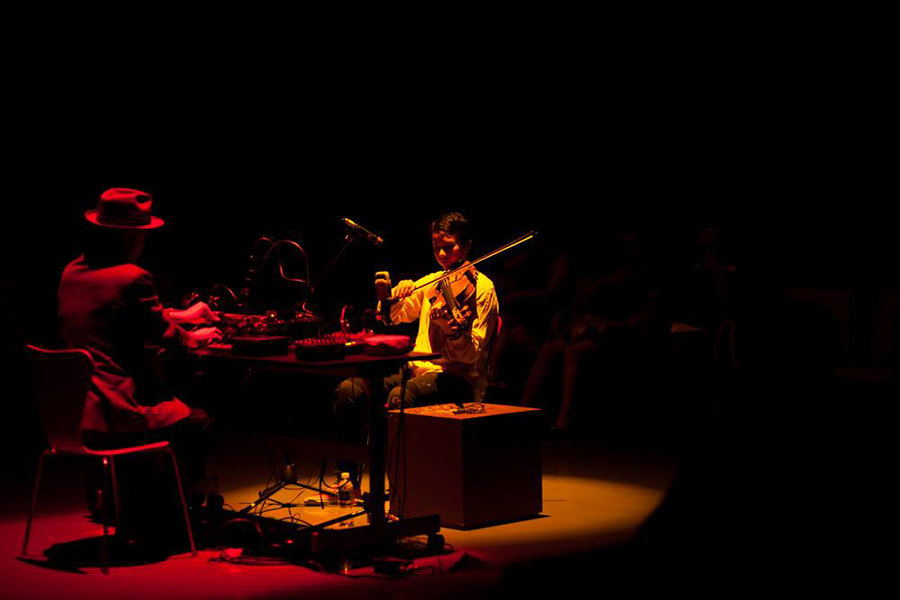
Articulaciones del Silencio series as a duo with Liliana Rodriguez at the Centro Cultural España 
Articulaciones del Silencio series as a duo with Liliana Rodriguez at the Centro Cultural España 
Articulaciones del Silencio series as a duo with Liliana Rodriguez at the Centro Cultural España 
Articulaciones del Silencio series as a duo with Liliana Rodriguez at the Centro Cultural España 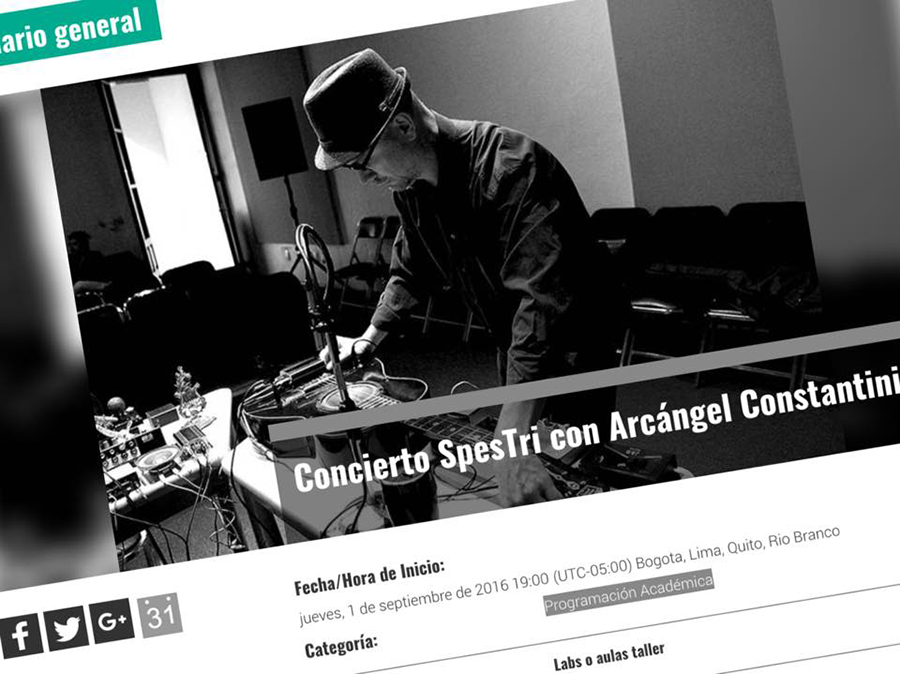

Museum of Modern Art in Medellin. curaduria Jorge Barco 
Museum of Modern Art in Medellin 
Museum of Modern Art in Medellin 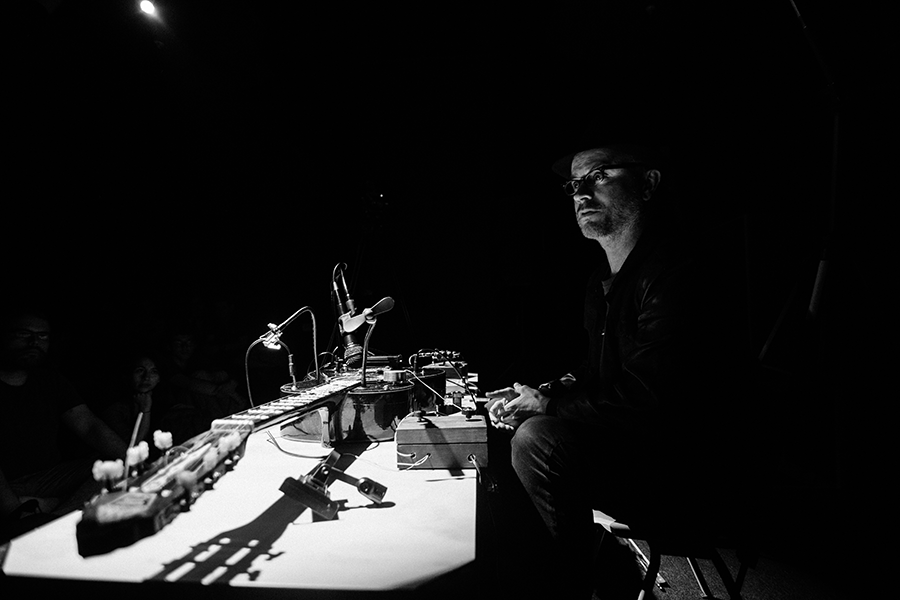
Museum of Modern Art in Medellin 
Museum of Modern Art in Medellin 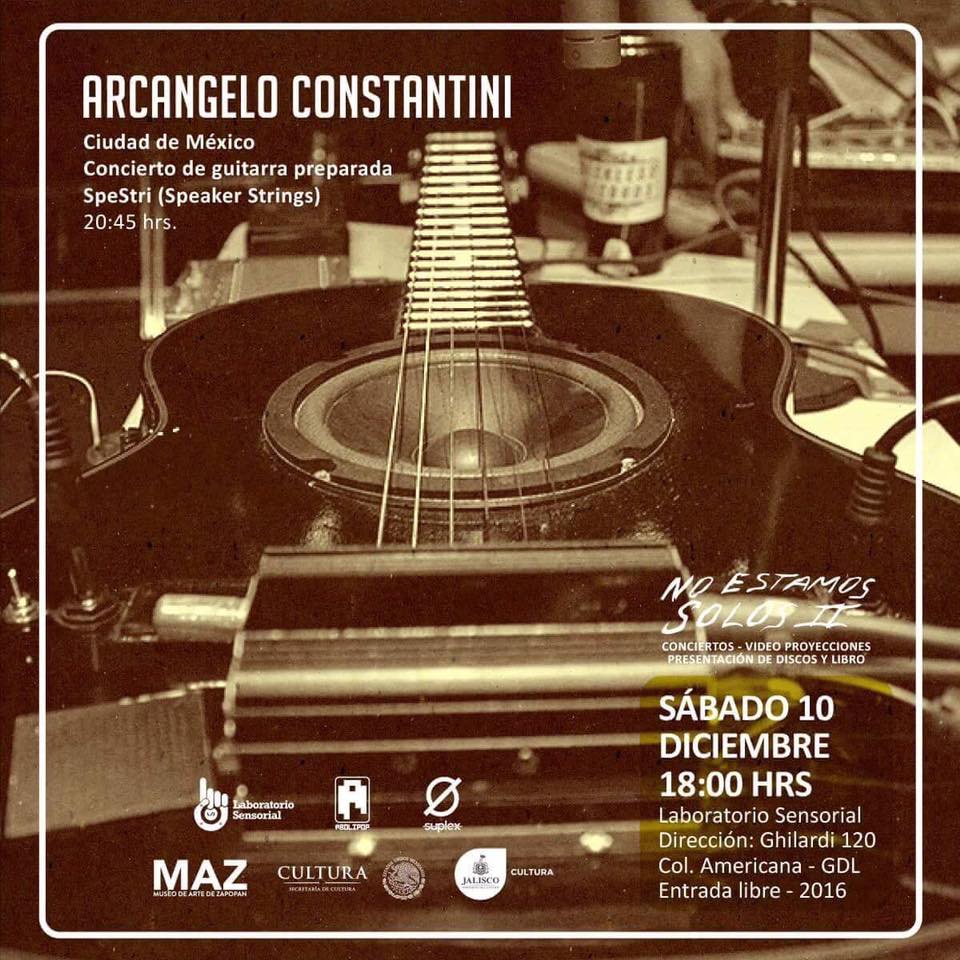
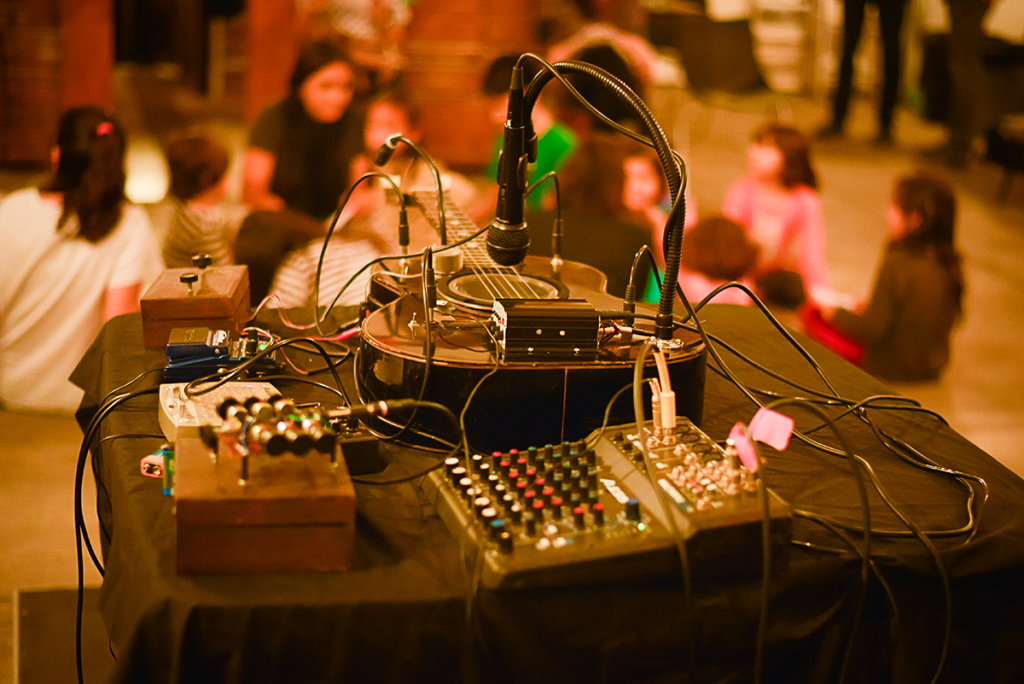
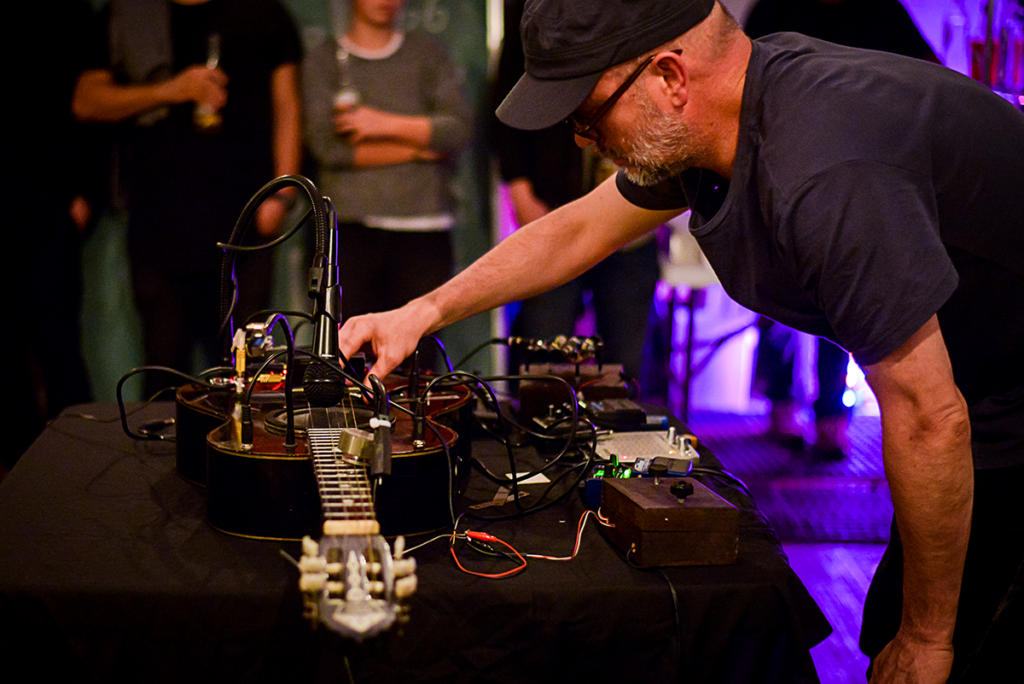
Sensory Laboratory at No Estamos Solos 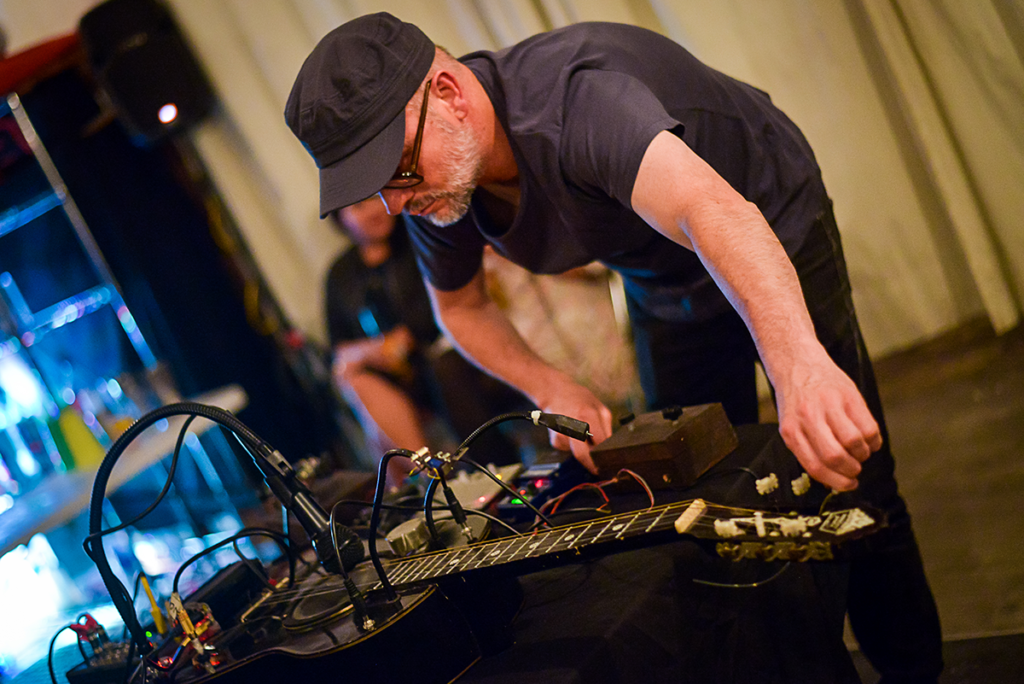
Sensory Laboratory at No Estamos Solos 
Sensory Laboratory at No Estamos Solos 

Sensory Laboratory at No Estamos Solos 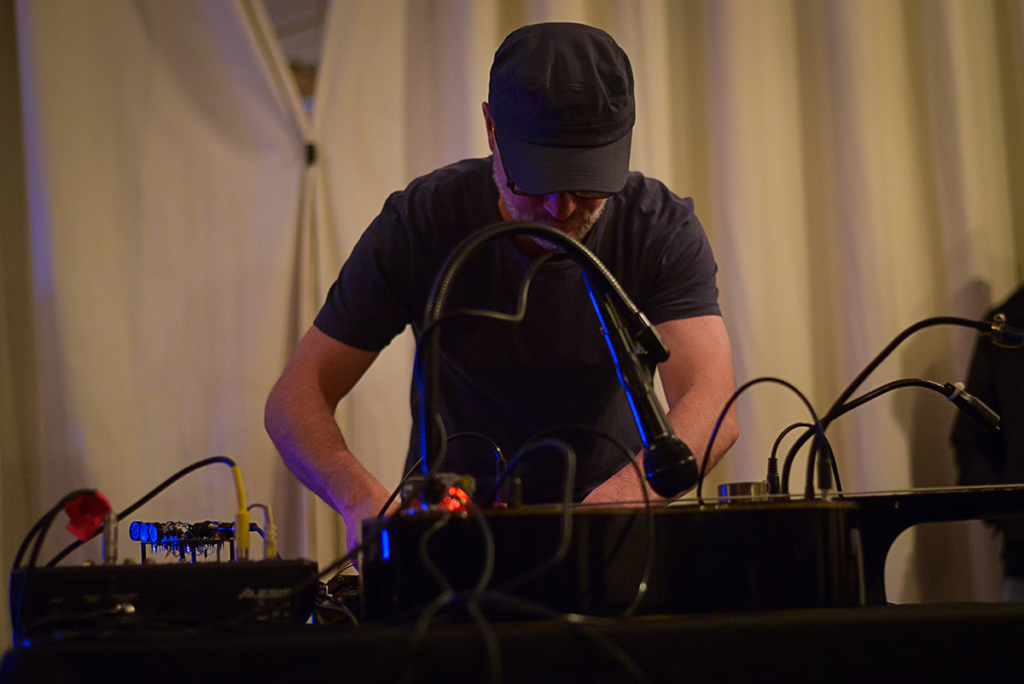
Sensory Laboratory at No Estamos Solos 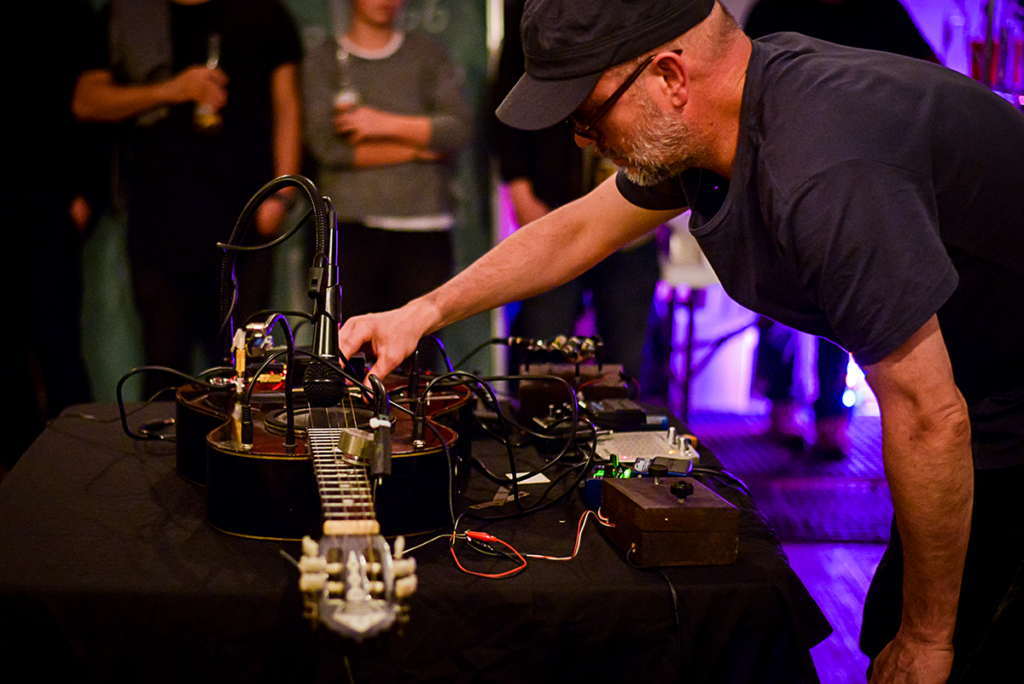
Sensory Laboratory at No Estamos Solos 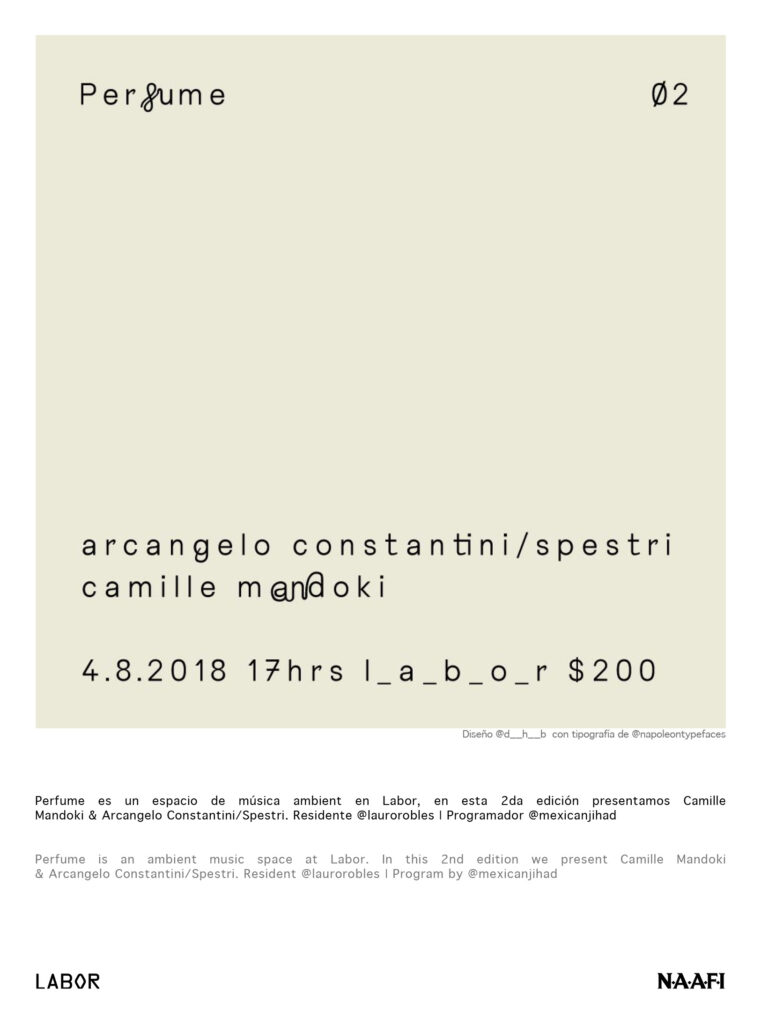
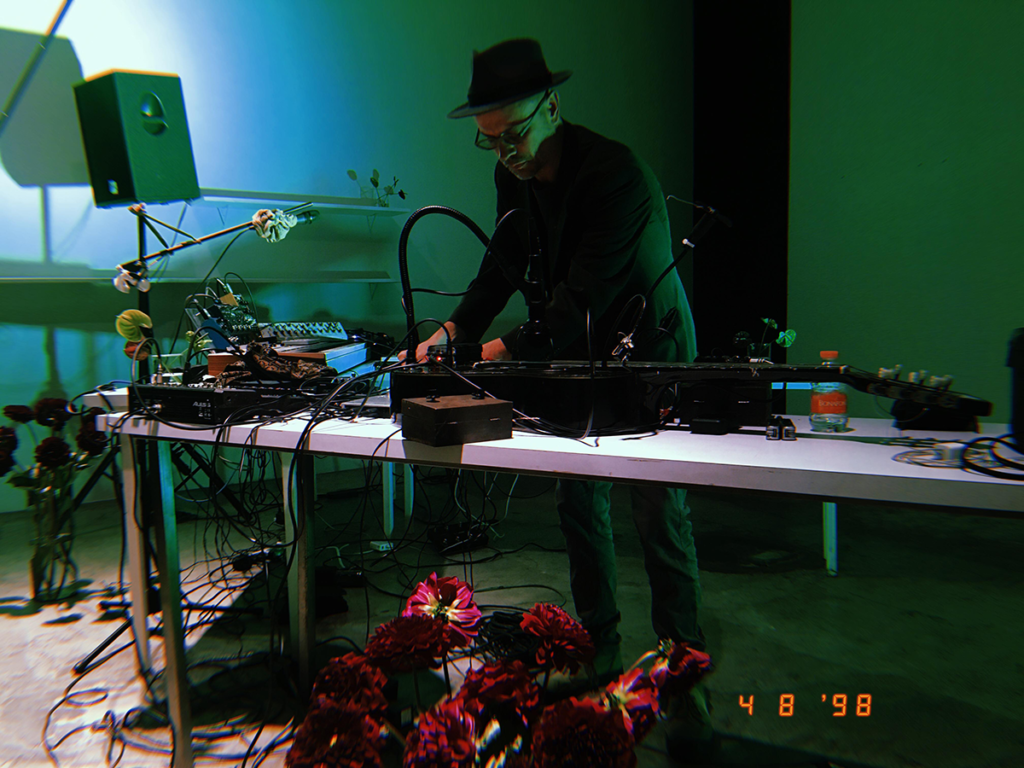
Perfume, Galería Labor 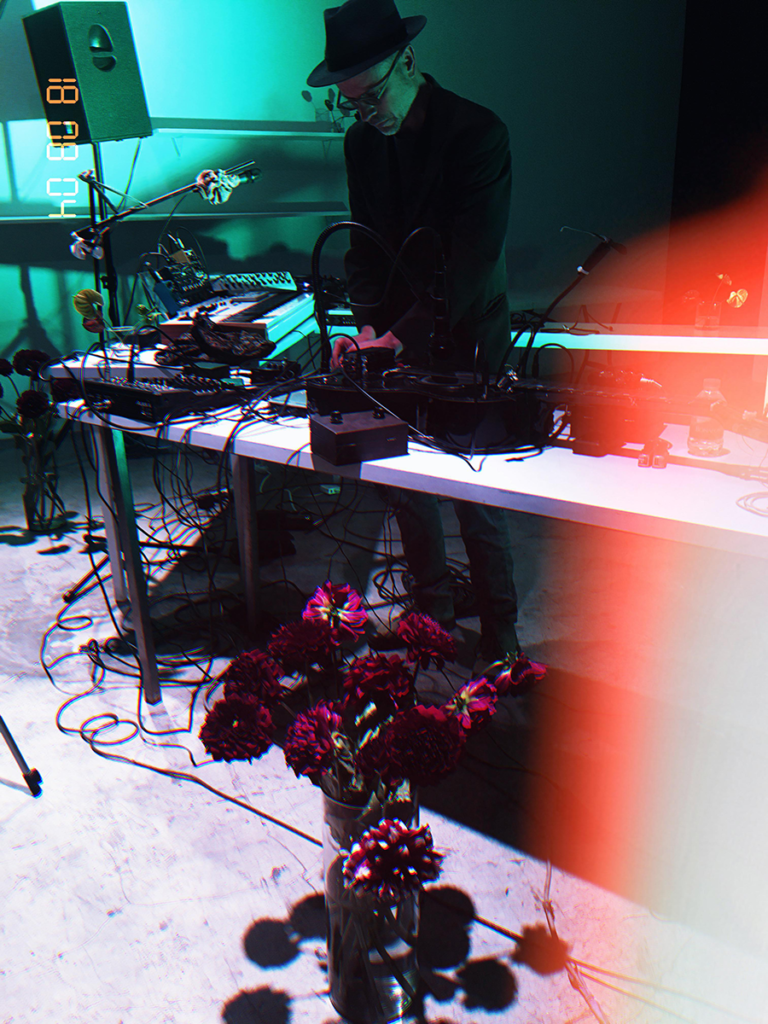
Perfume, Galería Labor 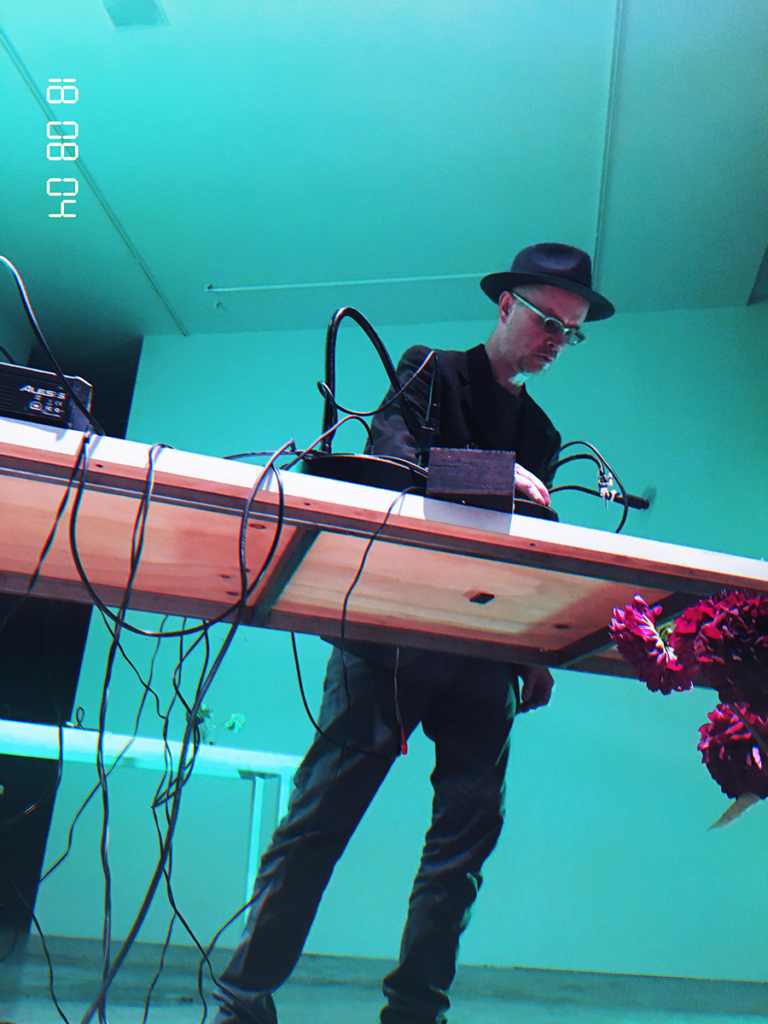
Perfume, Galería Labor 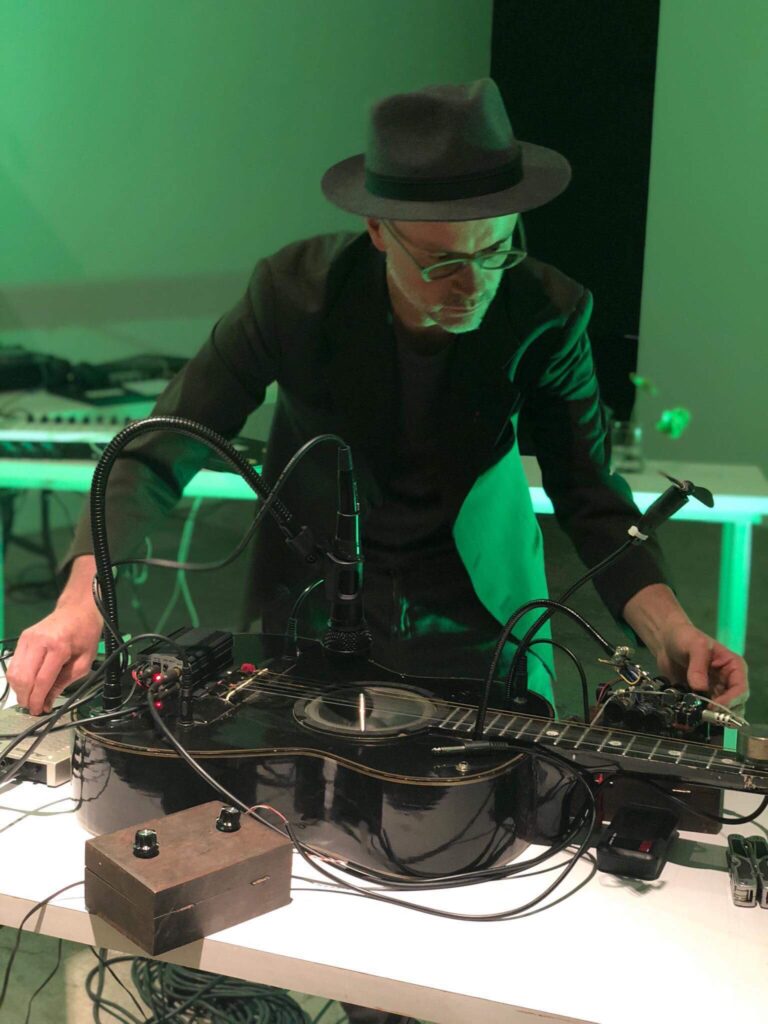
Perfume, Galería Labor 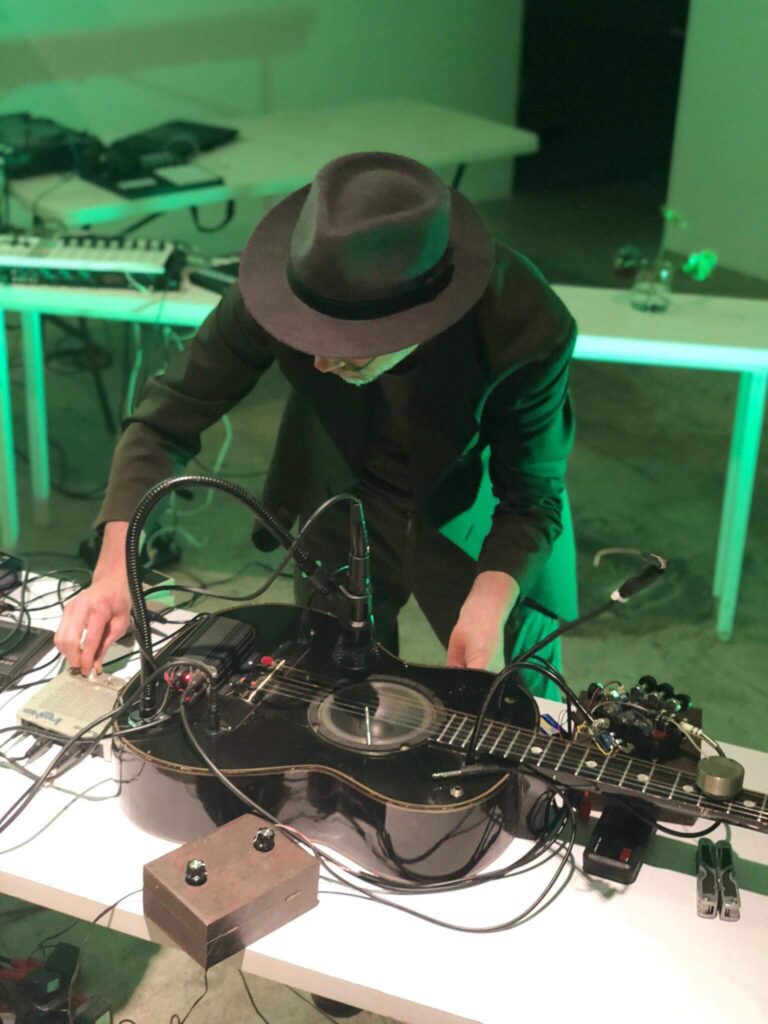
Perfume, Galería Labor 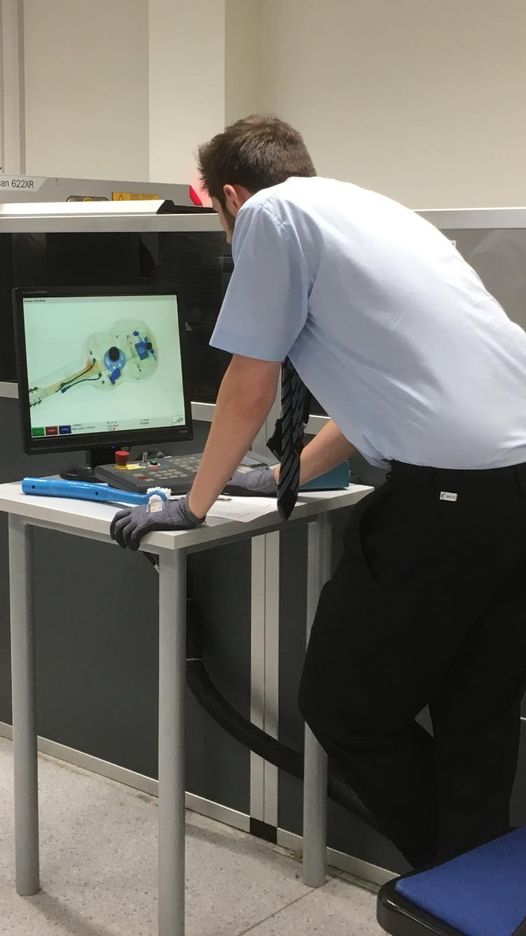
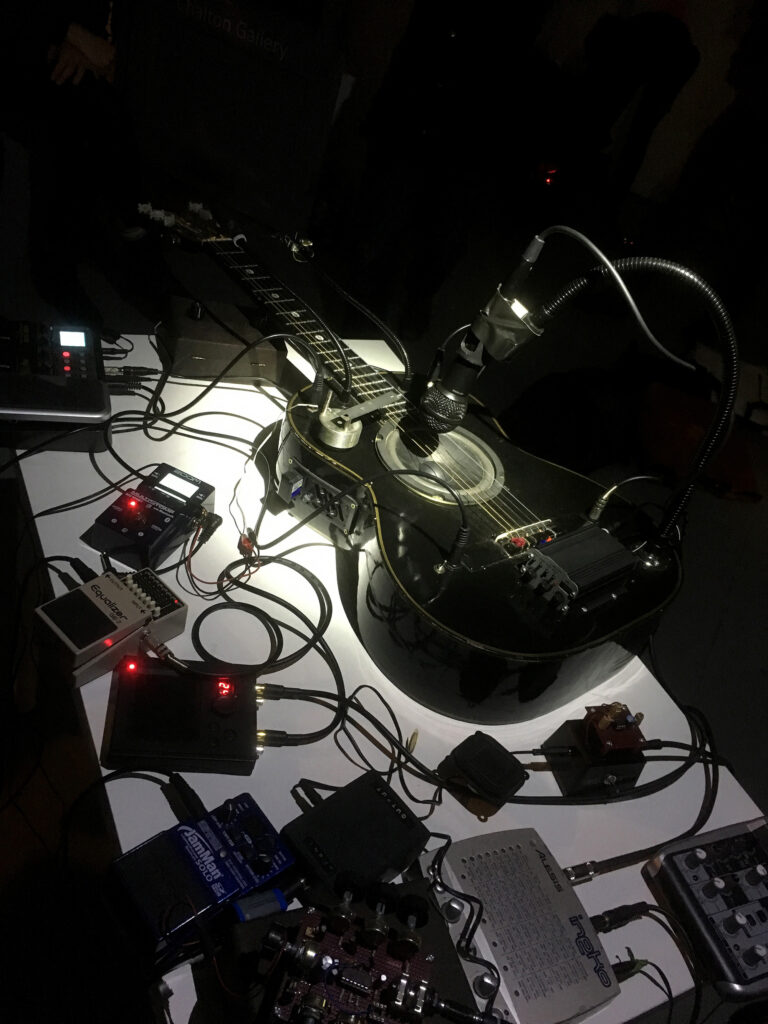
ElektronischeArtandMusic in London with J Milo and Dr. Nexus at Chalton Gallery 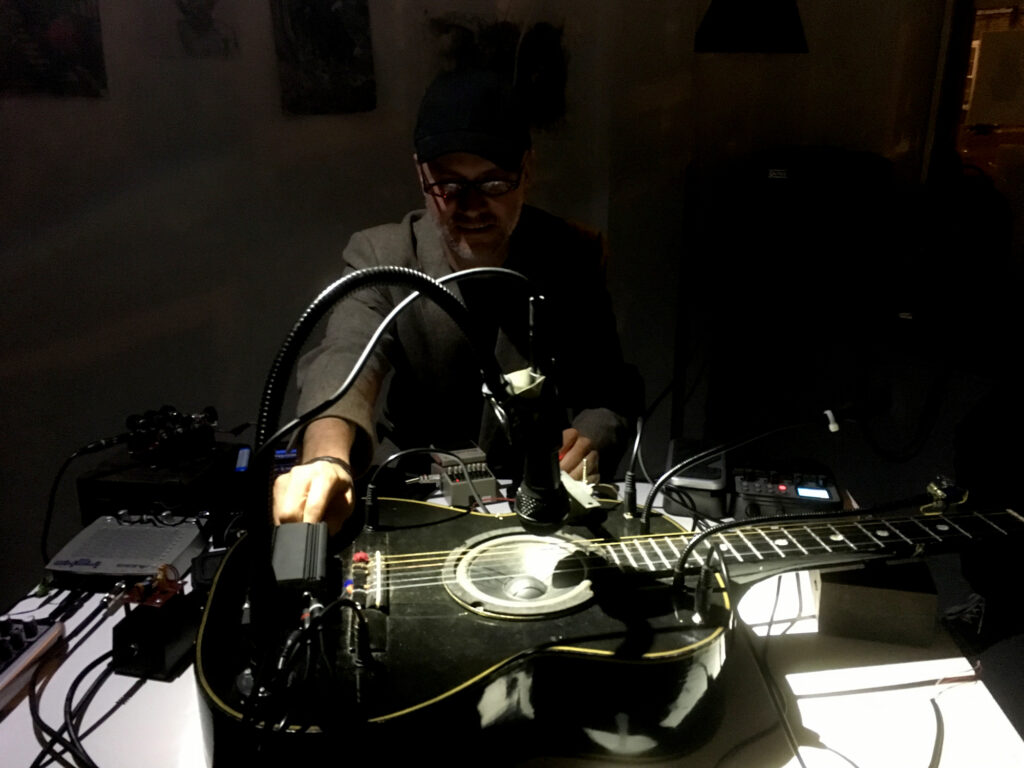
ElektronischeArtandMusic in London with J Milo and Dr. Nexus at Chalton Gallery 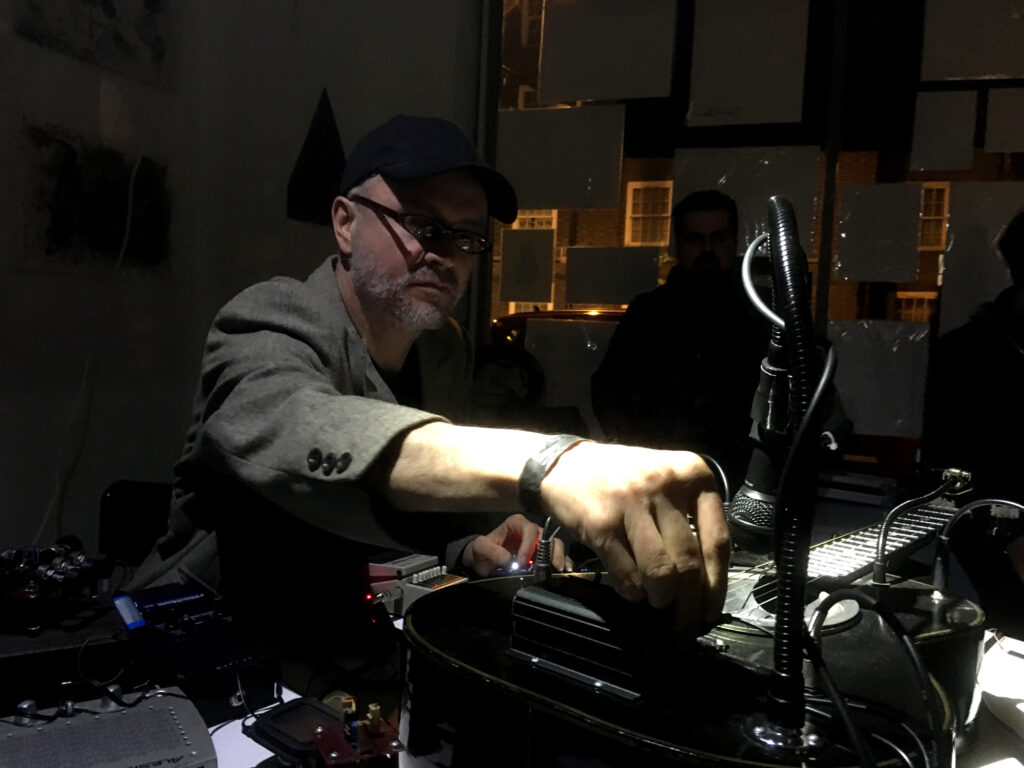
ElektronischeArtandMusic in London with J Milo and Dr. Nexus at Chalton Gallery 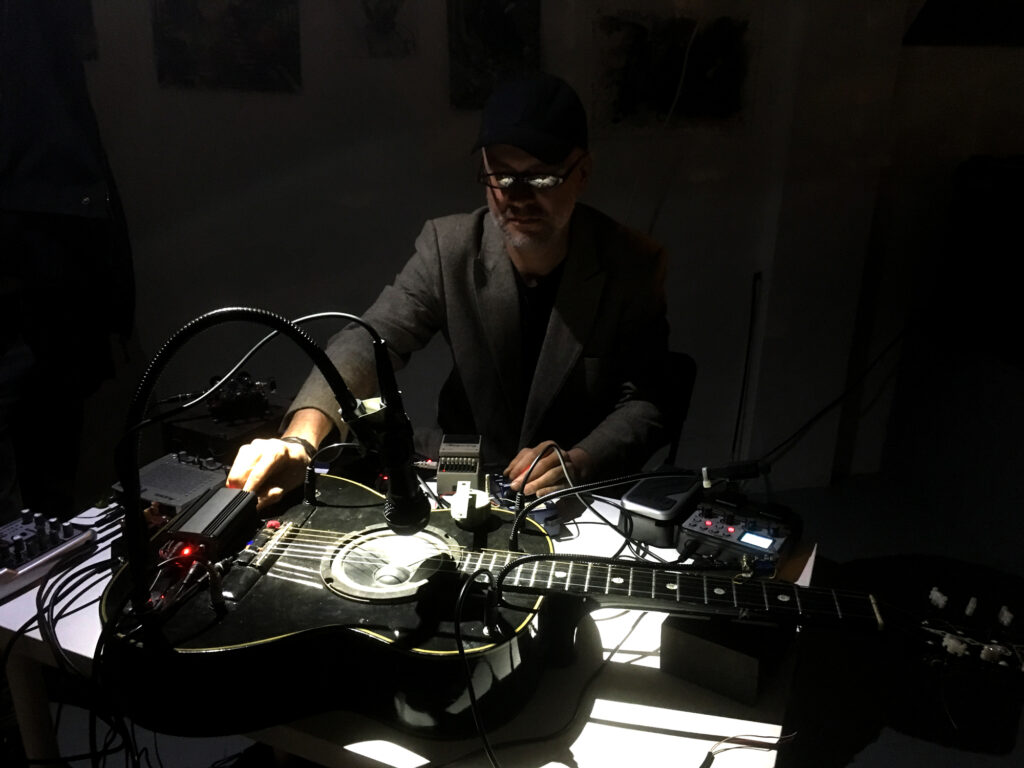
ElektronischeArtandMusic in London with J Milo and Dr. Nexus at Chalton Gallery 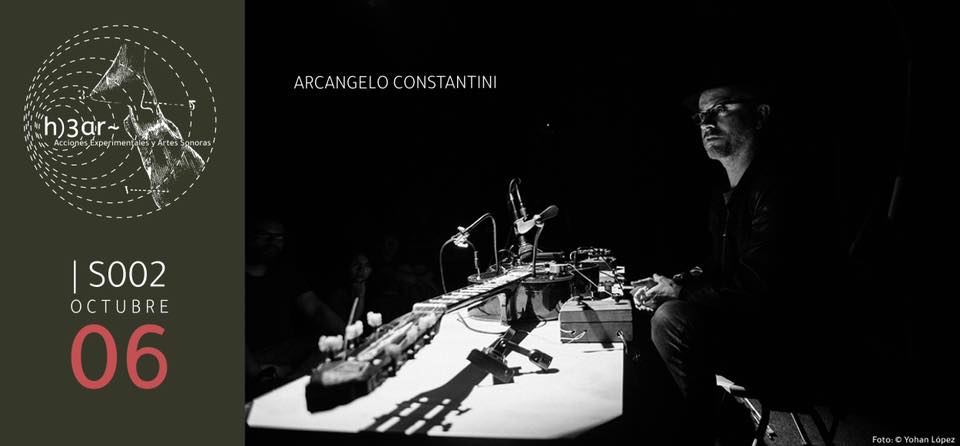

h)3ar in Taller 30 San miguel de allende Guanajuato 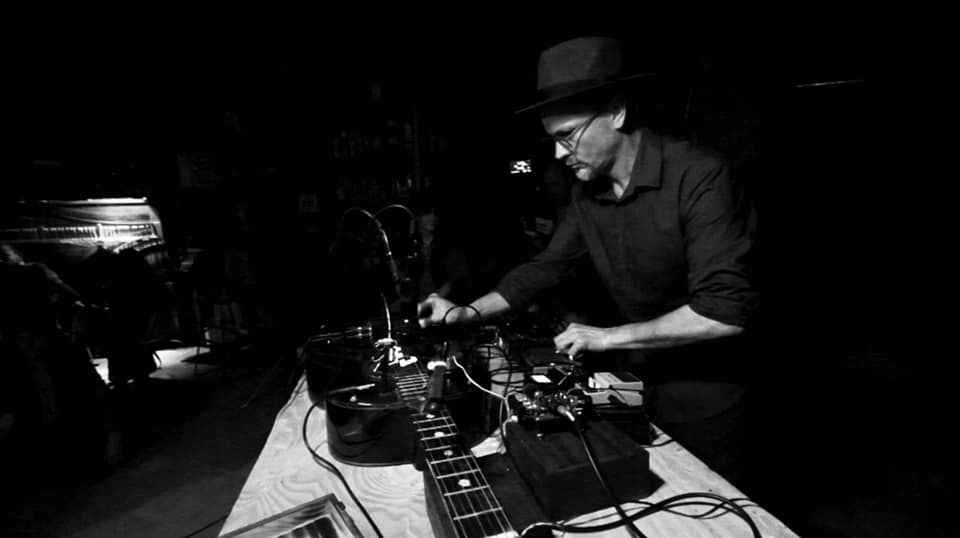
h)3ar in Taller 30 San miguel de allende Guanajuato 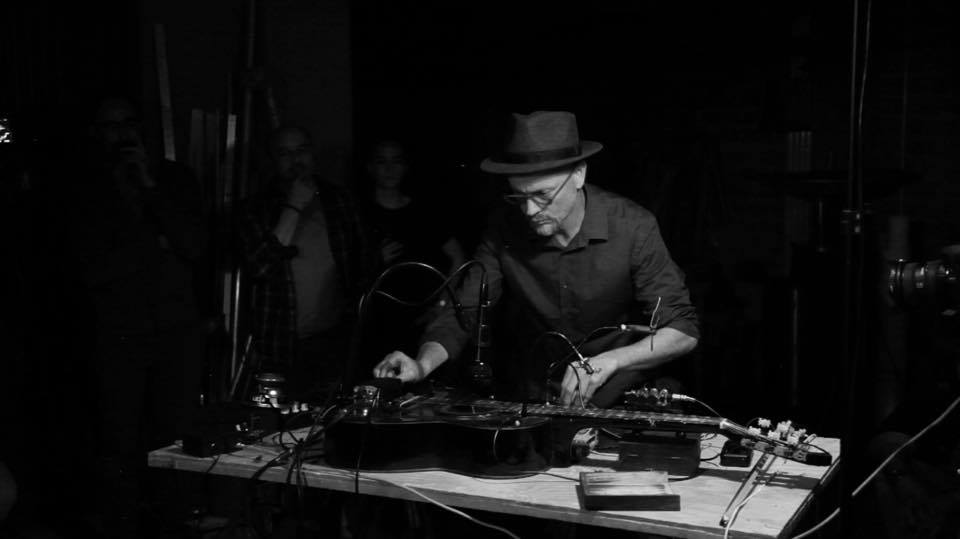
h)3ar in Taller 30 San miguel de allende Guanajuato -
- Arcangelo Constanitni 2013
- Comisionada Por El Museo Universitario del Chopo, para la Muestra
- Sonorama. Arte y tecnología del Hi-fi al MP3
- Curadores Daniel Garza-Usabiaga , Esteban king Alvarez
- Produccion /CNC La Metropolitana , apoyo Santiago Itzcoatl
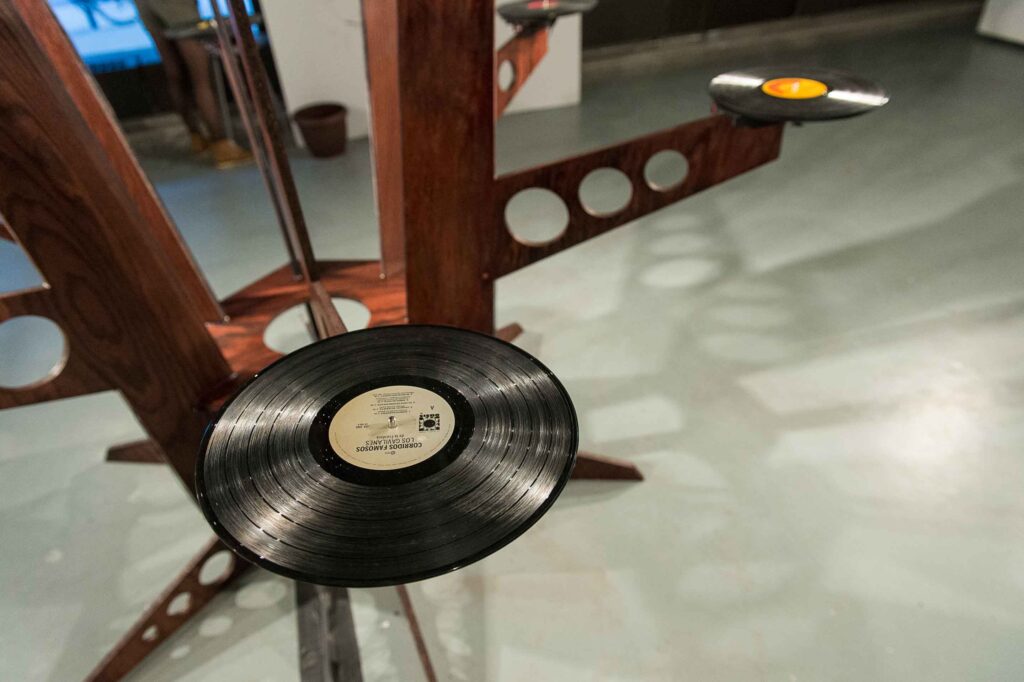
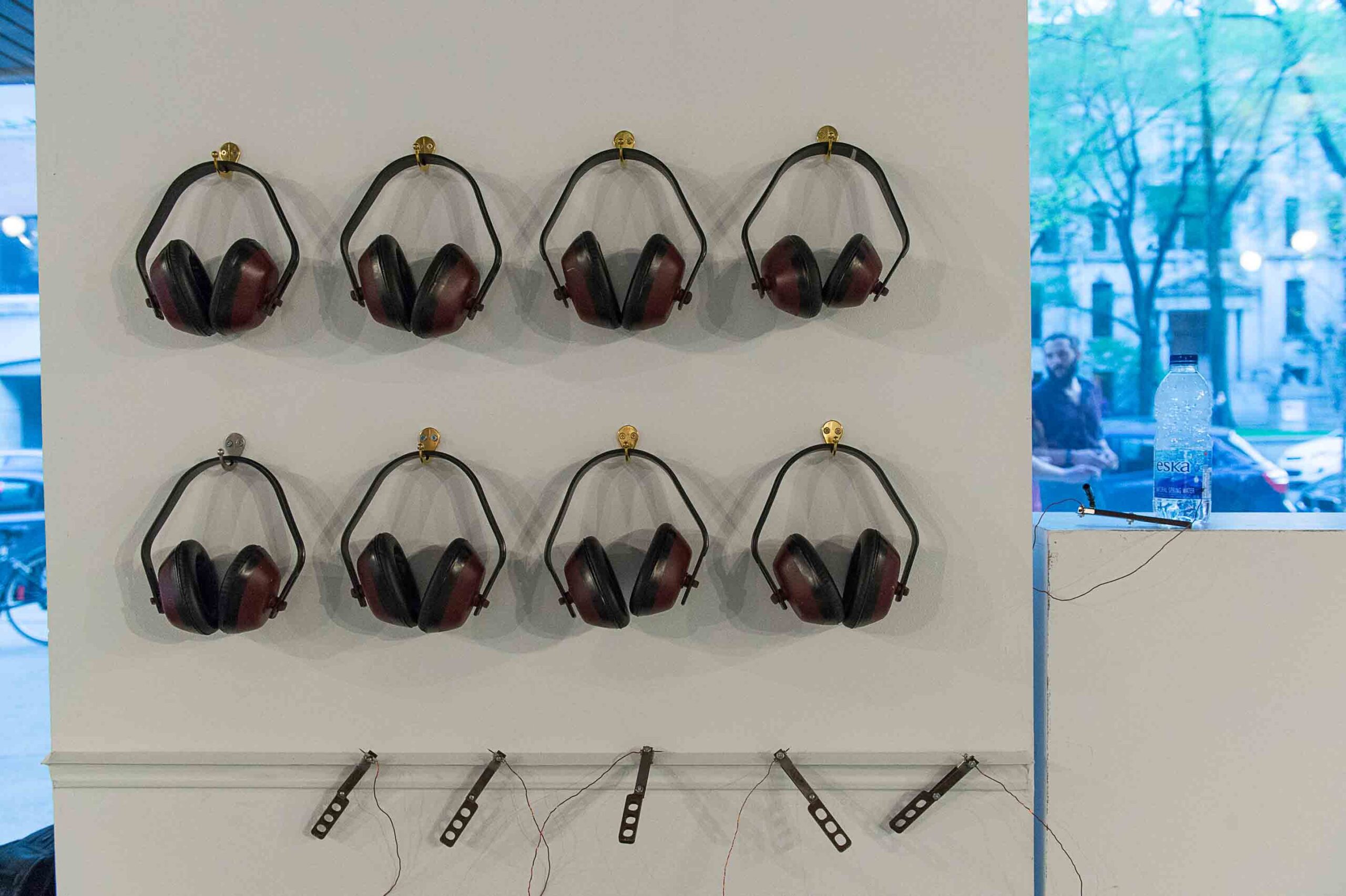
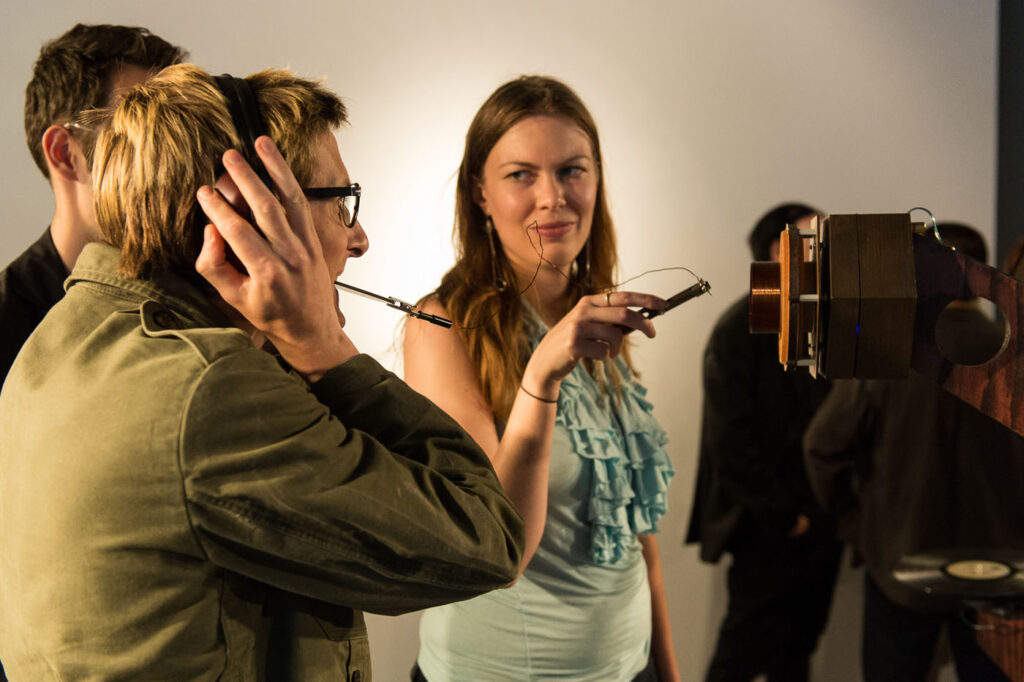
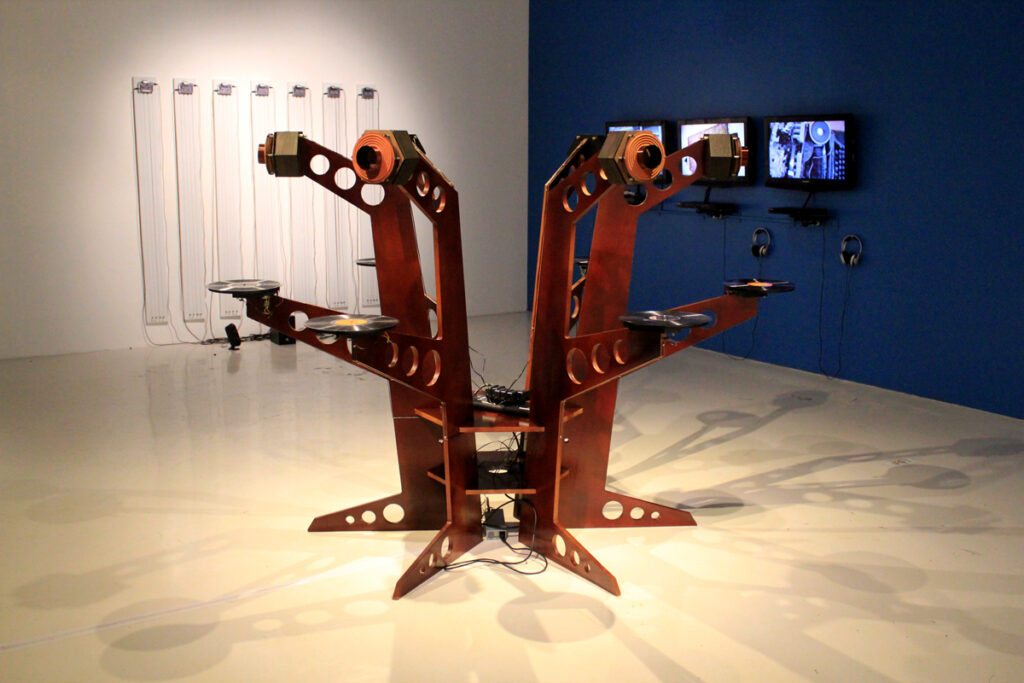
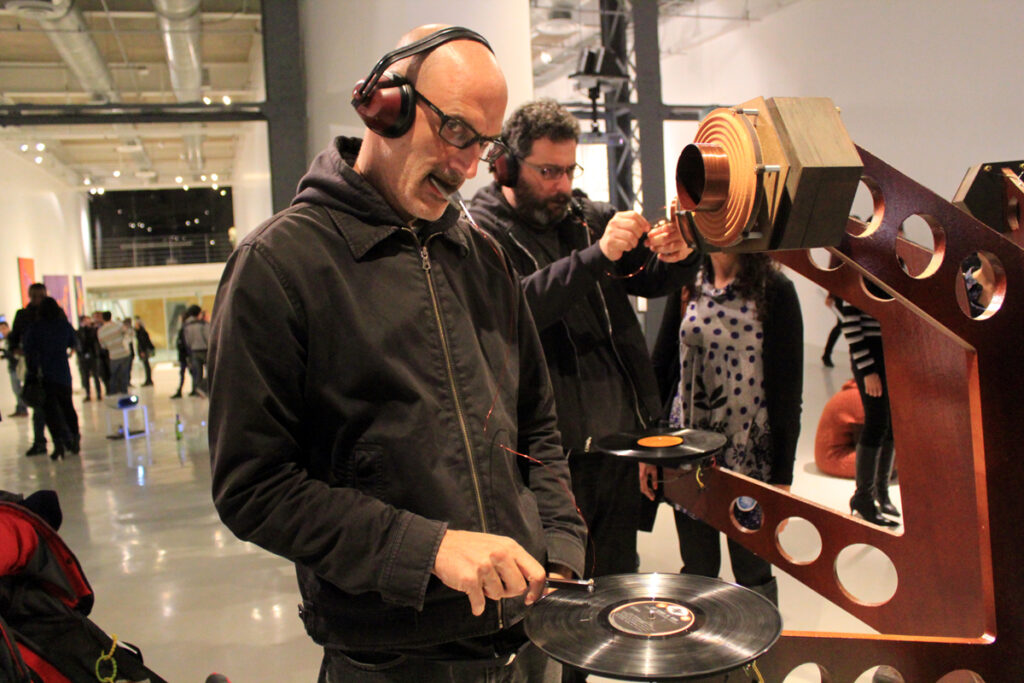
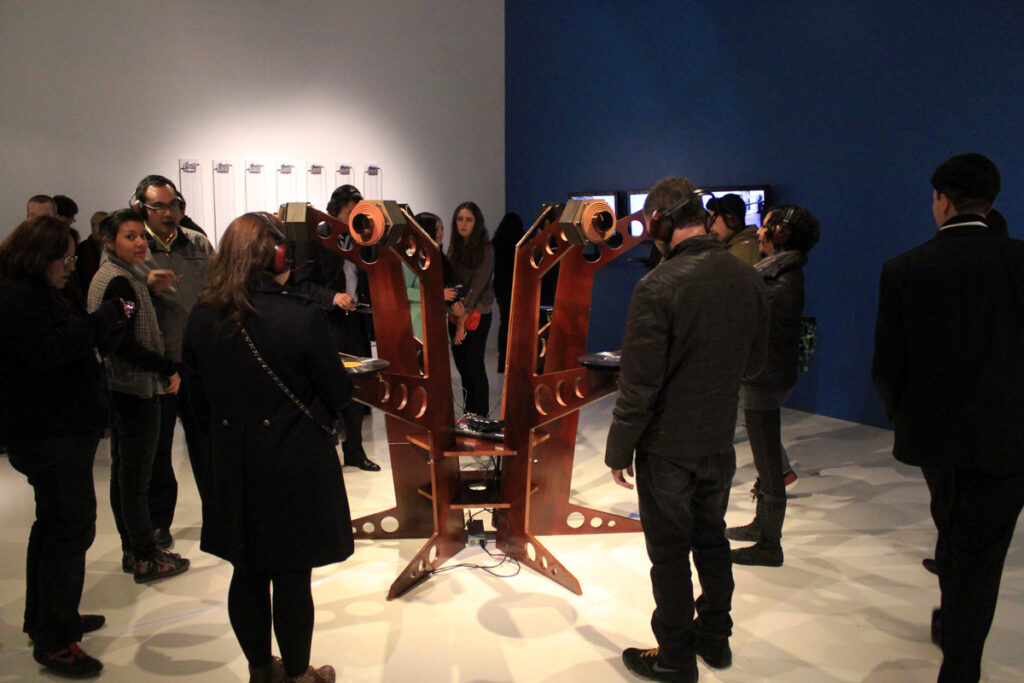
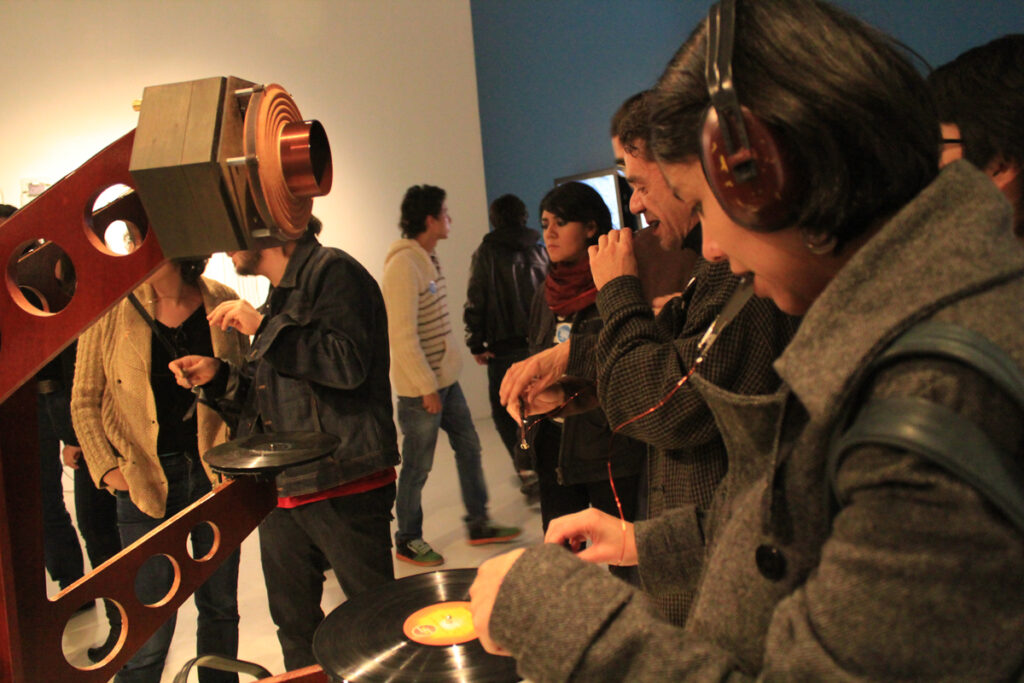
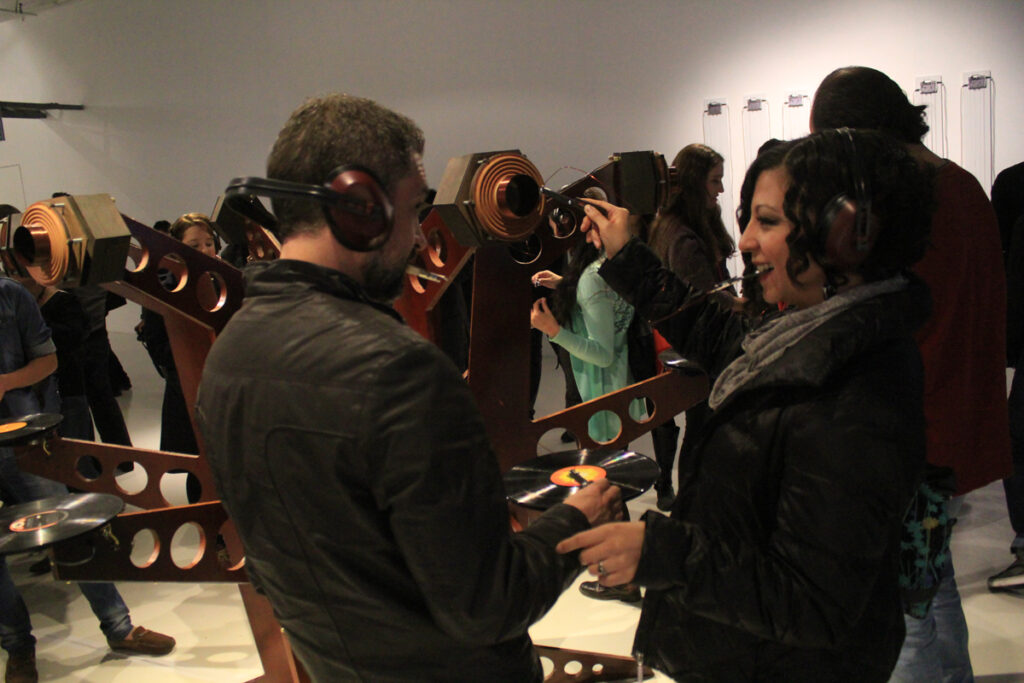
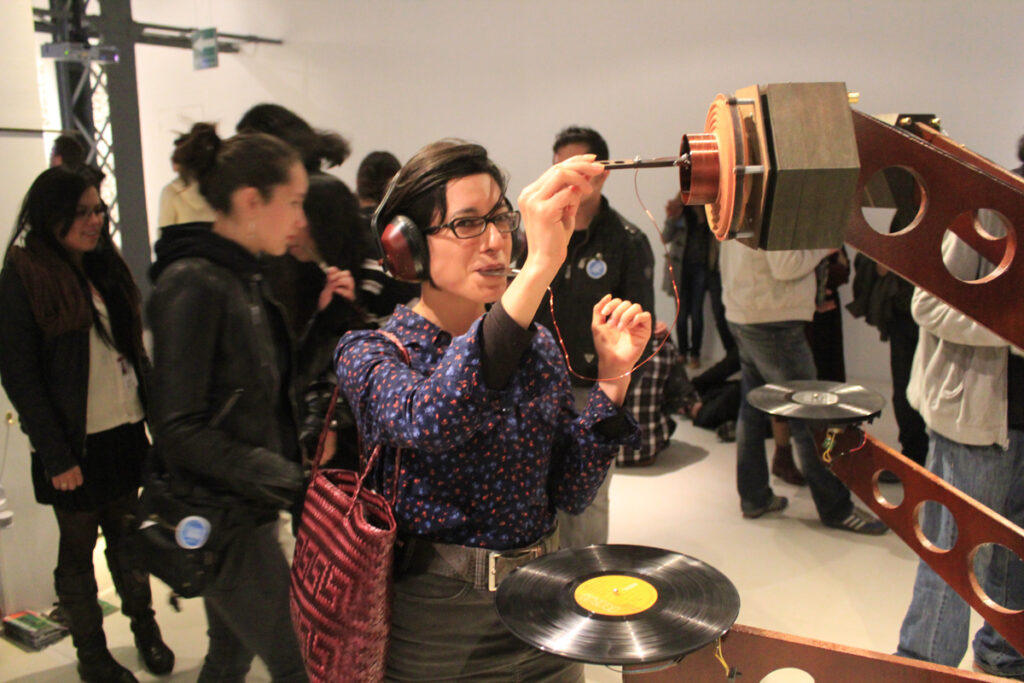
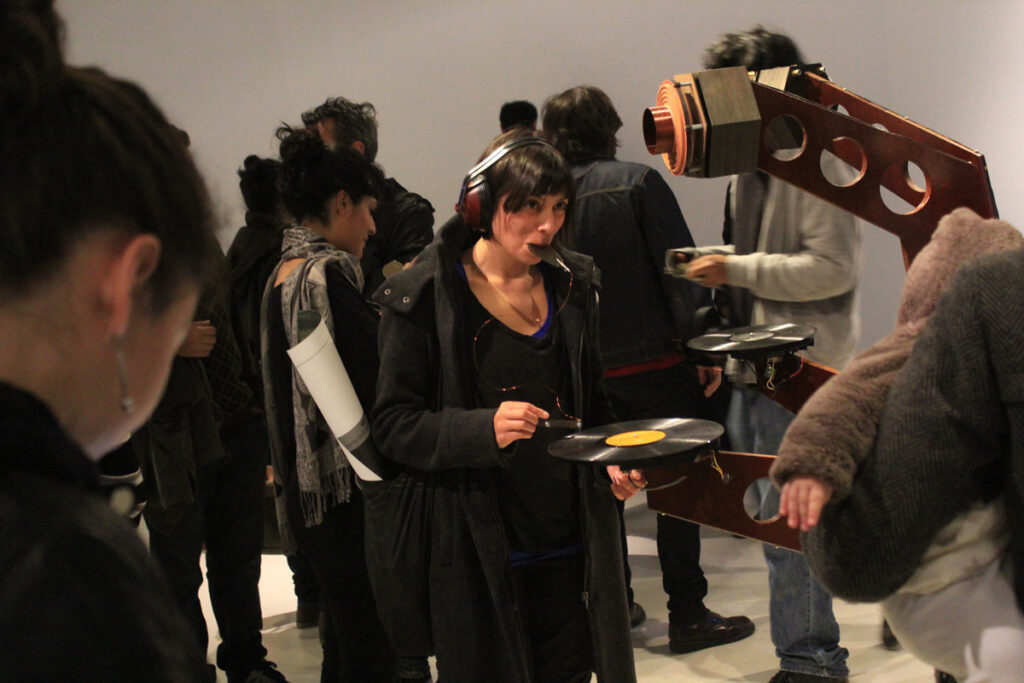
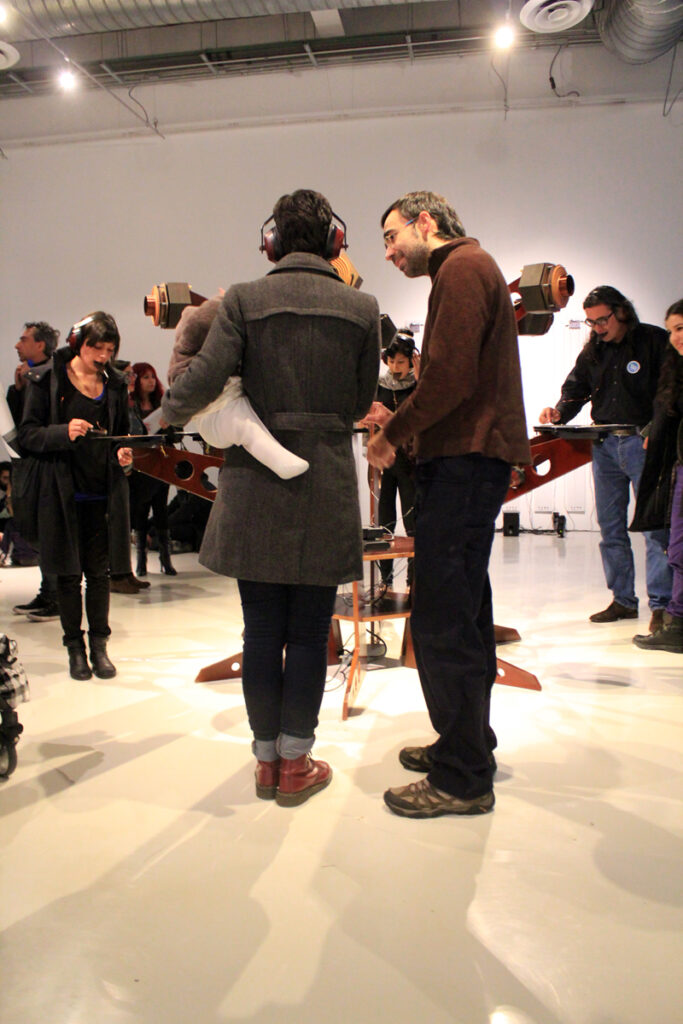
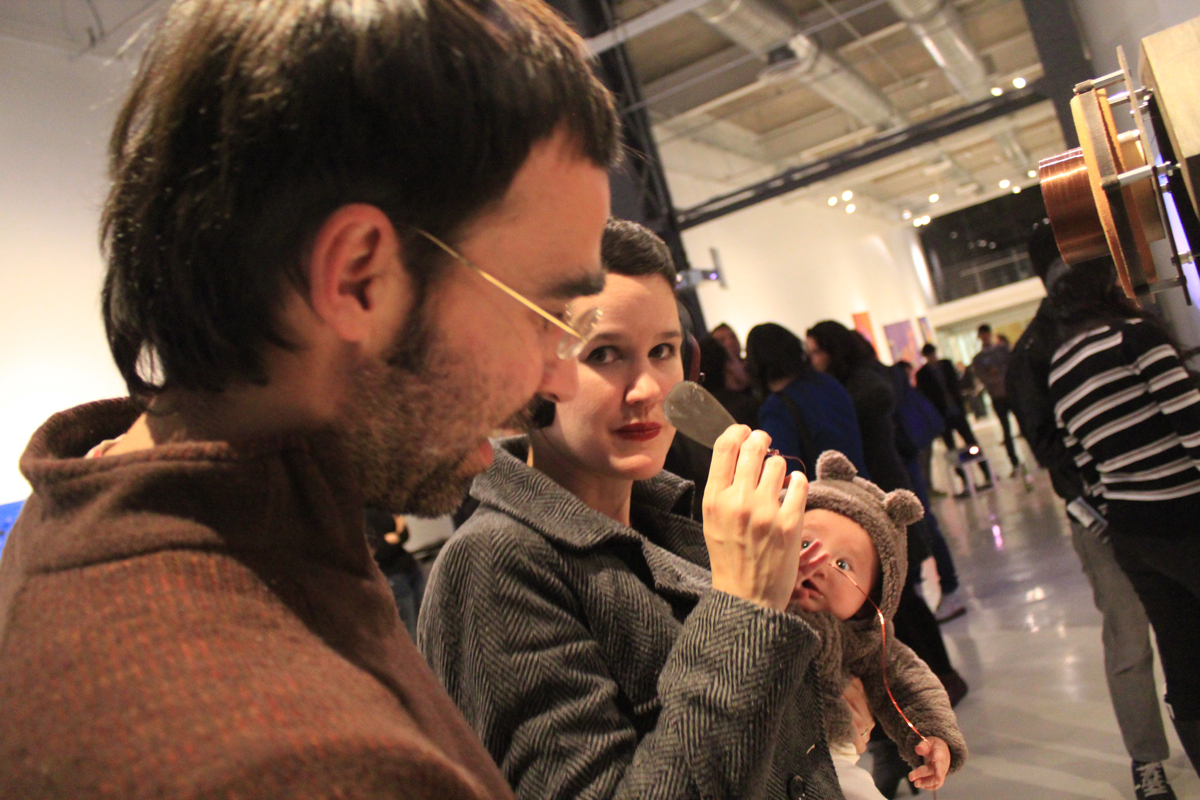
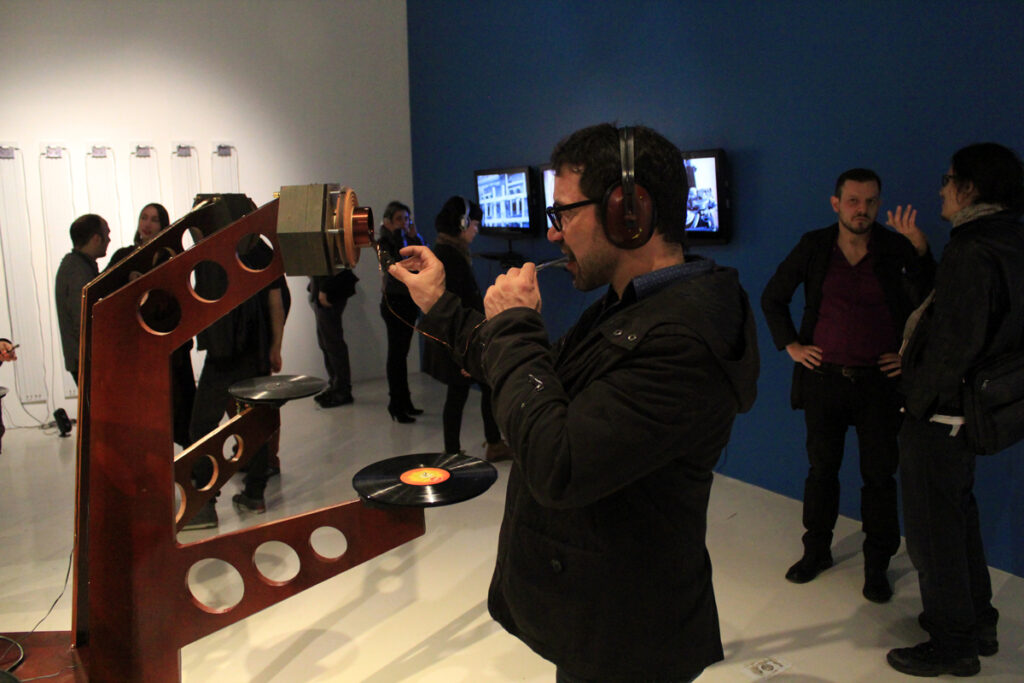
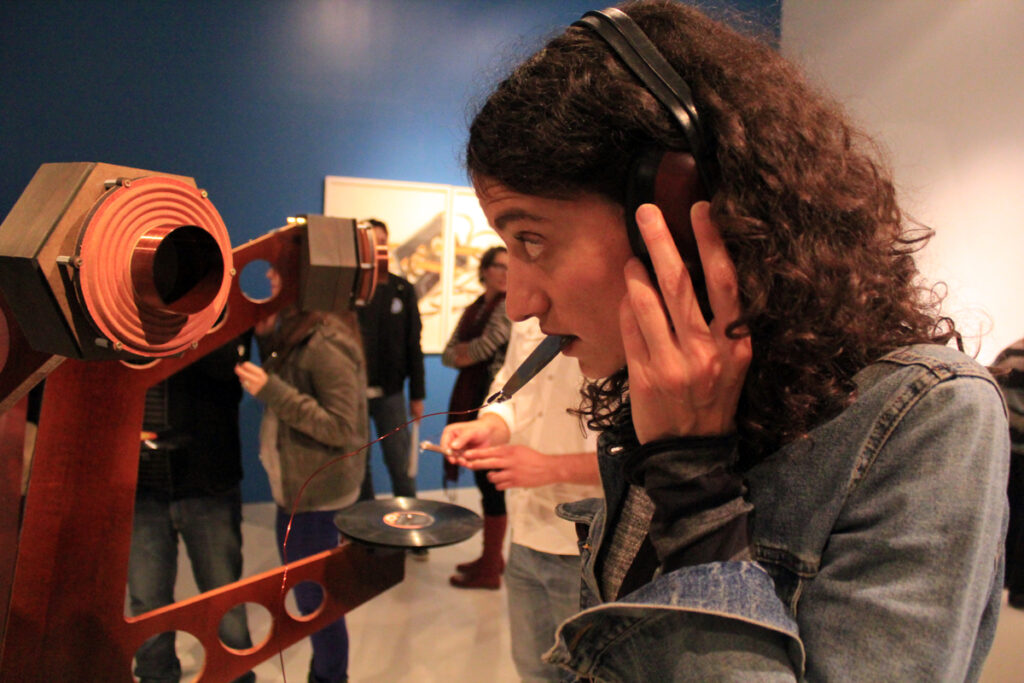
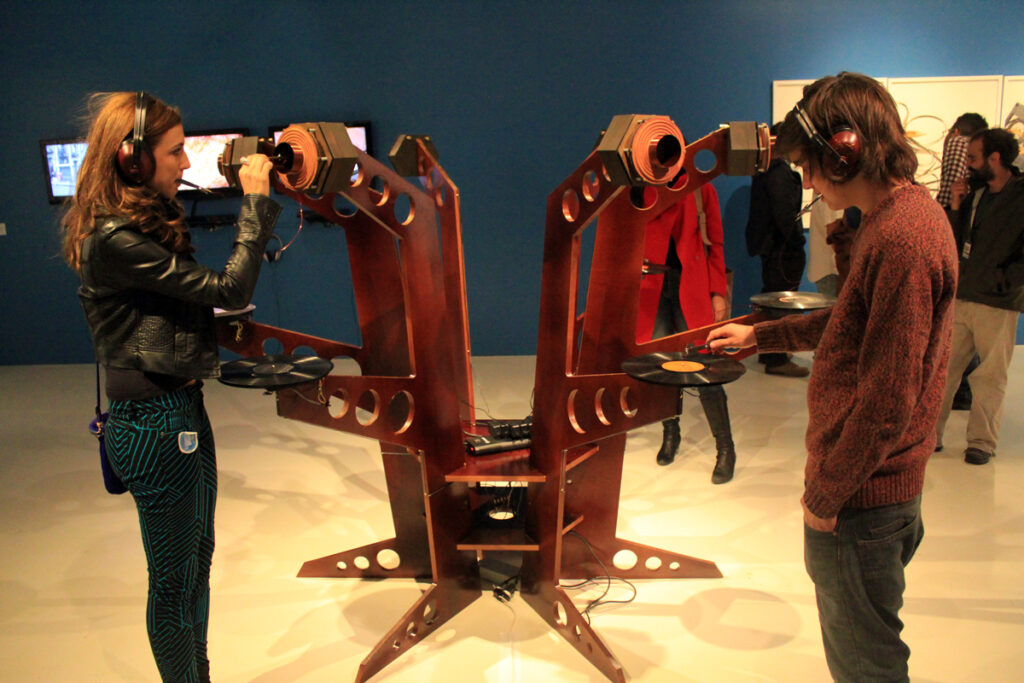
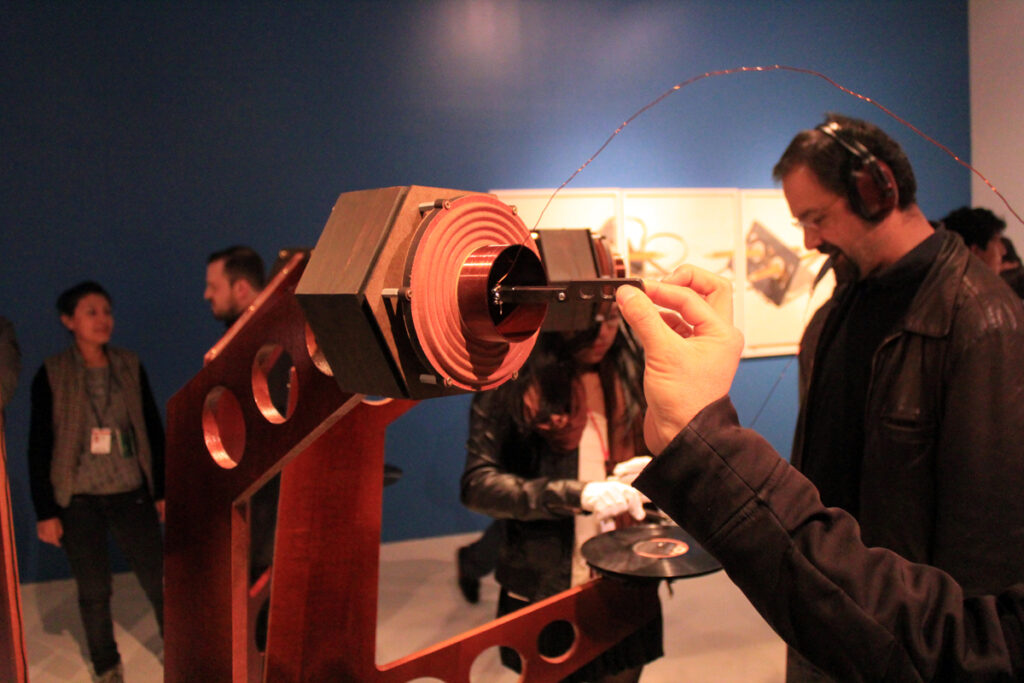
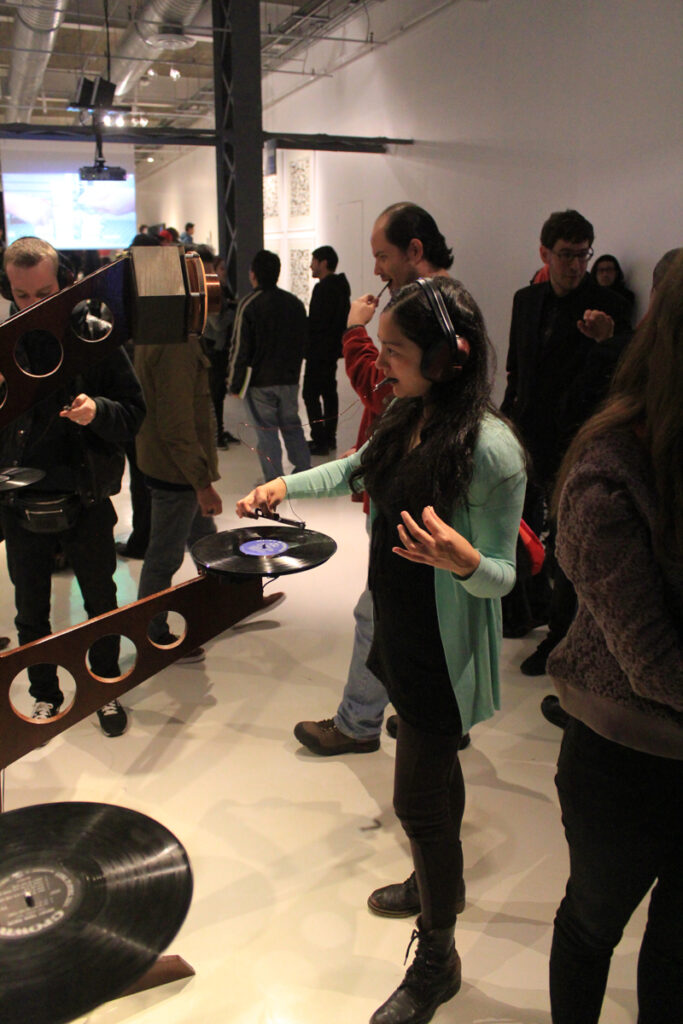
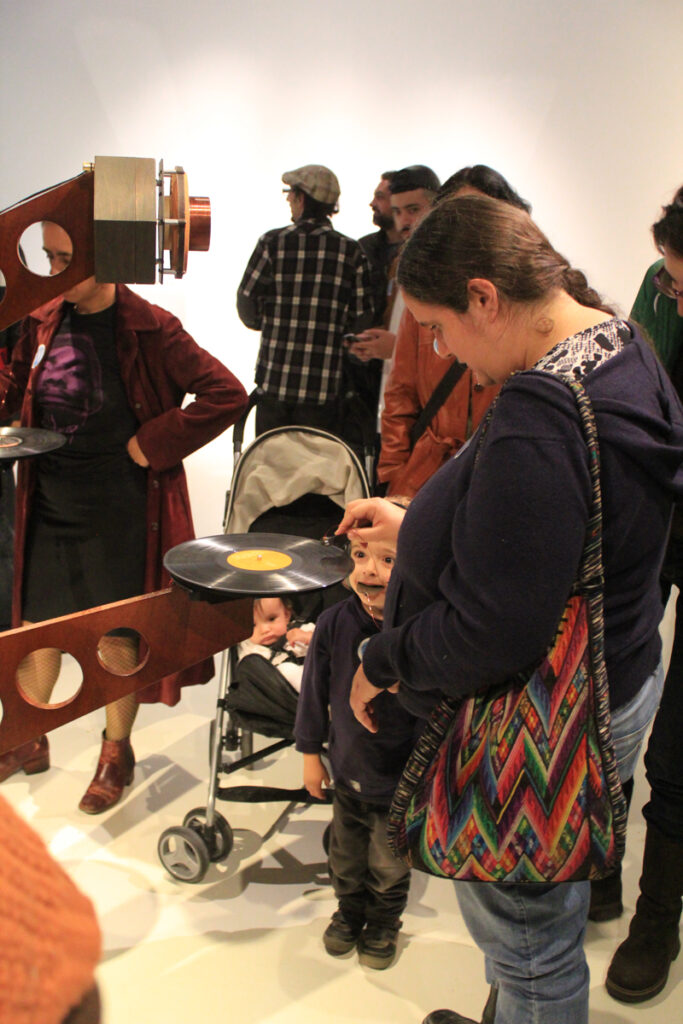
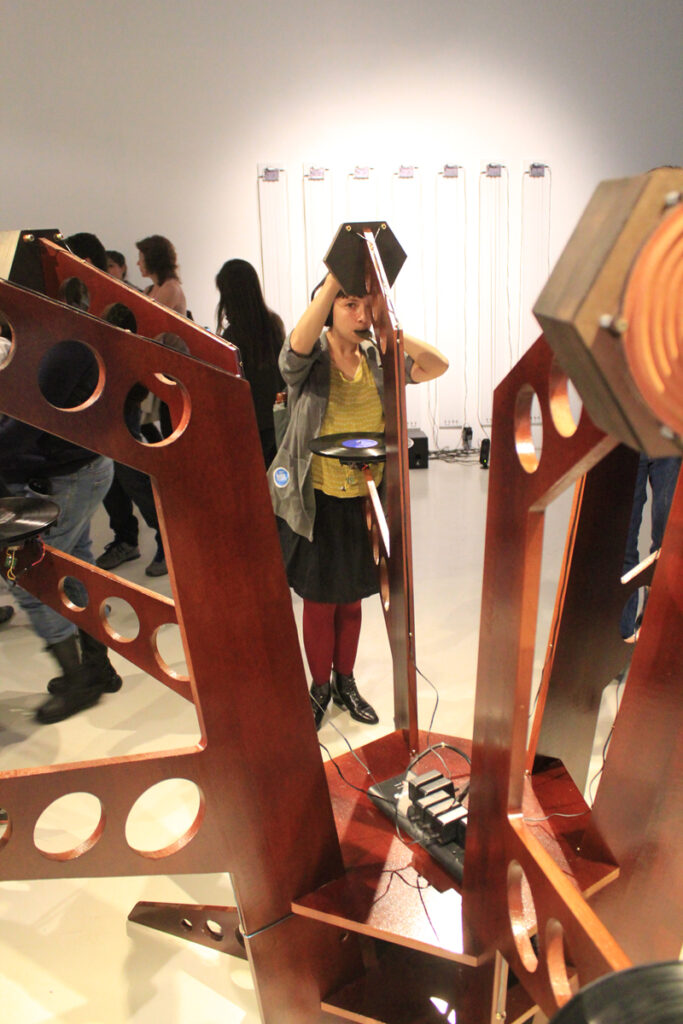
A hexagonal wooden structure holds six arms, each of which holds a turntable with an LP record. Another arm with a coil and the necessary electronics for the system’s operation is placed on top of these. The audience uses noise-canceling headphones and places an acrylic wafer in their mouth, which they bite down on. The wafer has a wire connected to a device with a 78 rpm turntable needle and a neodymium magnet. When the steel needle is placed on the rotating disk, the sound from the grooves is transmitted through the wire, causing the acrylic to vibrate and allowing for bone-conduction of the sound.
When the device is brought close to the coil, a sound recording of the disc as an MP3 file is transmitted to an amplifier connected to the coil. A variable electromagnetic field causes the magnet to vibrate, transmitting this elastic vibration as sound through the wire, the teeth, the bone, and finally reaching the eardrum.
Sound is a vibratory phenomenon transmitted in the form of elastic waves that propagate in solid, liquid, or gaseous matter. Its propagation is due to the transfer of energy and the interaction of these waves with matter.
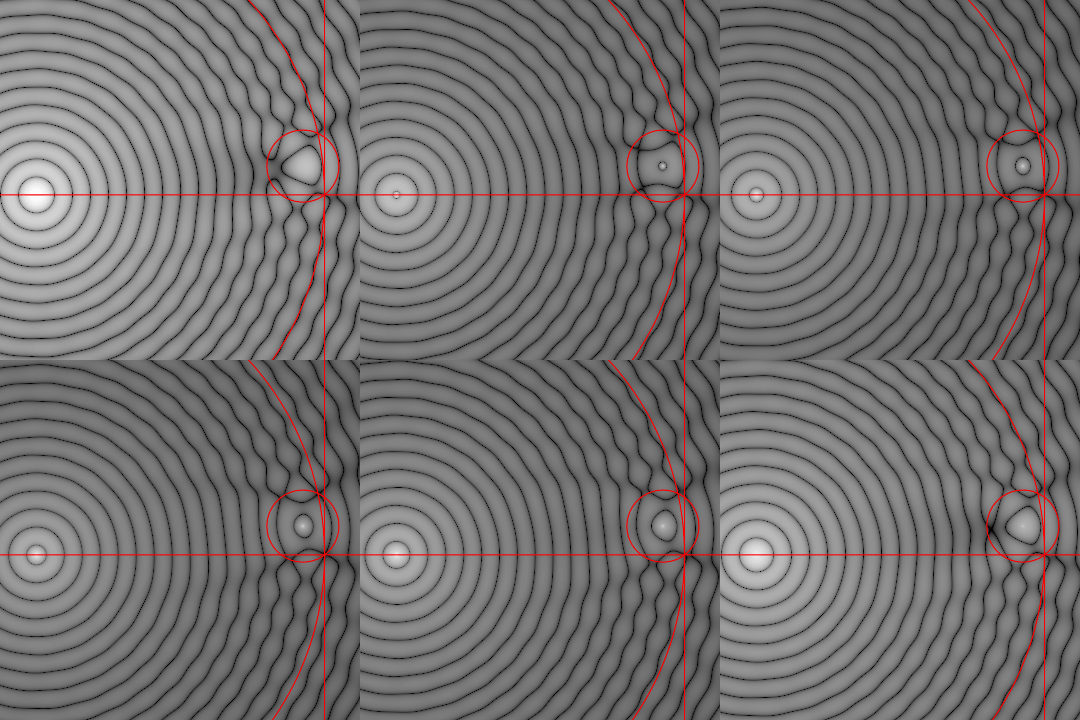

A principle of physics was used by Leon Scott to produce the first sound recordings in history. He invented the PhonoAutograph, an instrument that used a fountain pen connected to a diaphragm. When the diaphragm vibrated, it transmitted this vibration to the pen, which traced the sound waves produced onto paper darkened with the smoke of a lamp. This discovery, made in 1860, could only be heard until the year 2008, thanks to researchers of these documents and algorithms that translated these graphics back into sound.
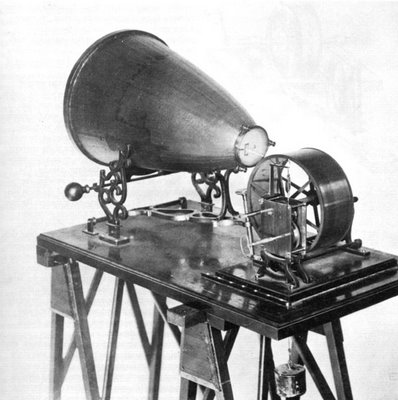
PhonoAutograph Leon Scott 1860 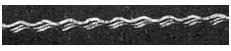
1859-Scott-Diapason-435-Hz.mp3 1859-Scott-Diapason-435-Hz, primer registro sonoro de la historian
In 1877, Thomas Edison patented the phonograph, a system capable of recording sound onto a physical medium through wave-like or groove-like indentations made on a malleable material. To amplify and make them audible, it was necessary to invert the process: a needle caused a diaphragm to vibrate, reproducing the sound. The use of grooves resembled many of the functions of the sound-producing instruments of the time. The generated sound was analog, created by mechanical systems that caused physical matter to resonate in order to transfer this resonance to the air and allow us to hear the sound.
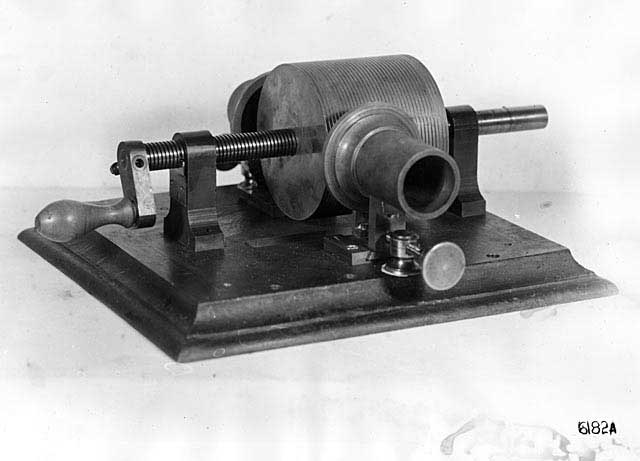
TinFoil original phonograph Thomas Alba Edison 1877 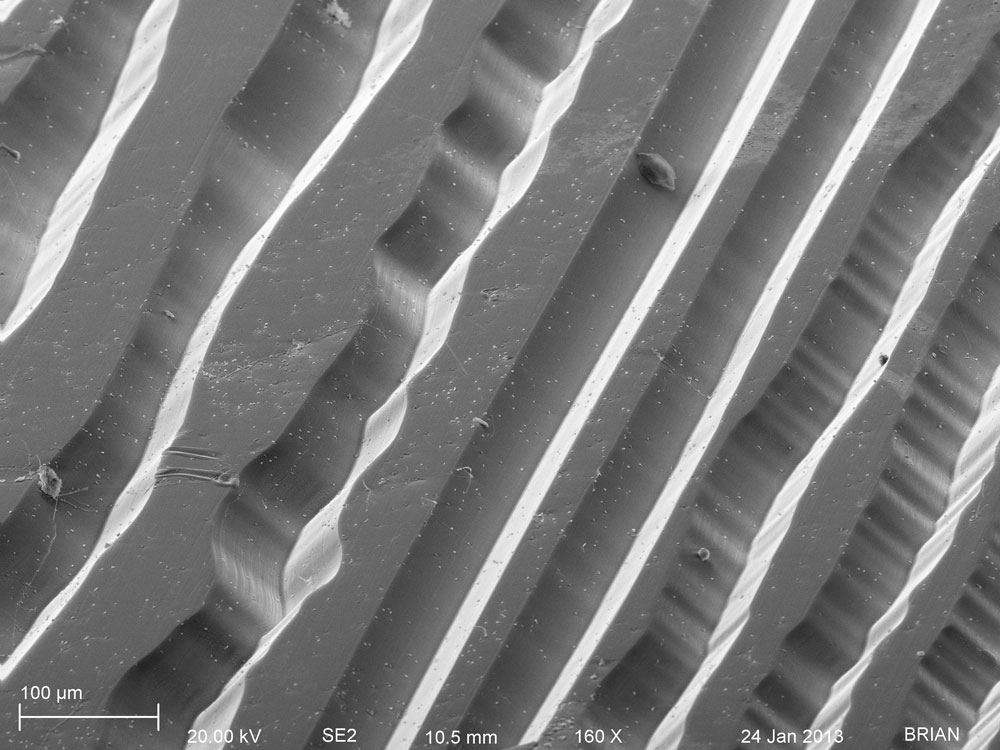
The understanding of sound as a wave that alters the physics of objects is much older.
In 1550, Girolamo Cardano described a listening method in which sound could be transmitted to the ear through a metal plate placed between the teeth. At the same time, Hieronymus Capivacci conducted experiments on bone conduction for medical purposes to study the auditory system. Medical audiology has used and studied bone conduction of sound for many years, inspiring listening through the teeth, acetates and other sounds such as those of tuning forks. John Cage proposed an action, and Beethoven, with his limited hearing, would press his skull against the piano to hear his compositions.
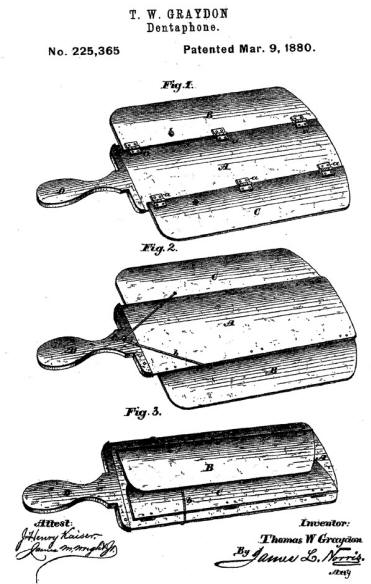
Dentaphone Co. Cincinnnati – 1880. 
“Philosophus” by John Bulwer (1648) The propagation of sound is much more effective in a solid medium than in air. Understanding the vibratory forces in matter led to the development of technological systems for sound recording.
With the knowledge of electricity and the development of electromagnetism systems, the first horns were built to amplify sound. The horn is made up of a coil wound with copper wire attached to a diaphragm and a permanent magnet. When a variable current flows through the coil, a variable electromagnetic field is generated. When in proximity to a permanent magnet, an oscillation is generated in the membrane. Moving the molecules and atoms in the air produces sound. Similarly, needles that reproduced sounds recorded in grooves began to use the piezoelectric phenomenon and induction to preamplify the sounds recorded on acetate much more subtly.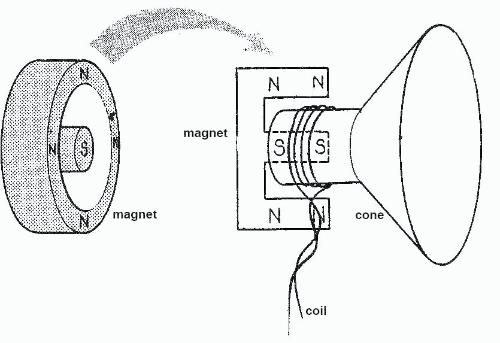
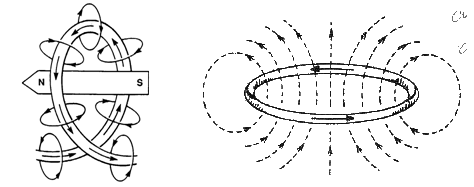
There was a transition from analog sound experience to electrical and electronic. Through the use of these two distinct forces, analog physics and electromagnetic physics, the most extensive impulse in the mass distribution of sound was generated. From Edison cylinders, we moved to discs, from 78 rpm to 33 1/2 rpm in stereo quality and then Hi-Fi (High Fidelity), of which billions of records were produced. For many years, this was the ideal format until the discovery of hysteresis (magnetic memory) and its commercial application, which led to the invention of magnetic wire and then magnetic tape. With the first electronic computing systems and sequencers, the field of electronics was established, leading to the digitalization of data, which has experienced exponential growth. Compression algorithms, such as MP3, were developed for the mass distribution of music, not for its quality.
There is currently a debate about formats and the quality of recorded sound, a debate between electronic, analog, and digital, between tape, disc, or chip.
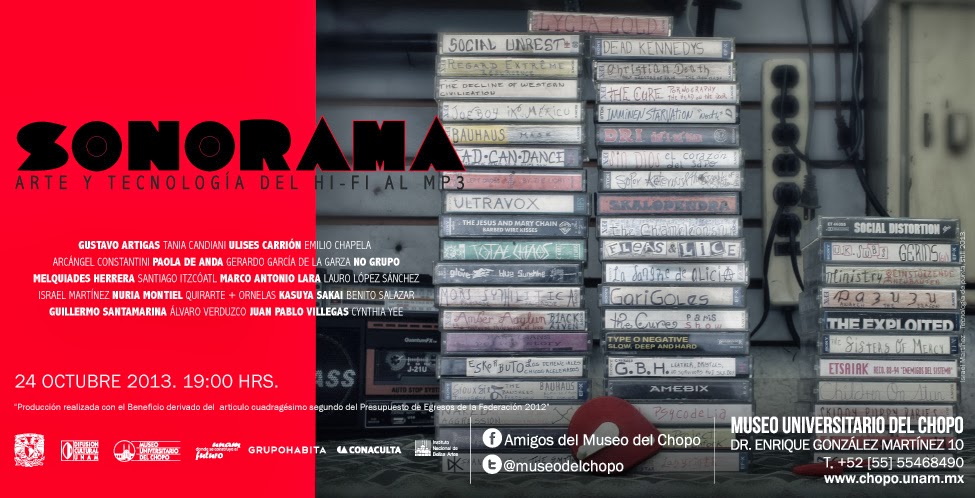
campo de surcos / surcos de campo
Each of the six LP discs in the selection will be recorded in MP3 format. When the needle is brought closer to the coil magnet, the corresponding record will be played. Due to the use of the discs by users, they will suffer damage and wear, which will be recorded as new grooves. At the end of the exhibition, each disc will be digitized again.
The memory of matter and binary data are key elements in the auditory experience, physical perception, and psychological understanding and enjoyment of sound.
Groove field / Field groove
Fernando Vigueras
The convergence of approaches, methods, and disciplines that surround Arcángel Constantini’s artistic practice situates his work in a complex territory to articulate. On one hand, it is inevitable to find in each of his works a network of reflections that trigger diverse lines of thought, formulations, and dissertations about technology and its impact on different perceptible processes. The artist investigates and generates correspondences with the environment and the way specific elements interact within diverse contexts: from an application for a tablet to the development of a system of artifacts that interact with the environment by controlling the pollution level of lakes (to name two essentially distant yet interconnected records). An important part of Constantini’s polyhedral production shows an interest in the physical nature of sound, understood as a flow of energy that can move and spread through different material elements with which it interacts. The propagation of this sound flow and the process involved in its physical representation and possible expansive diffusion has become one of the most interesting social phenomena in the history of contemporary culture. Groove Field / Field Groove is a piece that studies the coding, processes, and behaviors generated from the transit of sound diffusion technologies, exploring different sound reproduction formats. At the same time, the piece shows the deterioration of audio quality generated by the massive consumption of sound reproduction devices, a direct allusion to the socialization rituals established in the transmission of information through oral tradition and the self-absorption that demands listening to music through an iPod in the immediate context. To what extent have we been aware of the place that sound occupies in our environment? Could a different dimension of public space be defined or established in relation to the interaction that is had with sound matter? What elements shape and define the collective sound imaginary, and how much has it been worn down with the use and accumulation of information? What kind of information are we accumulating?
SIGHT & SOUND: SCIENCE FACTION
6th EDITION – INTERNATIONAL FESTIVAL – DIGITAL ART / Eastern Bloc, Montreal Quebec